Privacy vs fire safety: how to have both with your fence
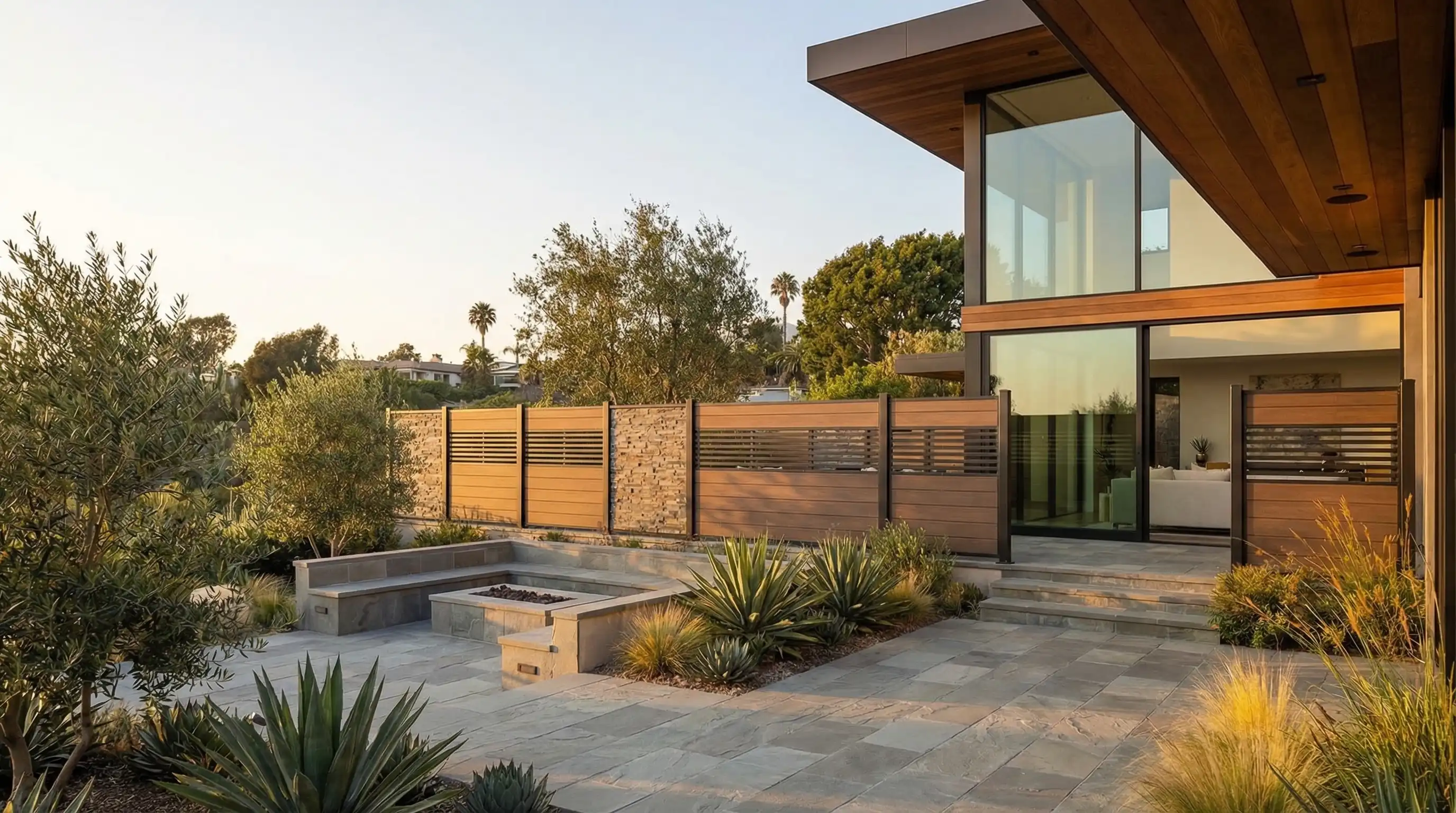
If you live in one of San Diego’s fire-prone areas — and a large portion of the county qualifies — you have probably run into this tension: you want privacy in your yard, but you also need to meet fire safety requirements. Traditional privacy fencing is a solid wall of wood, and a solid wall of wood next to your house is exactly what fire officials are trying to eliminate.
The good news is that this is not an either-or choice. Non-combustible and fire-resistant privacy solutions exist, and some of them deliver better privacy, better aesthetics, and longer lifespans than the wood fence they replace.
This guide covers the practical options for getting privacy and fire safety from the same fence. We will talk about materials, designs, code considerations, and real approaches that work in San Diego’s specific conditions.
Need a Zone 0 planning review?
Review near-structure material options and get parcel-specific guidance before you finalize your layout.
See Zone 0 FencingFor the full picture on fire-resistant fencing materials and how they perform, start with our complete guide to fire-resistant fencing in San Diego.
The perceived conflict: privacy vs. fire safety
Why homeowners think they have to choose
The conflict feels real because most people associate “privacy fence” with “six-foot solid wood fence.” And in fire zones, that is exactly the kind of structure that creates risk.
Here is the logic chain most homeowners walk through:
- I want privacy in my yard.
- Privacy means a solid, tall fence.
- The cheapest and most common solid, tall fence is wood.
- Wood burns.
- My property is in a fire zone.
- So I cannot have privacy?
The mistake is in step 3. Wood is the most common solid fence material, but it is far from the only one. And even the assumption in step 2 — that privacy requires a completely solid barrier — deserves questioning.
What fire safety actually requires
Let us be precise about what the rules say, because misunderstanding the requirements leads to bad decisions.
PRC 4291 (California Public Resources Code Section 4291) is the foundation of California’s defensible space law. It requires property owners in State Responsibility Areas (SRA) and some Local Responsibility Areas (LRA) to maintain defensible space around structures. The law establishes zones of defensible space and addresses vegetation management as well as the materials and placement of structures near the home.
Zone 0 (Ember-Resistant Zone) is the area within the first five feet of the structure. Guidance from the California State Fire Marshal (SFM) recommends that this zone use non-combustible materials and hardscaping. For fencing, this means that a wood fence running up to or connecting to the house is exactly the scenario fire officials are most concerned about — it acts as a conduit carrying fire directly to the structure.
Very High Fire Hazard Severity Zones (VHFHSZ) cover a significant portion of San Diego County, including communities like Scripps Ranch, Poway, Rancho Bernardo, Rancho Santa Fe, 4S Ranch, and much of the eastern and northern parts of the county. Properties in these zones face stricter enforcement of defensible space and material requirements.
The key takeaway: fire safety requirements focus most heavily on the area closest to the structure (Zone 0) and on combustible materials. If your fence is non-combustible, many of the restrictions that apply to wood fences simply do not apply to you.
Why traditional wood privacy fences are a fire risk
The combustible corridor
A standard wood privacy fence — six feet tall, boards tight together, running along a side yard right next to the house — is essentially a continuous wall of fuel attached to or immediately adjacent to your home.
In a wildfire or ember event:
- Embers accumulate against the solid surface. A solid fence catches embers the way a wall catches wind. The gaps in a board-on-board fence can also trap embers between the boards.
- The fence ignites. Dry wood (especially weathered, unmaintained wood) ignites readily from ember accumulation.
- Fire travels along the fence. Because the fence is continuous, fire can travel its entire length.
- Fire reaches the structure. Where the fence connects to the house — at a wall, under eaves, next to a door frame — the fire transfers to the structure.
This is not a theoretical concern. Post-fire investigations consistently identify fencing as a path of fire spread to structures. CAL FIRE incident reports have documented fence-to-structure fire spread in multiple wildfire events across Southern California.
The maintenance factor
The fire risk of a wood privacy fence increases with neglect. Weathered wood with checked (cracked) surfaces has more surface area exposed and a lower moisture content than freshly stained wood. An old cedar fence that has not been stained in five years is measurably more flammable than the same fence when it was new.
In practical terms, this means that the very quality that makes wood privacy fences popular — “set it and forget it” affordability — also makes them increasingly dangerous as they age.
Non-combustible privacy options
Here is where the solutions start. Each of these delivers privacy — partial or full — using materials that do not burn.
Aluminum with privacy panels
Aluminum is classified as non-combustible per ASTM E136 testing methodology. An aluminum privacy fence uses solid or nearly solid panels instead of pickets with gaps, giving you the same visual screening as a wood privacy fence with less combustible material at the perimeter compared with wood, subject to product documentation and site conditions.
How it works: Aluminum panels can be fabricated as solid sheets, interlocking tongue-and-groove boards, or tightly spaced horizontal or vertical slats with minimal gaps. The result is a fence that blocks sightlines while using documented non-combustible material options where appropriate.
Advantages for privacy and fire safety:
- Full visual screening is achievable
- Lower-fuel / non-combustible material option depending on product documentation and AHJ review
- Available in matte black, dark bronze, and other colors via powder coating
- Does not rot, warp, or attract termites
- Minimal maintenance compared to wood (see our maintenance guide)
Considerations:
- Solid aluminum panels in wind-exposed areas need proper engineering — solid panels create significant wind load, similar to wood. Post sizes and footing depth must account for this.
- Cost is higher than wood upfront, but lifetime cost is typically lower when maintenance and replacement cycles are factored in.
For more on aluminum fencing options, visit our aluminum fencing page or read our aluminum vs. wood comparison.
Steel with infill panels
Steel is also non-combustible and offers privacy options when combined with infill materials.
How it works: A steel frame (posts and rails) provides the structure, and infill panels — which can be steel sheet, perforated metal, composite, or even mesh with privacy screening — fill in between.
Advantages:
- Very strong structurally — steel handles larger panel spans and heavier wind loads
- Thinner profiles possible compared to aluminum for the same structural capacity
- Industrial and modern aesthetic that pairs well with contemporary architecture
Considerations:
- Steel requires more maintenance than aluminum (coating inspection and touch-up to prevent rust)
- Heavier — installation on hillside lots and tight-access side yards is more complex
- Higher fabrication cost for custom designs
Gabion walls: maximum privacy and non-combustible
Gabion walls — wire cages filled with stone, rock, or recycled concrete — provide complete privacy and are fully non-combustible. The thermal mass of the stone also provides a degree of fire resistance beyond simply not burning: a gabion wall absorbs heat rather than transmitting it.
How it works: Wire mesh cages (typically galvanized steel or stainless steel) are filled with natural stone, river rock, or architectural aggregate. Standard heights range from two to six feet, and walls can be built to virtually any length.
Advantages for privacy and fire safety:
- 100% opaque — complete visual screening
- Non-combustible with high thermal mass
- Excellent sound dampening — reduces noise from adjacent properties or roads
- Unique, natural aesthetic that improves with age
- No maintenance on the fill material (the stone does not rot, burn, or degrade)
Considerations:
- Requires a substantial foundation — gabion walls are heavy
- Not as tall-friendly as fence materials — heights above four feet need engineering
- More expensive per linear foot than most fence options
For more on gabion walls as a fencing option, visit our gabion walls page.
Block walls: the San Diego standard for privacy and fire separation
Masonry block walls (CMU — concrete masonry unit) are extremely common in San Diego, especially in newer developments. They provide complete privacy, are non-combustible, and have excellent fire resistance.
How it works: Standard CMU blocks (or split-face, precision, or slump block for better aesthetics) are laid in mortar on a reinforced concrete footing. Heights of six feet are standard for residential property lines.
Advantages:
- Complete privacy
- Non-combustible with excellent fire resistance
- High wind resistance
- Long lifespan (50+ years with minimal maintenance)
- Can be finished with stucco, paint, or stone veneer to match the home
Considerations:
- Highest upfront cost of common fencing options
- Requires permits and inspections in most San Diego jurisdictions
- Not easily relocated or modified once built
- Can feel institutional or stark without design treatment (caps, texture, color)
For more on block walls, visit our block walls page.
If you want artificial greenery instead of a fence or wall, that work belongs with Califauxscapes. Artificial hedge, privacy wall, fence extension, and living wall installation is handled by Califauxscapes, the California installation division of Geranium Street USA, Inc.
Artificial privacy hedge installation by Califauxscapes
Composite privacy fencing: fire performance varies
Composite fencing (wood fiber and plastic polymer blends) can provide solid privacy panels, and it is often marketed as a fire-resistant alternative to wood. But the fire performance of composite fencing varies significantly between products.
What to look for:
- ASTM E84 (Surface Burning Characteristics) test results. This test measures flame spread index and smoke development index. A Class A rating (flame spread index of 0-25) represents the best performance. Class B (26-75) and Class C (76-200) are progressively less fire-resistant. Some composite products achieve Class A; others do not.
- Manufacturer fire documentation. Ask for the specific fire test results for the product being proposed. “Fire-resistant” is a marketing claim. ASTM E84 Class A is a tested, documented performance level.
- ICC-ES evaluation reports. Some composite products have evaluation reports from ICC Evaluation Service that document their fire performance for code compliance purposes.
Composite is a legitimate privacy fence option in many situations, but if your property is in a VHFHSZ and you need non-combustible fencing in Zone 0, composite may or may not meet the requirement depending on the specific product and how your local Authority Having Jurisdiction (AHJ) interprets the code.
For a detailed look at composite fencing performance, see our composite fencing pros and cons guide.
Zone 0 rules and how they affect privacy fence placement
The five-foot question
Zone 0 — the ember-resistant zone within five feet of the structure — is where fencing decisions get the most scrutiny. The California State Fire Marshal’s guidance for this zone recommends:
- Non-combustible materials for fencing, walls, and other attachments within five feet of the structure
- Elimination of combustible “bridges” that could carry fire from the property to the structure
- Hardscaping and non-combustible ground cover within the zone
What this means for privacy fences:
If your fence runs along a side yard and connects to or approaches within five feet of your home, the portion of the fence within that five-foot zone should ideally be non-combustible. This does not necessarily mean your entire fence needs to be non-combustible — just the section closest to the structure.
A common approach: Use a non-combustible material (aluminum, steel, block) for the section of fence within Zone 0 (the first five feet from the house), then transition to your preferred material for the rest of the run. This is more cost-effective than converting the entire fence and addresses the highest-risk area.
For more on Zone 0 requirements and how they affect fencing, see our Zone 0 fencing guide.
Placement matters as much as material
Even with non-combustible fencing, placement and design details matter:
- Avoid creating ember traps. A privacy fence with a flat top rail that sits directly under the eaves creates a shelf where embers can accumulate near the structure. Consider how the fence meets the roofline.
- Address the fence-to-structure connection. Where the fence physically attaches to or contacts the house is the critical detail. A non-combustible fence with a combustible mounting block at the house wall defeats the purpose.
- Maintain clearance. Even with a non-combustible fence, maintaining some clearance between the fence and combustible portions of the structure (wood siding, vinyl siding, wood trim) reduces risk.
Design strategies for privacy and fire safety
You do not have to settle for a bland metal wall to get privacy and fire safety. Here are design approaches that deliver both.
Partial privacy with strategic screening
You may not need 100% privacy everywhere. Consider where you actually need visual screening:
- Full privacy panels facing the neighbor’s second-story windows or a busy street
- Semi-private louvered panels along side yards where you want airflow but not full visibility
- Open sections facing views (canyon, hills, ocean) where privacy is not needed
This mixed approach lets you use solid, non-combustible privacy panels only where they are needed, and lighter, more open designs elsewhere. The result is better airflow, more natural light, and a more interesting fence design. For more on design approaches, see our modern fence design trends guide.
Louvered and angled designs
Louvered fencing angles the slats so that you get visual privacy from normal viewing angles (standing on the neighbor’s property, walking on the sidewalk) while still allowing air to pass through. This is significant for fire safety because:
- Embers are less likely to accumulate against a louvered surface than a flat, solid one
- Airflow through the fence reduces the stagnant, superheated air pockets that form behind solid walls during fire events
- The reduced wind load means lighter structural requirements
Aluminum and steel louvered panels are available in custom configurations that let you dial in exactly how much privacy you want.
Mixed heights
Not every section of your fence needs to be six feet tall. Consider:
- Six-foot privacy panels where neighbors are close or where you use the yard most
- Four-foot open or semi-open panels along less-used sections
- Taller panels (seven to eight feet where allowed by code) at specific focal points
San Diego municipal code generally allows fences up to six feet in side and rear yards and up to three feet (or 42 inches in some areas) in front yards, though this varies by zone and specific property. Check with San Diego Development Services or your local AHJ before planning fence heights.
Combining materials for function and aesthetics
Some of the best privacy-plus-fire-safety solutions combine materials:
- Block wall base (three to four feet) with aluminum privacy panels on top (two to three feet). The block handles the lower portion where ground-level fire risk is highest, and the aluminum adds height and privacy.
- Gabion wall base with steel and composite privacy screening on top. The gabion provides the non-combustible, high-thermal-mass foundation, and the upper section provides the visual screening.
- Aluminum privacy fence with integrated planter boxes. Non-combustible planters built into the fence design let you add greenery (choose fire-resistant plants) without creating a combustible structure.
Real-world solutions for San Diego properties
Side yards: the most common privacy-and-fire problem
San Diego’s typical residential lot puts homes close together on the sides, often with just five to eight feet between structures. This is exactly where privacy is most wanted (you do not want to see into your neighbor’s kitchen) and where fire safety is most critical (that five-to-eight-foot gap is a potential fire corridor).
What works: Aluminum privacy panels on the side yard runs, with non-combustible connections where the fence meets the house. If the fence is within Zone 0, aluminum or steel is the straightforward answer. The fence provides full privacy while eliminating the combustible corridor.
Backyard facing open space or canyons
Properties backing up to canyons and open space in areas like Scripps Ranch, Tierrasanta, and the edges of Rancho Bernardo face significant wildfire exposure. Privacy is often desired to screen the wild vegetation from the manicured yard, but a combustible fence at the wildland-urban interface is a serious risk.
What works: A masonry block wall or gabion wall at the property line provides the most robust fire separation. If heights are restricted or aesthetics matter, an aluminum privacy fence with proper post engineering for wind exposure works well. Avoid any combustible material at this interface.
Front yards with street exposure
Front yard fencing in San Diego is governed by height restrictions (typically three feet or 42 inches) and often by HOA rules. Privacy in the front yard is more about partial screening than total opacity.
What works: Low aluminum or steel fencing with dense, fire-resistant landscaping behind it. Louvered designs at 36-42 inches can provide meaningful screening from the street while staying within code. Artificial hedge panels on a low non-combustible frame are another option for front-yard screening.
Choosing the right approach for your property
Step 1: Determine your fire zone status
Look up your property on the San Diego County Fire Hazard Severity Zone maps or contact your local fire authority. Your zone status determines which requirements apply and how strictly they will be enforced.
Step 2: Identify where privacy is actually needed
Walk your property line and note where you need visual screening. You probably do not need it everywhere. Prioritize the areas where you spend the most time outdoors and where neighboring sightlines are most direct.
Step 3: Choose the right material for each section
Match the material to the need:
- Zone 0 (within five feet of the house): Non-combustible materials are commonly recommended or requested, but requirements vary by jurisdiction and AHJ review — aluminum, steel, block, or gabion are often reviewed in this context.
- High-privacy areas: Solid panels in whatever non-combustible or fire-resistant material meets your budget and aesthetic preferences.
- Lower-priority areas: Semi-private or open designs that provide airflow and reduce cost.
Step 4: Consider the whole property design
A fence is not just a fence — it is part of the property’s landscape and hardscape. Think about how it integrates with retaining walls, gates, landscaping, lighting, and the architecture of the home.
Next steps
If you are trying to balance privacy and fire safety on your San Diego property, we can help you work through the options. Modern Fence & Deck designs and installs non-combustible and fire-resistant fencing solutions across San Diego County, from side-yard privacy panels to full perimeter systems.
Call us at (619) 975-1883 or request a quote to discuss your project.
Sources
- CAL FIRE, Defensible Space (PRC 4291) — California’s defensible space law establishing zone requirements, including Zone 0 guidance for non-combustible materials within five feet of structures.
- California State Fire Marshal (SFM), Ember-Resistant Zone (Zone 0) Guidance — recommendations for hardscaping and non-combustible materials in the area immediately surrounding structures.
- ASTM E136, Standard Test Method for Assessing Combustibility of Materials Using a Vertical Tube Furnace — the test standard used to classify materials as non-combustible, applicable to aluminum and steel.
- ASTM E84, Standard Test Method for Surface Burning Characteristics of Building Materials — test standard for flame spread and smoke development ratings used to evaluate composite and other materials, producing Class A, B, or C ratings.
- San Diego County, Very High Fire Hazard Severity Zone Maps — official mapping that determines which properties face stricter fire safety requirements for fencing and other exterior structures.
- ICC Evaluation Service (ICC-ES) — publishes evaluation reports documenting fire performance and code compliance for specific building products, including composite fencing materials.
- San Diego Municipal Code, Fence and Wall Regulations — height restrictions and setback requirements for residential fencing in the City of San Diego.
Verification note (updated March 26, 2026): Regulatory requirements can vary by parcel, jurisdiction, and inspection cycle. Confirm current requirements with your AHJ and official California sources before final design or contract decisions: PRC 4291, Board of Forestry Zone 0 updates, and OSFM FHSZ maps.