Aluminum vs wood fence: cost, lifespan, and fire safety compared
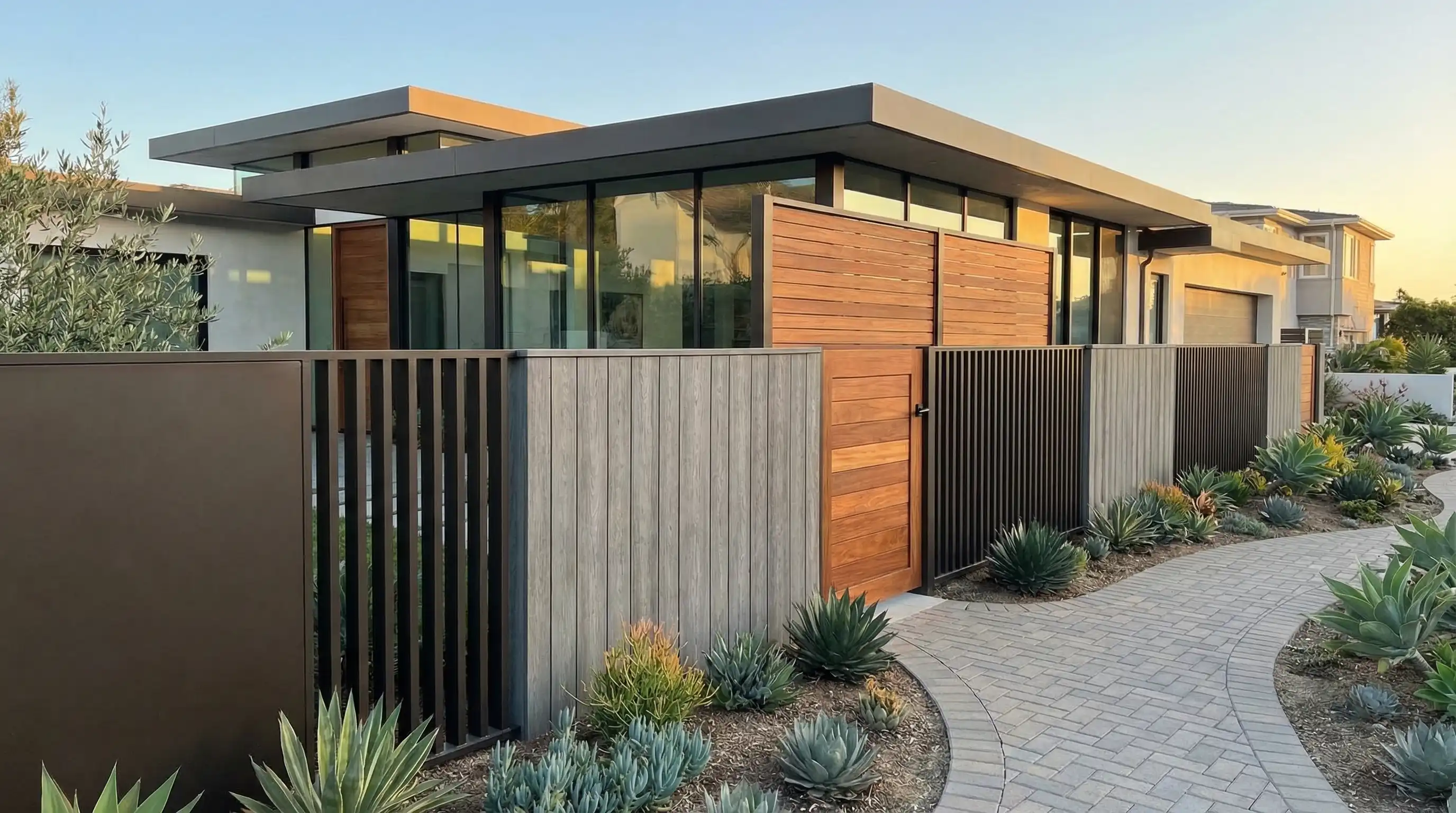
If you are replacing a fence in San Diego, there is a good chance you are looking at the same two options most homeowners start with: aluminum and wood. They are the bookends of the residential fencing world – one is the traditional default, the other is the material more homeowners are switching to.
This guide puts them side by side honestly. Aluminum wins on several fronts, but wood still has its place. The right choice depends on your priorities, your property, and how much ongoing work you are willing to sign up for.
For a broader look at all available materials (including composite, steel, and Ipe hardwood), see our complete fence material guide for San Diego.
Need a non-combustible fence that still looks residential?
See aluminum fence systems built for coastal durability, clean lines, and fire-aware near-structure transitions.
Explore Aluminum FencingFire performance: the biggest gap between the two
This is the area where aluminum and wood are not even in the same conversation.
Aluminum: non-combustible
Aluminum is classified as a non-combustible material per ASTM E136 (Standard Test Method for Assessing Combustibility of Materials Using a Vertical Tube Furnace at 750 Degrees C). It does not ignite from embers, does not sustain or spread flame, and does not contribute fuel to a fire. Its melting point is approximately 1,220 degrees F (660 degrees C), but it does not burn.
For San Diego homeowners in or near Very High Fire Hazard Severity Zones (VHFHSZ) as mapped by CAL FIRE, this classification matters. Under California Public Resources Code Section 4291, as amended by AB 3074, Zone 0 (the 0-5 foot band around a structure) is the area where material choices have the most direct impact on wildfire survivability. A non-combustible fence in Zone 0 removes one of the most common ignition pathways: a burning fence carrying fire directly to the structure.
For more on fire-rated materials and what the ratings mean, see our fire-resistant fencing guide.
Wood: combustible, full stop
Wood fencing – regardless of species – is combustible. It ignites, sustains flame, and can burn completely. During wildfire events, wood fences have been documented acting as “wicks” that carry fire from vegetation or neighboring structures directly to homes (CAL FIRE, “Ready for Wildfire” guidance).
Some wood species perform better than others under fire exposure. Ipe hardwood, for example, achieves a Class A flame spread rating per ASTM E84 due to its extreme density (USDA Forest Products Laboratory, “Wood Handbook,” FPL-GTR-282). But even Class A-rated wood is not non-combustible. It will burn under sufficient heat and sustained exposure.
Common fence woods like western red cedar and redwood have no inherent fire resistance advantage. Pressure-treated pine is similarly combustible; the preservative treatment protects against decay, not fire.
Bottom line on fire: If fire performance is a factor in your decision – and for a significant portion of San Diego County, it should be – aluminum has a categorical advantage that no wood species can match.
Durability in San Diego’s climate
Salt air and corrosion
San Diego’s coastal climate is beautiful and corrosive. Salt-laden marine air accelerates the degradation of many building materials.
Aluminum handles salt air well. It naturally forms a thin aluminum oxide layer that protects the base metal from further corrosion. When factory powder-coated, aluminum fencing provides two layers of protection. Quality powder coatings that meet AAMA 2604 or AAMA 2605 specifications offer superior resistance to UV degradation and corrosion in marine-adjacent environments.
Wood in coastal areas takes a beating. Salt air does not directly corrode wood, but it accelerates the breakdown of finishes (stains, sealers, paints). Coastal properties often see stain failures within one to two years rather than the two to three years that might be typical inland. Salt deposits also attract moisture, which can accelerate decay in susceptible species.
The hidden problem with coastal wood fences is often the hardware. Nails, screws, brackets, and hinges made from uncoated carbon steel will rust quickly near the coast, leaving orange streaks down the fence boards and weakening the structure.
UV exposure
San Diego averages over 260 sunny days per year (National Weather Service, San Diego). UV radiation has different effects on each material.
Aluminum with quality powder coating resists UV degradation well. Some color fading may occur over decades, but the structural integrity of the material is unaffected by UV exposure. The coating is the UV barrier; the aluminum underneath does not degrade from sunlight.
Wood is significantly affected by UV. Ultraviolet radiation breaks down lignin, the natural polymer that binds wood fibers together. This process turns unfinished wood gray (which some homeowners prefer as a look) and eventually causes surface checking, cracking, and fiber erosion. The USDA Forest Products Laboratory notes that weathering from UV and moisture can erode wood surfaces at a rate of approximately 1/4 inch per century for softwoods and somewhat less for dense hardwoods (“Wood Handbook,” FPL-GTR-282, Chapter 16).
In practical terms, UV means wood fences in San Diego need more frequent finish maintenance than the same fence in Seattle.
Termites
Subterranean termites are active year-round in San Diego County. The University of California Agriculture and Natural Resources identifies Southern California as a region with significant termite pressure from both subterranean and drywood species (UC ANR, Pest Notes: Termites).
Aluminum is not a food source for termites. This is not a factor.
Wood is vulnerable. Cedar and redwood heartwood have some natural resistance to termite damage, but sapwood does not. Pressure-treated wood has chemical protection, but termites can sometimes breach treated outer layers to reach untreated interior wood. Over a 20-year fence life, termite damage is a real maintenance concern for wood fences in San Diego.
Maintenance: the true cost difference
This is where the long-term economics of aluminum vs wood fencing become clear.
Aluminum maintenance
Aluminum fencing maintenance is minimal:
- Rinse occasionally. A garden hose removes dust, pollen, and salt deposits. Coastal properties may benefit from monthly rinsing during periods of heavy marine layer or onshore winds.
- Inspect hardware annually. Check gate hinges, latches, and fasteners. Even on an aluminum fence, hardware can be the failure point if it is not corrosion-resistant.
- Touch up damage as needed. If the powder coat is chipped or scratched (from impact, not weathering), touch-up paint can prevent the exposed area from oxidizing. This is an occasional task, not a scheduled one.
Total annual maintenance time for a typical residential aluminum fence: one to two hours.
Wood fence maintenance
Wood fencing requires significantly more ongoing work:
- Stain or seal every one to three years. The interval depends on the product used, sun exposure, and coastal proximity. In San Diego, many wood fences need refinishing closer to every one to two years for south- and west-facing sections. A typical six-foot privacy fence (150-200 linear feet) can take a full weekend to prep and stain.
- Replace damaged boards. Wood boards crack, warp, split, and rot over time. Expect to replace individual boards starting around year five to seven for softwoods, and to need more extensive repairs by year 10-15.
- Inspect for termite damage. Annual inspection for termite activity, especially at posts and near ground contact.
- Address post rot. Wood fence posts, even when set in concrete, eventually rot at the ground line. Post replacement is the single most disruptive and expensive wood fence repair.
Total annual maintenance time and cost for a typical residential wood fence: significantly more than aluminum, both in labor hours and material costs.
For a comprehensive breakdown of maintenance by material type, see our fence maintenance guide by material.
Lifespan comparison
Aluminum: 30+ years
Quality aluminum fencing has an expected service life of 30 years or more. The aluminum itself does not rot, rust, or decay. The limiting factor is typically the powder coat finish, which may need refreshing after 15-20+ years depending on exposure and coating quality. The structural integrity of the fence is usually maintained well beyond the finish life.
Wood: 10-20 years (species dependent)
Wood fence lifespan varies dramatically by species and maintenance level:
- Pressure-treated pine: 10-15 years with regular maintenance. Posts often fail first due to ground-contact decay.
- Western red cedar: 15-20 years for heartwood boards with consistent maintenance. Less for sapwood-heavy boards.
- Redwood: 15-20+ years for heartwood with maintenance. Similar to cedar but increasingly difficult to source in quality fence grades.
- Ipe hardwood: 25-40+ years. Ipe’s exceptional density and natural decay resistance (Class 1 per ASTM D2017) give it a lifespan that approaches or exceeds aluminum. Read our Ipe hardwood fencing guide for more on this premium option.
The USDA Forest Products Laboratory classifies western red cedar heartwood as “durable” and Ipe as “very durable” to “exceptionally durable” in terms of natural resistance to fungal decay (“Wood Handbook,” FPL-GTR-282, Chapter 15).
The critical variable is maintenance. A well-maintained cedar fence can last 20 years. A neglected one might look rough by year seven and need replacement by year 12.
Aesthetic options
Aluminum aesthetics
Modern aluminum fencing is far more versatile than the basic pool fence most people picture. Current options include:
- Horizontal slat systems with adjustable spacing for varying levels of privacy
- Vertical picket designs in contemporary profiles (flat bar, square tube, round tube)
- Privacy panels with solid or semi-solid configurations
- Custom gate designs with matching hardware
- Powder coat colors ranging from matte black and dark bronze to custom-matched architectural colors
The limitation of aluminum is that it looks like metal. If you want the warmth and grain of natural wood, aluminum is not going to provide that. It provides clean lines, consistent appearance, and a modern feel.
Wood aesthetics
Wood’s primary aesthetic advantage is that it looks and feels like wood. Grain patterns, warm tones, natural variation – these are qualities that metal and composite materials imitate but do not fully replicate.
- Cedar and redwood offer warm, reddish-brown tones when freshly stained that weather to silver-gray if left natural
- Ipe provides rich, dark brown tones with dramatic grain patterns
- Design flexibility is high: board-on-board, tongue-and-groove, lattice top, and custom patterns are all straightforward to build in wood
The limitation of wood aesthetics is that they are temporary without maintenance. A freshly stained cedar fence is striking. The same fence two years later without maintenance is faded, weathered, and starting to show its age.
Cost comparison
We deliberately avoid quoting specific per-foot prices because they vary based on design, site conditions, material grade, and market conditions. Instead, here is how the materials compare in relative terms.
Installed cost
Wood (softwood) has the lowest initial installed cost for most residential fence projects. Pressure-treated pine is the least expensive; cedar and redwood cost more but are still generally below aluminum.
Aluminum typically costs more to install than standard wood fencing. The material is more expensive per linear foot, and fabrication/installation may require different skills and equipment than wood framing.
Ipe hardwood is a premium option that can cost as much as or more than aluminum, depending on the design. The material itself is expensive, and it is harder to work with than softwoods.
Total cost of ownership (20-year view)
This is where the math shifts. When you factor in maintenance costs (stain, sealer, labor), board replacement, post repair/replacement, and the likelihood of full replacement within 20 years, wood fencing often costs more over its full lifecycle than aluminum.
A rough framework:
- Aluminum: Higher upfront cost, minimal ongoing cost. One fence over 20+ years.
- Cedar/redwood: Lower upfront cost, moderate to high ongoing maintenance cost. Likely one to one-and-a-half fences over 20 years (partial or full replacement).
- Pressure-treated pine: Lowest upfront cost, moderate ongoing maintenance cost. Likely one-and-a-half to two fences over 20 years.
For a project-specific cost estimate, request a quote or call (619) 975-1883.
When wood still makes sense
Despite aluminum’s advantages in durability, fire performance, and maintenance, wood is still the right choice in certain situations:
Budget is the primary constraint. If you need a fence now and the budget is tight, a well-built cedar fence will serve you for 15+ years with proper maintenance. The lower upfront cost is real and sometimes decisive.
The wood aesthetic is essential. Some homes and landscapes demand the warmth of natural wood, and the homeowner is willing to invest in ongoing maintenance to keep it looking right. In these cases, we would recommend Ipe over softwoods for longevity and fire performance.
The fence is far from the structure. In Zone 2 and beyond (30+ feet from the home), fire zone restrictions on combustible materials are less stringent. A wood fence at the property perimeter, well away from the structure, faces fewer regulatory concerns than one attached to the house.
Temporary fencing needs. If you know the fence is a placeholder for a future hardscape or landscape project, a simple wood fence at a lower cost can make sense as a short-term solution.
When aluminum is the clear winner
For many San Diego homeowners, aluminum is the straightforward best choice:
Your property is in or near a fire hazard zone. Non-combustible fencing in Zone 0 is increasingly expected by AHJs, insurers, and common sense. Aluminum delivers this without compromise.
You live near the coast. Salt air performance gives aluminum a clear durability advantage over wood and even over steel.
You do not want to maintain a fence. If staining, sealing, and board replacement are not how you want to spend your weekends, aluminum eliminates virtually all of that.
You want a long-term investment. A 30+ year fence that looks consistent throughout its life is a better value proposition than a fence that needs continual investment to stay presentable.
You are building near the home or in a side yard. This is where fire safety and durability overlap. A side-yard fence that connects to the house should be non-combustible in any fire-aware design approach.
Explore our aluminum fencing service page for installed project examples and design options.
The hybrid approach
Some of the best fencing projects we build are not all one material. A common San Diego approach:
- Aluminum in Zone 0 (0-5 feet from the structure) for non-combustible performance and low maintenance
- Ipe or composite farther from the structure where fire zone restrictions are less stringent and the homeowner wants a different aesthetic
- Custom gates in aluminum regardless of perimeter material, because gates take the most abuse and benefit most from a low-maintenance, durable material
The key to a hybrid approach is designing the material transitions so they look intentional. Changes at posts, pilasters, corners, or elevation changes read cleanly. A random material switch in the middle of a fence run looks like a budget compromise.
Making your decision
Here is a simple decision framework:
- Is your property in a fire hazard zone? If yes, start with non-combustible materials (aluminum) near the structure.
- How close to the coast are you? Within a couple of miles, corrosion resistance matters. Aluminum excels; wood requires more attention.
- How much maintenance are you willing to do? Be honest. If the answer is “very little,” wood is the wrong choice.
- What is your time horizon? If you plan to be in the home for 10+ years, the total cost of ownership favors aluminum. For shorter stays, the upfront cost difference may matter more.
- What does the fence need to look like? If only natural wood will do, consider Ipe for the best combination of aesthetics, durability, and fire performance among wood species.
Next steps
If you are weighing aluminum vs wood for a specific San Diego project, the best next step is a site visit. Your property’s exposure (fire zone, coastal proximity, sun orientation), your design preferences, and your budget all factor into the recommendation.
Call Modern Fence & Deck at (619) 975-1883 or request a quote. We will walk the property with you and give you a straightforward recommendation based on what we see.
Sources
- ASTM E136: Standard Test Method for Assessing Combustibility of Materials Using a Vertical Tube Furnace at 750 Degrees C. ASTM International.
- ASTM E84: Standard Test Method for Surface Burning Characteristics of Building Materials. ASTM International.
- ASTM D2017: Standard Test Method for Accelerated Laboratory Test of Natural Decay Resistance of Woods. ASTM International.
- USDA Forest Products Laboratory. “Wood Handbook: Wood as an Engineering Material.” General Technical Report FPL-GTR-282. Madison, WI. Chapters 15 and 16.
- California Public Resources Code Section 4291. Defensible space requirements.
- AB 3074 (2020). California legislation regarding defensible space Zone 0.
- CAL FIRE. “Ready for Wildfire” homeowner guidance and VHFHSZ maps.
- National Weather Service, San Diego. Climate data.
- University of California Agriculture and Natural Resources. Pest Notes: Termites.
- AAMA 2604 / AAMA 2605: Specifications for high-performance organic coatings on aluminum extrusions. American Architectural Manufacturers Association.
- American Galvanizers Association. Atmospheric corrosion data for coastal environments.
Deciding between aluminum and wood for your fence? Weigh maintenance, longevity and fire performance against your site, then get a recommendation for your specific property.
Verification note (updated March 26, 2026): Regulatory requirements can vary by parcel, jurisdiction, and inspection cycle. Confirm current requirements with your AHJ and official California sources before final design or contract decisions: PRC 4291, Board of Forestry Zone 0 updates, and OSFM FHSZ maps.