Ipe hardwood fencing: what to know before buying
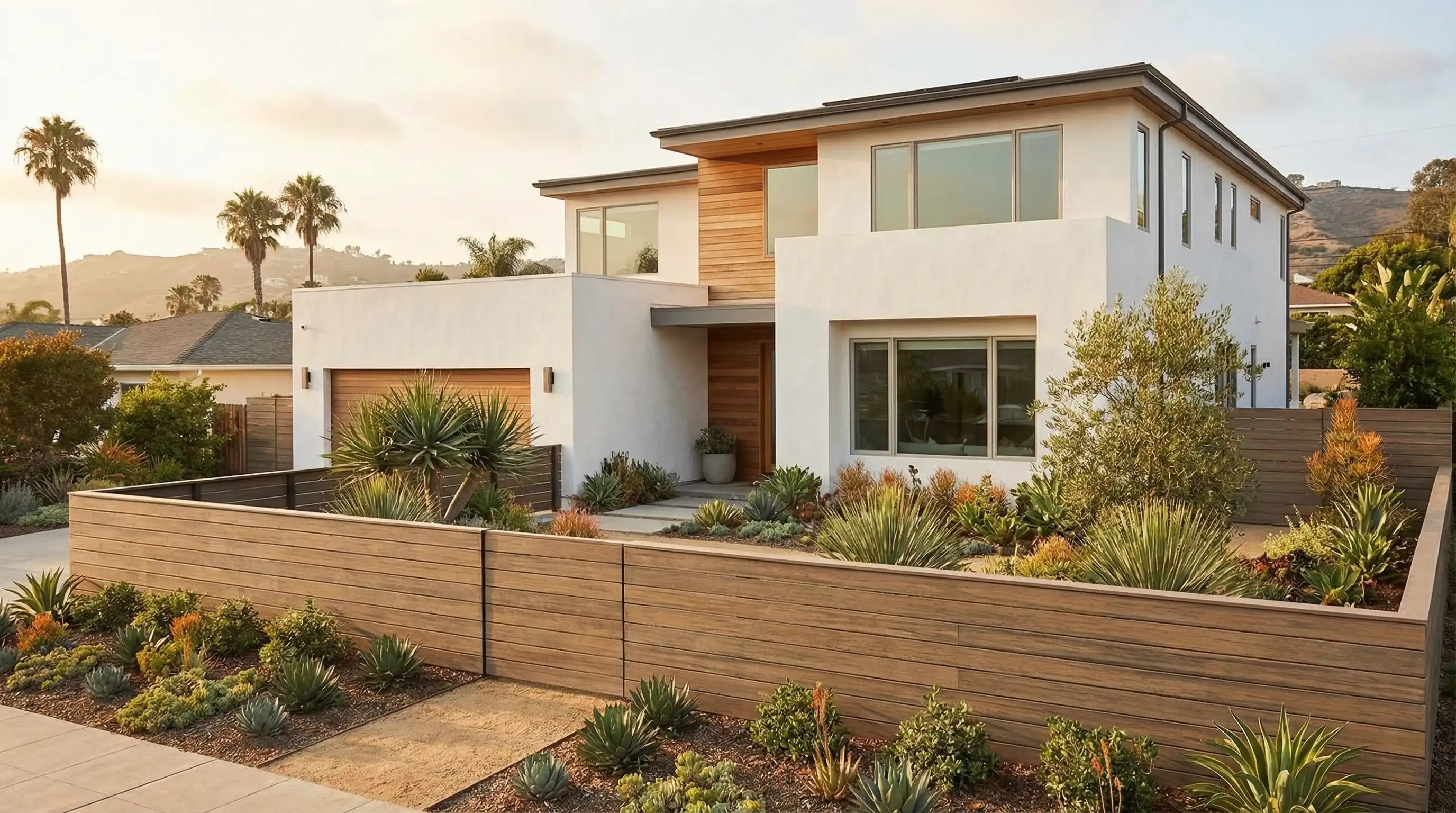
Ipe is the wood that makes other woods look ordinary. It is extraordinarily hard, naturally resistant to rot and insects, and achieves a Class A fire rating without chemical treatment. It is also expensive, heavy, and hard to work with. If you are considering Ipe for a fencing project in San Diego, this guide covers everything you need to know before you commit.
This is not a sales pitch for Ipe. It is a genuinely exceptional material, but it is not right for every project or every budget. We will cover the real performance data, the maintenance reality, the cost, and the situations where Ipe makes sense – and where a different material might serve you better.
For a comparison across all major fencing materials, see our complete fence material guide for San Diego.
Need a heavier-duty fire-wise perimeter solution?
See steel fence systems for security, long spans, and non-combustible perimeter planning.
Explore Steel FencingWhat Ipe is
Ipe (pronounced “ee-pay”) is a tropical hardwood in the genus Handroanthus (formerly classified under Tabebuia). It is commonly known as Brazilian walnut, lapacho, or pau d’arco, depending on the region. The species most commonly used in construction and fencing is Handroanthus spp., sourced primarily from forests in Brazil, Bolivia, Peru, and other parts of Central and South America.
Ipe has been used for centuries in demanding exterior applications. In Brazil, it has a long history as a boardwalk, dock, and bridge decking material – applications where durability under constant weather exposure is non-negotiable. The famous Coney Island boardwalk in New York used Ipe decking that lasted decades under heavy foot traffic and saltwater exposure.
What makes Ipe unusual among commercial wood species is the combination of extreme hardness, natural decay resistance, natural insect resistance, and fire performance – all without chemical treatment. Most wood species that perform well in one category are mediocre in others. Ipe performs well across the board.
Hardness: why Ipe doesn’t dent like other woods
Janka hardness rating
The Janka hardness test measures the force required to embed a 0.444-inch steel ball to half its diameter into a piece of wood. It is the standard measure for comparing wood hardness across species.
Ipe has a Janka hardness rating of approximately 3,680 lbf (pounds-force), according to the USDA Forest Products Laboratory (“Wood Handbook: Wood as an Engineering Material,” General Technical Report FPL-GTR-282).
To put that in context:
| Wood Species | Janka Hardness (lbf) |
|---|---|
| Balsa | 100 |
| Eastern white pine | 380 |
| Western red cedar | 350 |
| Douglas fir | 660 |
| Red oak | 1,290 |
| White oak | 1,360 |
| Hard maple | 1,450 |
| Hickory | 1,820 |
| Ipe | 3,680 |
Source: USDA Forest Products Laboratory, FPL-GTR-282
Ipe is roughly 2.5 times harder than hickory and more than 10 times harder than western red cedar. In fencing terms, this means Ipe boards resist dents, scratches, and surface damage far better than any common domestic wood species. A lawnmower throwing a rock at a cedar fence leaves a gouge; the same impact on Ipe may leave a minor scuff.
What extreme hardness means for installation
Ipe’s hardness is a double-edged sword. The same density that makes it incredibly durable also makes it challenging to work with:
- Pre-drilling is mandatory. You cannot drive screws into Ipe without pre-drilling. The wood will split, or the screw will snap. Every fastener hole must be drilled with a carbide-tipped bit.
- Carbide tooling is required. Standard high-speed steel saw blades dull quickly in Ipe. Carbide-tipped or carbide-tooth blades are necessary for clean cuts.
- Cuts are slow. Feed rates must be slower than with softwoods or domestic hardwoods. Pushing too fast will burn the wood and destroy blades.
- Labor costs are higher. The additional time required for pre-drilling, slower cuts, and more careful handling means installation labor for Ipe fencing is higher than for cedar or pine. This is a legitimate cost factor, not an installer trying to upcharge you.
Natural durability: Class 1 decay resistance
ASTM D2017 classification
The USDA Forest Products Laboratory classifies Ipe heartwood as Class 1 (most resistant) for natural resistance to fungal decay when tested per ASTM D2017 (Standard Test Method for Accelerated Laboratory Test of Natural Decay Resistance of Woods).
This is the highest classification on the scale:
| Durability Class | Weight Loss in Testing | Rating |
|---|---|---|
| Class 1 | 0-10% | Highly resistant |
| Class 2 | 11-24% | Resistant |
| Class 3 | 25-44% | Moderately resistant |
| Class 4 | 45% or more | Slightly or non-resistant |
Source: USDA Forest Products Laboratory, FPL-GTR-282, Chapter 15
For comparison, western red cedar heartwood is typically classified as “durable” (Class 2), and pressure-treated southern pine achieves its decay resistance through chemical treatment rather than natural properties.
What Class 1 means in practice
In ground-contact applications (where wood is partially buried in soil), Ipe has demonstrated service lives exceeding 25 years without preservative treatment. Above-ground applications, such as fencing where the wood is not in direct soil contact, can last significantly longer – 40 years or more is well documented for Ipe decking and exterior cladding in comparable climates.
This natural durability comes from Ipe’s combination of density (approximately 69 pounds per cubic foot at 12% moisture content, per USDA FPL data) and naturally occurring extractives that are toxic to wood-decay fungi and boring insects. The wood is so dense that it barely absorbs water, which further inhibits the moisture conditions that fungi need to thrive.
Insect resistance
Ipe’s density and extractives also make it highly resistant to insect damage, including:
- Termites: Both subterranean and drywood termites find Ipe unappealing. In San Diego, where termite pressure is year-round (University of California Agriculture and Natural Resources, Pest Notes: Termites), this is a meaningful advantage over softwoods.
- Marine borers: Ipe is one of the few wood species resistant to marine borer damage, which is why it has historically been used for dock and pier construction. For coastal San Diego fencing, this is an indirect benefit – it speaks to the material’s overall biological durability.
- Carpenter bees: While not immune, Ipe’s extreme hardness makes it much less attractive to carpenter bees than softer species.
Fire performance: Class A without chemical treatment
ASTM E84 testing
This is where Ipe stands apart from virtually every other commercial wood species.
When tested per ASTM E84 (Standard Test Method for Surface Burning Characteristics of Building Materials), Ipe achieves a Class A flame spread rating with a flame spread index (FSI) of 25 or less. It also achieves a low smoke developed index (SDI).
This is achieved without chemical fire-retardant treatment. The Class A performance is an inherent property of the material, resulting from its extreme density. At approximately 69 lbs per cubic foot, Ipe is dense enough that it resists ignition and slows flame spread to a degree comparable to fire-retardant-treated woods – but without the chemicals, which can leach over time and lose effectiveness.
What Class A means (and what it doesn’t)
A Class A flame spread rating is the best classification under the ASTM E84 system. It means Ipe has a flame spread index between 0 and 25, placing it in the same category as non-combustible materials like cement board and fire-retardant-treated lumber.
However, Class A does NOT mean non-combustible. This is an important distinction:
- Non-combustible (per ASTM E136) means the material does not burn. Aluminum and steel are non-combustible.
- Class A flame spread (per ASTM E84) means the material resists flame spread across its surface. It can still burn under sustained fire exposure, but it is among the best-performing combustible materials available.
For San Diego homeowners in fire hazard zones, Ipe’s Class A rating makes it one of the few wood species that can be seriously considered for fencing applications where fire performance matters. It is not equivalent to aluminum or steel for Zone 0 applications (0-5 feet from the structure, per California PRC 4291 as amended by AB 3074), but it is significantly better than cedar, redwood, or pine.
For detailed information on fire ratings and what they mean for fencing, see our fire-resistant fencing guide.
The steel-frame advantage
One of the most effective ways to build Ipe fencing is to use a steel or aluminum structural frame (posts, rails, and connection hardware) with Ipe boards as the infill.
Why hybrid construction works
This approach combines the structural and fire-safety benefits of a non-combustible metal frame with the aesthetic warmth and durability of Ipe boards:
- Posts and rails are non-combustible. Steel or aluminum posts and rails meet ASTM E136 and will not ignite or contribute fuel during a fire event. This is the structural skeleton of the fence.
- Ipe infill provides the visual appearance. The wood boards deliver the natural grain, color, and texture that homeowners want, while contributing Class A fire performance.
- Individual board replacement is possible. If a single board is damaged, it can be removed and replaced without rebuilding the fence structure. With an all-wood fence, post or rail failure often requires partial demolition.
- Structural longevity. Metal posts do not rot at the ground line – the most common failure point of all-wood fences. The structural frame should outlast the Ipe boards themselves.
Design considerations for steel-frame Ipe fencing
- Galvanic corrosion: Ipe’s natural extractives are mildly acidic, which can accelerate corrosion of certain metals. Use coated or stainless steel fasteners and avoid direct contact between raw steel and Ipe in moisture-prone areas.
- Thermal expansion differences: Steel and wood expand at different rates. Connection details need to accommodate some movement without loosening or binding.
- Powder coat the frame: In San Diego’s climate, bare steel will rust. A quality powder coat finish on the steel or aluminum frame protects against corrosion and provides a clean appearance. For more on powder coating, see our powder coating colors and durability guide.
Maintenance: the honest version
Ipe maintenance is simpler than softwood maintenance but not as hands-off as aluminum or composite. Here is what to expect.
Option 1: oil for color retention
If you want to maintain Ipe’s rich, dark brown color, you will need to apply a penetrating oil finish (typically a UV-resistant hardwood oil) approximately once per year in San Diego’s climate. South- and west-facing sections may benefit from twice-yearly application.
The process:
- Clean the wood surface (rinse with a hose, scrub if needed)
- Let it dry completely
- Apply the oil with a brush, roller, or sprayer
- Allow the oil to penetrate (follow manufacturer instructions)
- Wipe off excess
The job is not difficult, but it takes time. A typical residential fence (150-200 linear feet, both sides) can take a full day to clean and oil properly.
What happens if you skip a year: The wood will start to gray. It will not rot or fail – it will just change color. You can bring it back with cleaning and re-oiling. Unlike cedar, where skipping a season of maintenance can lead to structural damage, Ipe’s natural durability means the maintenance is cosmetic, not structural.
Option 2: let it weather to silver-gray
Many homeowners – especially those with modern or coastal-style homes – choose to let Ipe weather naturally to a silver-gray patina. This is not a sign of deterioration. It is a surface-level change caused by UV exposure breaking down the surface lignin, similar to what happens to teak outdoor furniture.
The advantages of this approach:
- Zero finish maintenance. No oiling, no staining, no sealing. Just occasional rinsing.
- Consistent long-term appearance. After the initial weathering period (typically six to twelve months), the silver color stabilizes and remains consistent for years.
- The wood is still structurally sound. Weathering is a surface phenomenon. Ipe’s density and decay resistance are not affected by the color change.
The disadvantage is that you lose the rich brown color that attracts many people to Ipe in the first place. It is a trade-off between aesthetics and effort.
What does NOT work on Ipe
- Film-forming finishes (polyurethane, varnish, paint): These products sit on the surface rather than penetrating the wood. On Ipe, they tend to peel and flake because the wood is too dense for proper adhesion. Penetrating oils are the only appropriate finish.
- Pressure washing: High-pressure washing can damage even Ipe’s hard surface and can force water into end grain, causing checking. Use a garden hose or low-pressure rinse instead.
- Ignoring both options: Ipe does not require finish maintenance to survive, but it does need occasional rinsing to prevent dirt and organic matter from building up on the surface. Basic cleaning extends the life and appearance of any finish option.
For detailed maintenance schedules across all fencing materials, see our fence maintenance guide by material.
Sustainability and responsible sourcing
Ipe is a tropical hardwood, and its sourcing raises legitimate environmental questions. Here is what responsible buyers should know.
FSC certification
The Forest Stewardship Council (FSC) certifies forests that meet international standards for responsible management, including environmental protection, worker rights, and sustainable harvest levels. FSC-certified Ipe comes from forests where harvesting is managed to maintain long-term forest health and biodiversity.
FSC-certified Ipe is available but costs more than uncertified material. The price premium reflects the cost of sustainable forest management, chain-of-custody tracking, and third-party auditing.
Legality and documentation
The U.S. Lacey Act (amended in 2008) makes it illegal to import, sell, or trade wood that was illegally harvested in its country of origin. Reputable Ipe suppliers provide documentation verifying legal harvest and chain of custody. If a supplier cannot provide this documentation, that is a concern.
The longevity argument
One sustainability argument for Ipe that is often overlooked: because Ipe lasts 25-40+ years in fencing applications, you use one fence over the period where you might install two to three cedar or pine fences. The total wood consumption and waste generation over a 40-year period can actually be lower with Ipe than with shorter-lived species that require more frequent replacement.
This does not eliminate the sourcing concern, but it adds context to the lifecycle calculation.
San Diego climate performance
UV exposure
San Diego’s intense sun is a challenge for all wood species, but Ipe handles it better than most. Its density means UV degradation is limited to the surface – the wood weathers to a silver-gray patina but does not develop the deep checking, cracking, and fiber erosion that softwoods experience under the same UV exposure.
If you oil Ipe annually, UV protection is provided by the oil’s UV inhibitors. If you let it weather, the gray patina itself acts as a natural UV barrier for the wood below the surface.
Salt air
Ipe performs well in coastal environments. Its density and natural extractives provide inherent resistance to the moisture cycling that salt air causes. The wood does not absorb and release moisture the way softwoods do, which reduces the swelling, shrinking, and cracking cycles that degrade less dense species near the coast.
The hardware used with Ipe in coastal locations still needs to be corrosion-resistant. Stainless steel fasteners are the standard recommendation for coastal Ipe installations.
Dry heat and fire conditions
San Diego’s dry climate, Santa Ana winds, and fire season conditions are where Ipe’s fire performance becomes relevant. While no wood is fire-proof, Ipe’s Class A rating and extreme density mean it is far more resistant to ember ignition than cedar, pine, or even most composite products.
During Santa Ana wind events, when low humidity and high winds create peak fire risk, an Ipe fence presents a much lower ignition risk than a softwood fence. It is still a combustible material, and we would still recommend non-combustible (aluminum or steel) fencing in Zone 0 for maximum fire protection. But for fencing beyond the immediate structure zone, Ipe provides fire performance that other wood species simply cannot match.
Cost reality
Ipe is a premium material with premium pricing. There is no way around this.
Material cost factors
Ipe lumber cost is driven by:
- Limited supply: Ipe grows slowly and is harvested from natural tropical forests, not plantations. Supply is inherently limited.
- Shipping distance: Most Ipe comes from South America, adding significant transportation costs.
- Density and weight: At 69 lbs per cubic foot, Ipe is one of the heaviest commercial woods. Shipping costs are higher per board foot than lighter species.
- FSC certification premium: Certified material costs more than uncertified.
- Market demand: Ipe has become increasingly popular for exterior applications, driving prices upward.
Installation cost factors
Installation labor for Ipe fencing is higher than for softwoods because:
- Pre-drilling every fastener hole adds time
- Specialized carbide tooling is required
- The material is heavier to handle and position
- Steel-frame hybrid systems require metalwork in addition to wood installation
General cost positioning
We avoid quoting specific per-foot prices because they vary with design, site conditions, lumber market conditions, and project scope. In general terms, Ipe fencing falls in the upper tier of residential fencing materials – comparable to or somewhat above quality aluminum fencing, and significantly above standard wood fencing.
The value argument for Ipe is lifecycle cost: one Ipe fence over 30-40 years vs two or three softwood fences over the same period. Whether the upfront premium pencils out depends on your time horizon and how you value maintenance-free years vs lower initial investment.
For a project-specific estimate, request a quote or call (619) 975-1883.
When Ipe makes sense vs other materials
Ipe vs cedar or redwood
Choose Ipe when you want the natural wood aesthetic but need dramatically better durability, fire performance, and longevity. Choose cedar or redwood when budget is the primary constraint and you are willing to accept more maintenance and a shorter lifespan.
For a full wood-to-metal comparison, see our aluminum vs wood fence comparison.
Ipe vs aluminum
Choose Ipe when the natural wood look is essential and you want the best-performing wood available. Choose aluminum when non-combustible performance is required (Zone 0), maximum low maintenance is the priority, or the metal aesthetic works with your home’s design.
Both are excellent long-term materials. They serve different design goals.
Ipe vs composite
Choose Ipe when you want genuine wood grain, texture, and character rather than a manufactured approximation. Choose composite when you want wood-like appearance with zero finish maintenance and do not need the fire performance or hardness that Ipe provides.
Ipe requires periodic oiling (or acceptance of silver weathering); composite requires essentially no finish maintenance. Ipe provides better fire performance than most composite products. The materials are at similar price points, so the decision is usually about aesthetics, maintenance preference, and fire requirements.
What to look for when buying Ipe
Grade and quality
Not all Ipe is equal. Look for:
- Clear or select grade for fencing faces where appearance matters
- Heartwood-only boards – sapwood has significantly less durability and different color
- Straight, well-dried material with moisture content below 19% (ideally kiln-dried to 12-15%)
- Consistent color if appearance uniformity matters to your design
Supplier documentation
Request and verify:
- Species verification (some suppliers substitute similar-looking but less durable species)
- Legal harvest documentation (Lacey Act compliance)
- FSC certification if sourced from certified forests
- ASTM E84 fire test results for the specific product
Fastener compatibility
Ipe requires:
- Stainless steel screws (316 grade for coastal San Diego, 304 minimum for inland)
- Pre-drilling with carbide bits for every fastener
- Countersinking or hidden fastener systems depending on the design
- Avoiding galvanized fasteners – the tannins in Ipe can react with zinc coatings and cause staining
Conclusion
Ipe is not the right fence material for everyone. It is heavy, expensive, harder to install than softwood, and still combustible despite its excellent fire rating. For Zone 0 applications in fire hazard areas, we still recommend non-combustible materials like aluminum.
But if you want a natural wood fence that will outlast virtually any other wood option, resist termites without chemical treatment, achieve Class A fire performance inherently, and look stunning either oiled or silver-weathered – Ipe is the material that delivers all of that.
The key is working with an installer who understands Ipe’s specific requirements: pre-drilling, carbide tooling, stainless hardware, and the structural frame that gives the fence its best chance at a multi-decade lifespan.
If you are considering Ipe for a San Diego fencing project, call Modern Fence & Deck at (619) 975-1883 or request a quote. We will help you evaluate whether Ipe is the right fit for your property, your goals, and your budget.
Visit our hardwood fencing service page for project examples and design options.
Sources
- USDA Forest Products Laboratory. “Wood Handbook: Wood as an Engineering Material.” General Technical Report FPL-GTR-282. Madison, WI. Chapters 2, 4, 15, and 16.
- ASTM E84: Standard Test Method for Surface Burning Characteristics of Building Materials. ASTM International.
- ASTM E136: Standard Test Method for Assessing Combustibility of Materials Using a Vertical Tube Furnace at 750 Degrees C. ASTM International.
- ASTM D2017: Standard Test Method for Accelerated Laboratory Test of Natural Decay Resistance of Woods. ASTM International.
- Forest Stewardship Council (FSC). Chain of custody certification standards for tropical hardwoods.
- U.S. Lacey Act (16 U.S.C. 3371-3378), as amended by the Food, Conservation, and Energy Act of 2008. Provisions on illegal timber trade.
- California Public Resources Code Section 4291. Defensible space requirements.
- AB 3074 (2020). California legislation regarding defensible space Zone 0.
- CAL FIRE. Fire Hazard Severity Zone Maps. California Department of Forestry and Fire Protection.
- University of California Agriculture and Natural Resources. Pest Notes: Termites.
- National Weather Service, San Diego. Climate data for San Diego, California.
Verification note (updated March 26, 2026): Regulatory requirements can vary by parcel, jurisdiction, and inspection cycle. Confirm current requirements with your AHJ and official California sources before final design or contract decisions: PRC 4291, Board of Forestry Zone 0 updates, and OSFM FHSZ maps.