Choosing the best fence material for your San Diego home
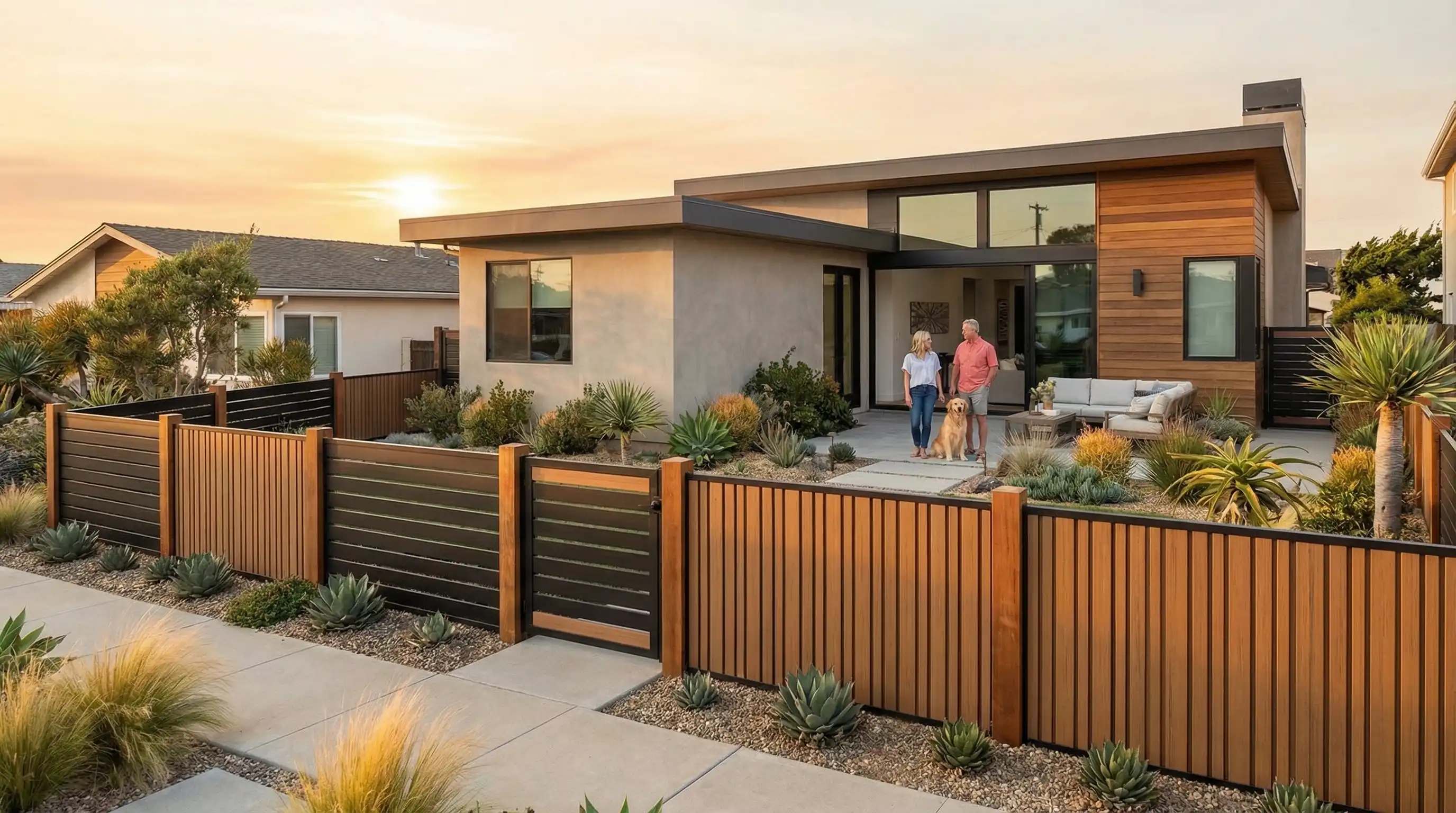
There is no single fence material that wins every San Diego project. The right choice depends on where the fence sits on your parcel, how close you are to salt air, how much maintenance you can tolerate, and what visual style matters most to you.
This guide keeps the decision practical. We will start with scenario-based sorting, then break down aluminum, composite, hardwood, steel, and masonry-style options with clear trade-offs.
Best low-maintenance choice
Aluminum is usually the cleanest answer for San Diego homeowners who want low upkeep and strong fire performance.
Best premium natural look
Ipe can work well when the goal is appearance and durability, but it is not non-combustible.
Quick material sort
Near the house in a fire-prone area
Start with non-combustible materials such as aluminum, steel, masonry, or gabion.
Close to the coast
Favor corrosion-resistant materials and finishes that hold up to salt air.
Warm privacy look
Composite or hardwood can fit, but they need honest trade-off planning.
Thin modern lines
Steel or aluminum usually make the cleanest contemporary profiles.
Material chooser
What changes the material decision in San Diego
Fire exposure near the house
If a fence run sits close to the structure, fire behavior matters more than style preference. In and around Very High Fire Hazard Severity Zones, near-house runs are usually where non-combustible materials make the most sense. For code context and defensible-space rules, see our fire-resistant fencing in San Diego guide.
Need help choosing the right fence material?
We can help you compare fire performance, privacy, maintenance, and coastal durability without forcing every project toward the same answer.
Get a Material RecommendationCoastal corrosion pressure
Salt-laden air accelerates corrosion and can shorten coating life. On coastal properties, coating quality, hardware selection, and routine rinse/inspection habits matter much more than many homeowners expect.
UV and heat load
San Diego sun and heat cycles drive fading, checking, and expansion/contraction. Composite systems and wood finishes are especially sensitive to this over time.
Budget vs lifetime ownership cost
A lower install price can still become the higher long-term cost once refinishing, repairs, and replacement cycles are included. Material selection should account for both up-front and maintenance cost.
Scenario-first recommendations
Scenario 1: Fence run is near the structure in a fire-prone setting
Start with non-combustible options: aluminum, steel, masonry, or gabion. If wood is the desired aesthetic, treat it as a design conversation with explicit risk and placement boundaries rather than a universal default.
Scenario 2: You are within a few miles of the coast
Prioritize corrosion resistance and finish durability. Aluminum is often the least-friction choice. Steel can work, but coating damage and cut edges need active maintenance to prevent rust progression.
Scenario 3: You want a warm privacy look with reduced upkeep
Composite and hardwood are common candidates. Composite may reduce routine refinishing compared to softwoods, but fire performance varies by product and thermal movement must be planned honestly.
Scenario 4: You want thin, modern architectural lines
Aluminum and steel usually deliver the cleanest profiles. Steel can support slimmer, stiffer spans in some designs; aluminum often wins on corrosion resistance and maintenance simplicity.
Material deep dive
Aluminum fencing
Aluminum is usually the most practical all-around answer for San Diego homeowners who want low upkeep, strong coastal durability, and non-combustible performance.
Where aluminum is strong
- Non-combustible per ASTM E136 context for material class.
- Naturally corrosion-resistant, especially with quality powder coating.
- Low maintenance: typically periodic rinse and inspection.
- Flexible design range: picket, slat, and privacy-oriented systems.
Where aluminum has limits
- Open picket styles do not provide full privacy.
- Aluminum can dent under impact more easily than steel.
- Up-front price can be higher than entry-level wood.
If your shortlist is aluminum vs wood, use our aluminum vs. wood comparison.
Composite fencing
Composite can deliver a warmer look with less routine finish work than many wood systems, but it is not a one-size-fits-all upgrade.
Where composite is strong
- Wood-like appearance with reduced refinishing workload.
- Typically resists rot and splintering better than standard softwoods.
- Often attractive for privacy layouts.
Where composite needs caution
- Fire behavior is product-specific. Many products are not non-combustible.
- Expansion and contraction can cause visible gaps or panel movement if details are not planned correctly.
- Damaged or deeply stained panels cannot be refinished like real wood.
For a detailed breakdown, read composite fencing pros and cons.
Hardwood fencing (including Ipe)
Hardwood is selected for appearance, longevity potential, and premium feel. Species selection is the entire story here.
Ipe in practical terms
Ipe is a dense hardwood often chosen when homeowners want a refined natural look with strong durability. It can achieve a Class A flame-spread rating in ASTM E84 testing context, but it is still not non-combustible.
Softwood reality check
Cedar, redwood, and pressure-treated pine can look great initially and may reduce initial project cost, but they typically demand more ongoing maintenance in San Diego sun and dry conditions.
If you want the hardwood route, read our Ipe guide before choosing species and finish strategy.
Steel fencing
Steel is non-combustible and structurally strong, and it can be the right answer when stiffness, security, or specific architectural detailing is the priority.
Where steel is strong
- High strength and rigidity.
- Strong fit for security-focused designs.
- Clean contemporary profiles.
Where steel requires discipline
- Coating failures can become rust points, especially near marine air.
- Weight affects installation complexity.
- Ongoing touch-up and inspection are usually part of long-term ownership.
If steel is on your shortlist, review steel fencing options.
Masonry and gabion options
For some properties, non-combustible walls or hybrid boundary systems are more practical than traditional fence panels.
- Gabion walls: stone-filled systems that can pair durability with strong architectural character.
- Block walls: high privacy and wind control, with heavier engineering and cost implications.
Coatings and finishes matter more than most homeowners expect
Material selection is only part of durability. Finish quality and maintenance habits frequently decide long-term outcome.
- For metal systems, evaluate coating quality and coastal suitability.
- For wood systems, decide early whether you want color retention (periodic oil/stain cycles) or a weathered look.
For finish strategy details, see powder coating color and durability guidance.
Side-by-side comparison snapshot
| Feature | Aluminum | Composite | Ipe Hardwood | Steel | Cedar/Redwood |
|---|---|---|---|---|---|
| Fire profile | Non-combustible material class | Product-dependent | Can achieve Class A flame spread in tested assemblies | Non-combustible material class | Combustible |
| Coastal durability | Strong | Strong | Good with maintenance | Moderate to strong, depending on coating care | Moderate |
| Maintenance load | Low | Low to moderate | Moderate | Moderate | High |
| Style direction | Modern to transitional | Warm privacy look | Premium natural look | Modern, security-oriented | Traditional warmth |
| Typical best fit | Fire-aware, low-upkeep projects | Privacy with reduced refinishing | Premium natural aesthetics | Structural/security priorities | Budget-first installs |
How to make the final decision without overthinking it
Use this sequence:
- Define where each run sits relative to the structure.
- Filter by fire exposure and local requirements first.
- Filter by coastal exposure second.
- Pick your maintenance tolerance.
- Choose style inside that narrowed set.
If two materials still look close, compare 20-year ownership effort, not only install price.
Sources
- ASTM E136: Standard Test Method for Assessing Combustibility of Materials Using a Vertical Tube Furnace at 750 Degrees C. ASTM International.
- ASTM E84: Standard Test Method for Surface Burning Characteristics of Building Materials. ASTM International.
- ASTM D2017: Standard Test Method for Accelerated Laboratory Test of Natural Decay Resistance of Woods. ASTM International.
- ASTM A123: Standard Specification for Zinc (Hot-Dip Galvanized) Coatings on Iron and Steel Products. ASTM International.
- USDA Forest Products Laboratory. “Wood Handbook: Wood as an Engineering Material.” General Technical Report FPL-GTR-282. Madison, WI.
- National Weather Service, San Diego. Climate data for San Diego, California.
- CAL FIRE. Fire Hazard Severity Zone Maps. California Department of Forestry and Fire Protection.
- California Public Resources Code Section 4291. Defensible space requirements.
- AB 3074 (2020). California legislation amending PRC 4291 regarding defensible space and Zone 0.
- American Galvanizers Association. “Corrosion Rate Factors” and atmospheric corrosion data.
- University of California Agriculture and Natural Resources. Pest Notes: Termites.
- The Aluminum Association. Material properties and durability data for aluminum alloys.
- AAMA 2604 / AAMA 2605: Specifications for high-performance organic coatings on aluminum extrusions. American Architectural Manufacturers Association.
Verification note (updated March 26, 2026): Regulatory requirements can vary by parcel, jurisdiction, and inspection cycle. Confirm current requirements with your AHJ and official California sources before final design or contract decisions: PRC 4291, Board of Forestry Zone 0 updates, and OSFM FHSZ maps.