Composite fencing pros and cons for San Diego homes
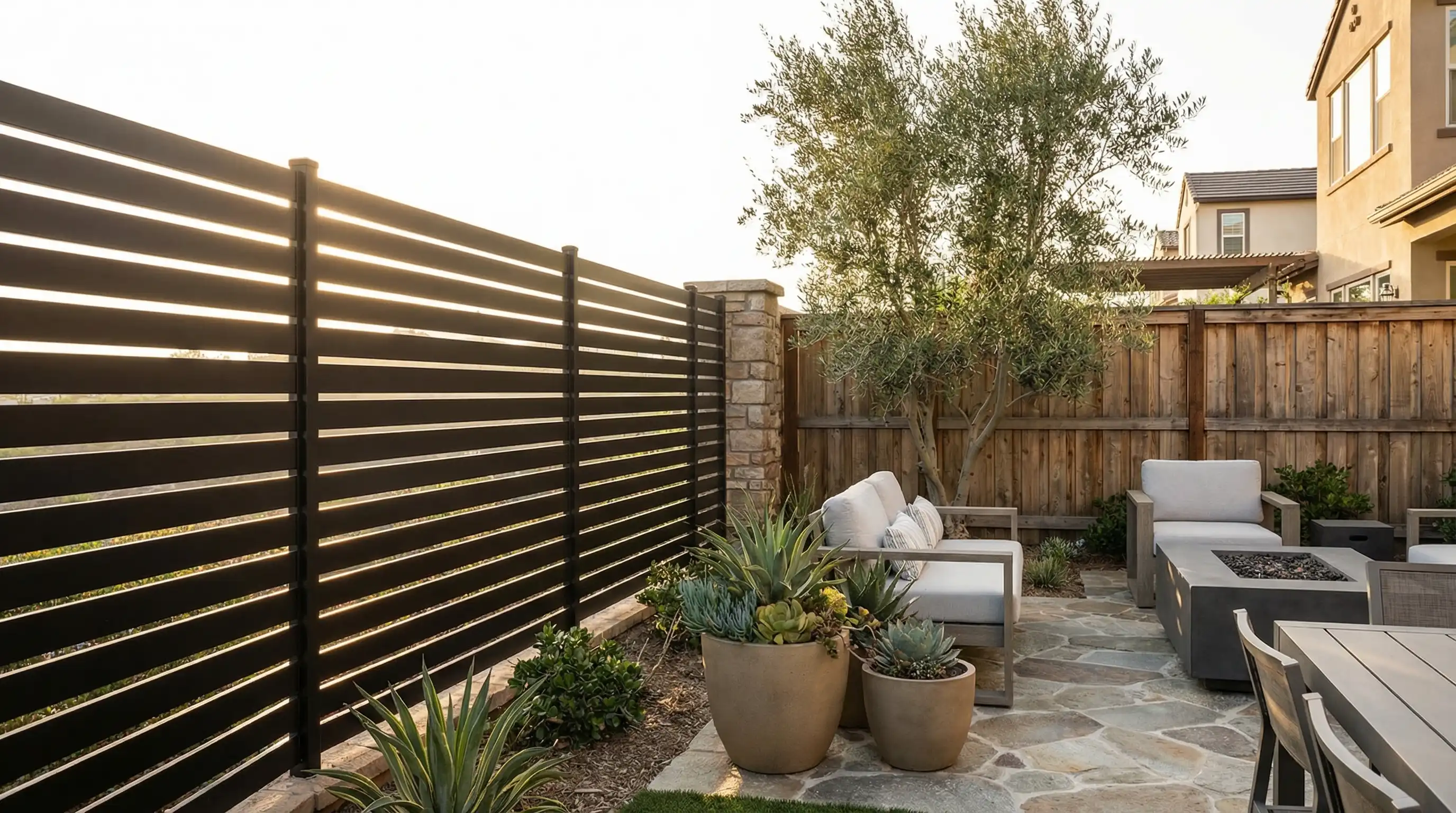
Composite fencing shows up in a lot of San Diego conversations because it promises something appealing: the look of wood without the maintenance. That promise is partially true, which is exactly why it needs a closer look. “Partially true” can mean a great fit for some projects and a frustrating surprise for others.
This guide breaks down composite fencing honestly – what the material actually is, what it does well, where it falls short, and the fire performance question that too many homeowners skip over. If you are still trying to pin down the basic definition first, start with our guide to what composite wood means for decks and fences. If you are comparing composite to other materials, our complete fence material guide for San Diego covers the full landscape.
What composite fencing actually is
Composite fencing is manufactured from a blend of wood fibers (sometimes called wood flour) and a polymer binder, typically high-density polyethylene (HDPE) or polypropylene (PP). The ratio of wood to polymer varies by manufacturer and product line. Some products are roughly 50/50; others lean heavier on one component.
Need a Zone 0 planning review?
Review near-structure material options and get parcel-specific guidance before you finalize your layout.
See Zone 0 FencingMost modern composite fence products fall into two categories:
Uncapped composite: The wood-polymer blend is consistent throughout the board. The surface is the same material as the core. These products tend to be less expensive but more vulnerable to moisture absorption, staining, and fading.
Capped composite: The wood-polymer core is wrapped in a polymer shell (the “cap”) that provides additional protection against moisture, UV, and staining. Capped products generally perform better over time but cost more. Major manufacturers like Trex, TimberTech, and Fiberon offer capped composite lines.
Understanding this distinction matters because the performance characteristics that attract homeowners to composite – low maintenance, fade resistance, moisture resistance – are significantly better in capped products than uncapped ones. When someone says “composite fencing didn’t hold up,” it is often an uncapped product or an older-generation formulation.
If you want the broader deck-and-fence version of this definition before going deeper on fencing, read what composite wood is in practical homeowner terms.
The pros: what composite fencing does well
Wood-like appearance with less maintenance
This is the primary selling point, and it is real. Quality composite fencing can convincingly mimic the look of stained wood – warm tones, grain patterns, and a natural feel – without requiring periodic staining, sealing, or painting.
For homeowners who want a warm, natural aesthetic but are not interested in the ongoing maintenance cycle of real wood, composite delivers. In San Diego, where UV exposure accelerates the breakdown of wood finishes and can require restaining every one to two years on sun-facing sections, avoiding that cycle saves significant time and money.
Low routine maintenance
Day-to-day maintenance of composite fencing is minimal. It amounts to:
- Periodic rinsing with a garden hose to remove dirt and pollen
- Occasional cleaning with soap and water for stubborn spots
- Removing debris from the base of the fence to prevent moisture buildup
Compare that to the staining, sealing, sanding, and board replacement schedule for wood fencing, and the labor savings are real. Our fence maintenance guide by material has the full comparison.
Termite resistance
The polymer content in composite fencing makes it unappealing to termites. In San Diego, where subterranean termites are active year-round and drywood termites are also present (University of California Agriculture and Natural Resources, Pest Notes: Termites), this is a meaningful benefit. You will not wake up to find termite damage in a composite fence the way you might with a cedar or pine fence.
No splintering or rotting
Composite boards do not splinter, which matters if you have children or pets running along the fence line. They also resist the moisture-related rot that eventually affects all wood fences, particularly at ground contact points and where water pools.
Consistent appearance
Unlike natural wood, where grain patterns, knots, and color vary from board to board, composite fencing offers a more uniform appearance. If consistency matters to your design, composite delivers it. Some products even offer multi-tonal color variation that mimics the look of natural wood variation – but in a controlled, predictable way.
The cons: where composite fencing falls short
Fire performance varies significantly by product
This is the most important limitation for San Diego homeowners, and it is the one most often glossed over in marketing materials.
Most composite fencing products are NOT non-combustible. They contain wood fiber and polymer – both of which are combustible materials. The question is not whether composite can burn, but how it behaves under fire exposure.
Fire performance of composite products is evaluated under ASTM E84 (Standard Test Method for Surface Burning Characteristics of Building Materials), which measures two things:
- Flame spread index (FSI): How quickly flame travels across the surface. Class A is an FSI of 0-25; Class B is 26-75; Class C is 76-200.
- Smoke developed index (SDI): How much smoke the material produces.
Some composite products achieve a Class A or Class B rating under ASTM E84. Others fall into Class C or have not been tested at all. The rating depends entirely on the specific product formulation – you cannot assume one composite brand’s rating applies to another.
What this means for San Diego homeowners: If your property is in or near a Very High Fire Hazard Severity Zone (VHFHSZ), you need to verify the fire test data for any composite product you are considering. A composite fence that has not been tested or that has a Class C rating may not be appropriate near structures in fire hazard zones. Products evaluated by ICC-ES (ICC Evaluation Service) will have evaluation reports that include fire test results – ask for these.
For context on what non-combustible means and how it differs from fire-rated, our fire-resistant fencing guide covers the hierarchy. And for fire ratings data, see our fire ratings page.
Thermal expansion and contraction
Composite materials expand and contract with temperature changes more than wood, metal, or concrete. In San Diego, where a south-facing fence panel can reach surface temperatures above 140 degrees F on a summer afternoon and cool to 50 degrees F overnight, thermal movement is a real design consideration.
If composite fence panels are installed without proper expansion gaps, the result can be:
- Bowing or buckling of panels as they expand in heat
- Visible gaps between boards in cooler weather
- Fastener stress as the material pushes against fixed connection points
Manufacturers provide installation guidelines specifying required expansion gaps (typically 1/8" to 3/16" per 8-foot span, but this varies by product). Installers who are not familiar with composite-specific requirements sometimes skip these gaps, and the results show up within the first summer.
Cannot be refinished
This is a deal-breaker for some homeowners and irrelevant to others, depending on your expectations.
If a composite fence board gets deeply scratched, gouged, stained (from something like a sprinkler hitting fertilizer), or faded beyond what cleaning can fix, you cannot sand it down and refinish it the way you can with real wood. The options are to live with the damage or replace the affected boards.
For capped composite products, the cap provides good protection against surface damage, but it is not armor. A weed trimmer hitting the fence base, a ladder leaned against the fence, or kids throwing rocks can still damage the surface.
Fading over time
All composite products experience some degree of color change over their lifespan. Manufacturers have improved UV resistance significantly in recent generations, and most quality products now come with fade and stain warranties of 25 years or more.
However, “warranted against fading” does not mean “will never change color.” Warranties typically cover fading beyond a certain threshold (measured in delta E color units), not zero fade. In San Diego’s intense UV environment, expect some color lightening over the first year or two as the material acclimates, followed by relative stability.
Weight and structural considerations
Composite fence boards are generally heavier than wood boards of the same dimension. This adds load to posts and can affect shipping costs. It also means that composite fencing typically requires a metal or heavy-duty post system rather than relying on composite posts alone – particularly for tall fences or long spans.
Cost
Quality composite fencing is not a budget option. Capped composite fence systems from major manufacturers typically fall in the mid-to-upper range of fencing materials. When you add the cost of a metal post and rail system (which many composite fences require), the installed cost can approach or equal that of aluminum or Ipe hardwood fencing.
The cost argument for composite is a lifetime value calculation: higher upfront cost offset by lower maintenance costs over 20+ years. Whether that math works out depends on the specific product, the alternative you are comparing it to, and how honestly you assess your willingness to maintain a wood fence.
Composite vs wood: when composite wins
If you are choosing between composite and standard wood fencing (cedar, redwood, pressure-treated pine), composite has clear advantages in several areas:
Maintenance commitment. If you know you will not keep up with staining and sealing a wood fence, composite is the better long-term choice. A neglected wood fence deteriorates rapidly; a neglected composite fence just gets dusty.
Termite exposure. In areas with heavy termite pressure (which includes most of San Diego County), composite eliminates a persistent maintenance and repair issue.
Consistency. If you want a uniform appearance that stays relatively stable over time, composite delivers this more reliably than wood.
Longevity in the right conditions. A quality capped composite fence can last 25-30 years. A softwood fence in San Diego, even with good maintenance, typically needs replacement or major repair in 15-20 years.
For a detailed breakdown comparing both to aluminum, see our aluminum vs wood fence comparison.
Composite vs aluminum: different products for different goals
Composite and aluminum are not directly competing products in the same way composite and wood are. They serve different priorities:
Choose composite when: The wood-like appearance is essential to your design, you are willing to pay the premium for it, and fire performance requirements in your area are satisfied by the specific product’s ratings.
Choose aluminum when: Non-combustible performance is required or preferred (fire hazard zones, Zone 0), maximum durability and minimum maintenance are the priorities, and you are comfortable with a metal aesthetic.
The key difference on fire: Aluminum is categorically non-combustible per ASTM E136. Composite fire performance varies by product and is never non-combustible. If fire safety is a primary concern, aluminum is the safer specification. This is not a knock on composite – it is a statement about the physical properties of the materials.
San Diego-specific considerations
UV and heat performance
San Diego’s climate is a stress test for composite materials. Intense UV, high surface temperatures, and minimal rainfall mean:
- UV resistance is more important here than in overcast climates. Choose products with demonstrated UV stability and meaningful fade warranties.
- Dark-colored composite fencing absorbs more heat, which amplifies thermal expansion. Lighter colors or variegated finishes can reduce surface temperatures somewhat.
- South- and west-facing fence sections take the most abuse. If budget requires compromises, prioritize product quality on these exposures.
Coastal salt air
Composite materials themselves hold up well in salt air – the polymer content provides inherent moisture and corrosion resistance. However, the metal hardware, posts, and rail systems used with composite fencing are still subject to coastal corrosion. Make sure the structural system uses corrosion-resistant materials (aluminum posts and rails, stainless steel or coated fasteners).
Fire zone compliance
This bears repeating because it is San Diego-specific: many properties in San Diego County are in or near mapped fire hazard zones. If yours is, you must verify that any composite product you specify has fire test documentation appropriate for your application.
Do not assume that “composite” automatically means “fire-conscious.” Some products perform well under fire testing; others do not. The only way to know is to review the actual test data.
How to evaluate composite fencing products
If you are considering composite fencing, here is what to ask for before committing:
Fire test documentation
Ask the manufacturer or supplier for the product’s ASTM E84 test results (flame spread index and smoke developed index). If the product has been evaluated by ICC-ES, the evaluation report (ESR number) will include fire performance data. If no fire test data is available, that is a red flag for any San Diego property in or near a fire zone.
UV and fade warranty details
Look beyond the headline warranty period. Read the fine print:
- What level of fading is covered?
- Does the warranty cover cosmetic issues or only structural failure?
- Are there exclusions for “normal weathering”?
- Does the warranty require specific maintenance (cleaning at minimum intervals)?
Thermal expansion specifications
Reputable manufacturers publish thermal expansion coefficients and installation guidelines that specify required gap dimensions. If the product does not have published expansion data, the installer is guessing on gap sizing, and that guessing often shows up as problems after the first hot season.
Capped vs uncapped
If you are investing in composite fencing in San Diego, capped products are worth the premium. The cap provides meaningfully better protection against moisture, staining, and UV degradation. Uncapped composite in San Diego’s UV environment will show its age faster than capped product.
Sample weathering
Ask for samples and leave them outside for a few weeks in the sun before committing to a large project. How a product looks in a showroom under fluorescent lighting is not how it will look on your south-facing fence in August.
The slip-fence system option
One approach gaining traction for composite fencing is the slip-fence or panel-in-post system. In this design, composite boards slide into channels in metal posts (typically aluminum or steel), creating a clean, modern look without exposed fasteners.
Advantages of this approach:
- Board replacement is easy. Individual boards can slide out and be replaced without disassembling the fence.
- Clean aesthetics. No visible screws or brackets on the fence face.
- Mixed-material flexibility. Metal posts provide structural strength and non-combustible support while composite boards provide the wood-like appearance.
- Expansion management. The channel allows boards to expand and contract without buckling.
This system works particularly well in San Diego because it combines the corrosion-resistant, non-combustible structural benefits of aluminum posts with the aesthetic warmth of composite boards. Our composite fencing and composite fence service pages show examples of this approach.
Common mistakes with composite fencing
Based on what we see on jobsites and in repair calls, these are the most common problems with composite fence installations:
Insufficient expansion gaps. Boards installed tight to each other in cool weather buckle in summer heat. Follow the manufacturer’s expansion guidelines exactly.
Wrong post material. Composite posts (when available) may not provide the structural support needed for tall or long-span fences. Metal posts are usually the better choice.
Ignoring fire zone requirements. Installing composite fencing in Zone 0 without verifying fire test data. If the product does not have documented fire performance, it should not be specified near structures in fire hazard areas.
Cheap hardware. Using carbon steel brackets and fasteners with composite fencing near the coast. The composite boards will outlast the hardware by a decade, creating a maintenance problem that should have been avoided at installation.
Not accounting for color change. Ordering a replacement board two years after installation and expecting it to match the original boards. Even the same product and color will look different new vs weathered. Order extra boards at installation and store them in similar conditions to minimize future mismatch.
Is composite right for your San Diego project?
Composite fencing is a good choice when:
- You want a wood-like appearance without wood maintenance
- Your property is not in a fire hazard zone, or the specific product you are using has fire ratings appropriate for your location
- You are willing to invest in a quality capped product and proper installation
- You understand and accept that composite is not refinishable and not non-combustible
Composite fencing is NOT the right choice when:
- Non-combustible performance is required (fire hazard zone, Zone 0 near structure)
- Budget is the primary constraint (wood will cost less upfront)
- You want the ability to change the color by refinishing
- You expect zero color change over the life of the fence
Next steps
If composite fencing sounds right for your project, the next step is verifying that the specific product meets the requirements of your property – including fire zone status, HOA rules, and structural needs.
Call Modern Fence & Deck at (619) 975-1883 or request a quote. We will help you evaluate products, verify fire ratings, and design an installation that accounts for San Diego’s climate. If composite is not the right fit after we look at your property, we will tell you that too.
Sources
- ASTM E84: Standard Test Method for Surface Burning Characteristics of Building Materials. ASTM International.
- ASTM E136: Standard Test Method for Assessing Combustibility of Materials Using a Vertical Tube Furnace at 750 Degrees C. ASTM International.
- ICC-ES (ICC Evaluation Service). Evaluation reports for composite building products.
- University of California Agriculture and Natural Resources. Pest Notes: Termites.
- CAL FIRE. Fire Hazard Severity Zone Maps. California Department of Forestry and Fire Protection.
- California Public Resources Code Section 4291. Defensible space requirements.
- AB 3074 (2020). California legislation regarding defensible space Zone 0.
- AAMA 2604 / AAMA 2605: Specifications for high-performance organic coatings on aluminum extrusions and components. American Architectural Manufacturers Association.
- Trex Company. Product specifications and installation guidelines (referenced as general manufacturer example).
- National Weather Service, San Diego. Climate data for San Diego, California.
Verification note (updated March 26, 2026): Regulatory requirements can vary by parcel, jurisdiction, and inspection cycle. Confirm current requirements with your AHJ and official California sources before final design or contract decisions: PRC 4291, Board of Forestry Zone 0 updates, and OSFM FHSZ maps.