Fence maintenance guide: what each material actually needs
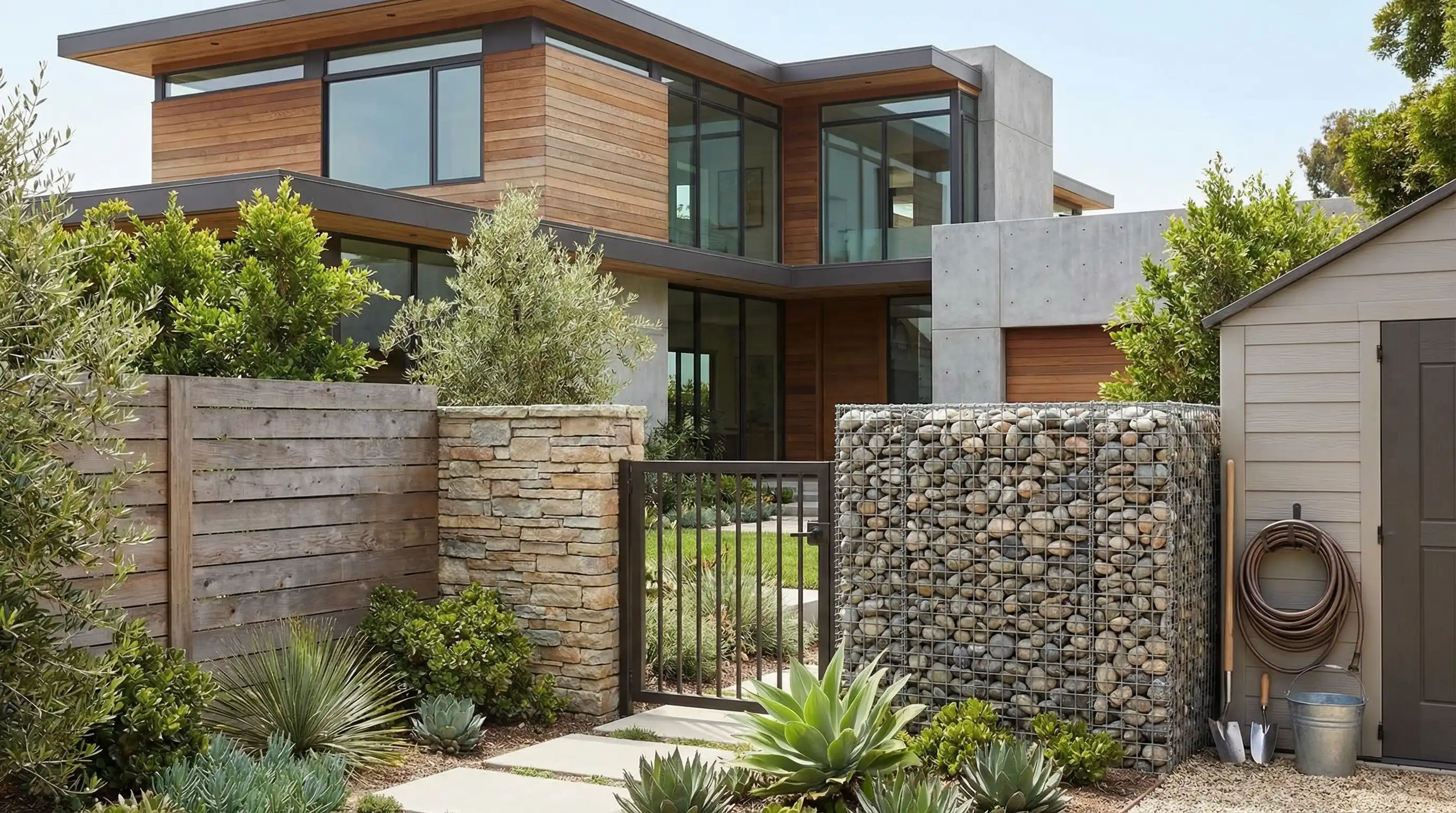
Nobody buys a fence because they are excited about maintaining it. But every fence material requires something — even the ones marketed as “maintenance-free.” The difference between materials is not whether you will do maintenance, but how much, how often, and what happens if you skip it.
This guide covers the actual maintenance requirements for every common residential fence material used in San Diego: aluminum, composite, Ipe hardwood, steel, wood (cedar and redwood), and vinyl. We are going to be honest about what each one needs, what happens when you neglect it, and what “low maintenance” really means in practice.
If you are still deciding on a material, our guide to choosing the best fence material covers the bigger picture — cost, lifespan, fire performance, and aesthetics. This post is specifically about what happens after installation day.
Comparing hardwood fencing options?
Review Ipe and premium hardwood systems with finish, climate, and maintenance considerations.
Explore Hardwood FencingWhy maintenance matters more than most people think
Longevity
The expected lifespan of any fence material assumes reasonable care. An aluminum fence rated for decades of service still needs its hardware checked. A composite fence that should last 25-plus years can develop mold if it sits in permanent shade with no cleaning. Maintenance is what gets you from the theoretical lifespan to the actual one.
Warranty coverage
Most manufacturer warranties have maintenance clauses. If a composite fence develops staining and you have never cleaned it, the manufacturer can — and often will — deny the warranty claim. If a powder-coated aluminum fence shows corrosion around a chip you never touched up, the same applies.
Read your warranty documents. They almost always specify a minimum maintenance schedule. Keep records of what you have done and when.
Appearance
A fence that is structurally sound but looks neglected drags down the entire property. In San Diego’s real estate market, curb appeal matters. A well-maintained fence signals a well-maintained home. A fence with peeling stain, green mold, or visible rust signals the opposite.
Resale and insurance
Some insurers in fire-prone areas of San Diego are paying closer attention to the condition and material of fences, especially those close to the structure. A wood fence that has not been maintained is a higher fire risk than one that has — dry, weathered wood ignites more readily than wood with a maintained finish. Keeping your fence in good shape is not just about looks.
Aluminum fencing: minimal maintenance
What it needs
Aluminum fencing is as close to “maintenance-free” as fencing gets, but it is not zero-maintenance. Here is what to plan for:
Annual wash. Once a year, wash your aluminum fence with water and a mild soap (dish soap works). A garden hose and a soft brush or cloth are all you need. For coastal properties in La Jolla, Del Mar, Coronado, and other beach-adjacent areas, washing twice a year is better — salt spray deposits on the surface and can dull the finish over time if left.
Inspect hardware. Once a year, check all hinges, latches, and fastener points. Tighten anything that has loosened. Replace any hardware that shows corrosion. Even on a powder-coated aluminum fence, the hardware (screws, bolts, hinge pins) can be a weak point if it is not stainless steel or properly coated.
Check for damage. Walk the fence line and look for dents, bent sections, or areas where something has impacted the fence (landscaping equipment, fallen branches, a basketball). Aluminum does not rust, but it can dent. Small dents are cosmetic. Larger ones can compromise the panel’s fit in the frame.
Touch up chips. If the powder coating gets chipped — from a rock thrown by a mower, a ladder leaned against it, or anything else — touch it up with manufacturer-matched paint. A bare aluminum surface will not rust like steel, but it will oxidize over time (turning chalky white), and the chip will be visible.
What happens if you skip it
Honestly, not much in the short term. That is the advantage of aluminum. Skip a year of washing and you will have a slightly dull fence. Skip hardware checks and a gate might start sagging. But you are not going to come home to rot, termites, or structural failure because you missed a maintenance cycle.
Over the long term (five-plus years of no maintenance), you might see hardware failure on gates, accumulated grime that becomes harder to remove, and minor powder coating degradation in areas with heavy UV exposure or salt air.
For a deeper look at how aluminum compares to wood over time, see our aluminum vs. wood fence comparison. For details on powder coating care specifically, our powder coating guide goes further.
Maintenance effort: Low
Time per year: 1-2 hours for washing and inspection on a typical residential installation.
Composite fencing: low maintenance, not no maintenance
What it needs
Composite fencing (made from a blend of wood fibers and plastic polymers) is marketed as low-maintenance, and that is generally true. But there are specific things it needs.
Regular washing. Wash composite panels with soap and water at least twice a year. A soft bristle brush works well. Some manufacturers recommend specific cleaners — check your product documentation.
Mold and mildew inspection. This is the big one for San Diego. Composite fencing in shaded areas — north-facing side yards, sections behind garages, anywhere with limited sun exposure — can develop mold and mildew. The wood fiber content in the composite gives mold something to feed on. In shaded, humid microclimates (which exist even in San Diego, especially near the coast), mold can become a recurring issue.
If you see mold, a solution of oxygen bleach (sodium percarbonate) and water will usually remove it. Avoid chlorine bleach, which can damage the composite surface. Some manufacturers sell branded cleaners for this purpose.
Check for warping and expansion. Composite materials expand and contract with temperature changes. In San Diego, surface temperatures on a south-facing composite fence can exceed 150 degrees Fahrenheit on a hot day. Quality composite products are engineered to handle this, but improper installation (insufficient gap allowance at ends, over-tightened fasteners) can lead to warping or buckling. Check for this during your inspections.
Stain removal. Composite surfaces can stain from grease, oil, wine, and certain plant materials (like berry-producing vines). Clean spills promptly. Once a stain sets into composite, it can be difficult to remove without specialized products.
What happens if you skip it
Mold is the main risk. In shaded areas, unchecked mold growth can discolor composite panels permanently and potentially void your warranty. Accumulated dirt and organic debris in the wood-fiber surface can also become a breeding ground for mold spores.
Structural failure from skipped maintenance is rare with composite. The material does not rot in the way that wood does. But appearance degradation — fading, staining, mold — is real, and it is the reason “low maintenance” is not the same as “no maintenance.”
For a comprehensive look at composite fencing benefits and limitations, see our composite fencing pros and cons guide.
Maintenance effort: Low to moderate
Time per year: 2-4 hours for washing, mold inspection, and stain treatment on a typical residential installation.
Ipe hardwood fencing: moderate maintenance, with a choice
What it needs
Ipe (pronounced “ee-pay”) is a tropical hardwood with exceptional density, hardness, and natural resistance to rot, insects, and decay. It is one of the most durable wood species available for exterior use. According to the USDA Forest Products Laboratory, Ipe heartwood is rated “very durable” for decay resistance, and independent testing has demonstrated a Janka hardness rating of approximately 3,510 lbf — among the highest of any commercially available wood species.
But Ipe gives you a maintenance choice, and which path you take affects your workload.
Option 1: Maintain the original color. When first installed, Ipe is a rich, warm brown. To keep that color, you need to apply a UV-protective oil finish annually. Penofin Hardwood and Ipe Oil are common product choices. The process involves:
- Cleaning the surface with a wood cleaner to remove dirt and oxidation
- Allowing it to dry completely
- Applying the oil with a brush, roller, or sprayer
- Allowing 24-48 hours to cure before contact
This annual oiling is the primary maintenance commitment with Ipe.
Option 2: Let it weather to silver. If you do not oil Ipe, it will gradually turn a silver-gray color over several months to a year. This is not decay — it is surface oxidation. The structural integrity of the wood is unaffected. Many homeowners in San Diego (and architects designing with Ipe) prefer the silver-gray patina. It looks natural and pairs well with coastal and modern architecture.
If you choose the silver route, your maintenance drops to:
- Annual inspection for checking (small surface cracks that develop as the wood dries — cosmetic, not structural in properly dried Ipe)
- Occasional washing to remove dirt and organic buildup
- Checking fasteners and connections
Either way: Inspect all fasteners annually. Ipe is so dense that it requires pre-drilling for every screw, and if fasteners loosen over time, they will not grip as easily as in softer wood. Stainless steel fasteners are mandatory for Ipe — standard steel will corrode and stain the wood.
What happens if you skip it
If you chose option 1 (maintain color) and skip a year of oiling, the Ipe will start to gray. You can usually restore the color with a cleaning and re-oiling, though deeply weathered Ipe may need light sanding first.
If you chose option 2 (let it silver) and skip inspections, the main risk is fastener issues going unnoticed. Ipe itself is incredibly resistant to rot and insects — termites generally will not touch it. But a loose fastener or a post connection that has shifted can lead to a panel that is no longer secure.
For more on Ipe as a fencing material, see our Ipe hardwood fencing guide.
Maintenance effort: Moderate (if oiling) or Low (if letting silver)
Time per year: 4-8 hours for oiling a typical fence installation. 1-2 hours for the silver-gray approach (inspection and washing only).
Steel fencing: moderate maintenance focused on the coating
What it needs
Steel is strong, non-combustible, and versatile in design. But unlike aluminum, steel rusts. The only thing standing between your steel fence and corrosion is its protective coating — typically powder coating, sometimes hot-dip galvanizing with a powder coat on top.
Inspect the powder coating regularly. At least twice a year, walk the fence line and look for chips, scratches, or any place where the bare steel is exposed. Pay extra attention to:
- Areas near the ground where mowers and trimmers might contact the fence
- Gate edges and latch areas where metal-to-metal contact occurs
- Any welds, especially if the fence was field-welded rather than factory-welded
- Locations where sprinklers consistently hit the fence
Touch up immediately. When you find a chip or scratch that exposes bare steel, touch it up as soon as possible with a matching paint. The longer bare steel is exposed to air and moisture, the faster rust begins. In coastal San Diego, salt air accelerates this significantly. A chip that might take months to rust in Poway could start showing orange within weeks in Ocean Beach.
Wash regularly. Wash steel fencing with soap and water at least twice a year. For coastal properties, quarterly washing is better. Removing salt deposits before they have time to work on the finish extends the coating’s life.
Check for rust formation. If you find any rust, address it immediately. Light surface rust can be removed with fine sandpaper or a wire brush, then primed and repainted. If rust has penetrated deeper, the section may need professional refinishing.
What happens if you skip it
Rust. And once rust starts on steel, it spreads. A small chip that could have been fixed with a $10 touch-up pen can turn into a section that needs professional sandblasting and recoating. In San Diego’s coastal zones, this progression happens faster than most people expect.
The worst-case scenario with neglected steel is structural compromise. Rust at a post base or at a welded connection can weaken the fence to the point of failure. This is rare with modern hot-dip galvanized steel that has been properly maintained, but it is possible with extended neglect.
For more on how powder coating protects metal fences and how to maintain it, see our powder coating guide.
Maintenance effort: Moderate
Time per year: 3-6 hours for inspection, touch-up, and washing on a typical residential installation.
Wood fencing (cedar and redwood): high maintenance
What it needs
Let us be straightforward: wood fencing requires the most maintenance of any common fence material. If you are choosing wood, go in with your eyes open.
Stain or seal every 1-2 years. Both cedar and redwood contain natural oils that provide some resistance to rot and insects, but UV exposure breaks down these oils over time. In San Diego’s intense sun, an unfinished wood fence will start showing UV damage within months. A quality exterior stain or sealer protects against UV, moisture, and biological growth.
The process:
- Clean the fence with a wood cleaner or pressure washer (low pressure — high pressure damages wood fibers)
- Allow 24-48 hours of drying time
- Apply stain or sealer with a brush, roller, or sprayer
- Allow proper cure time before rain or sprinkler contact
Expect to do this every one to two years depending on sun exposure and the product used. South-facing and west-facing fence sections will need attention sooner than shaded north-facing sections.
Inspect for rot. Check the bottom of each board and the base of each post at least annually. Wood posts set in soil — especially in San Diego’s clay soils — are prone to rot at the ground line. This is where failure usually starts. Poking the wood near the ground with a screwdriver can reveal soft spots that are not visible on the surface.
Check for termites. San Diego is one of the heaviest termite areas in the United States. Both subterranean termites and drywood termites are active in the region. Cedar and redwood have some natural resistance, but “resistant” does not mean “immune.” If you see mud tubes on posts, small holes in boards, or what looks like sawdust (frass), get a termite inspection.
According to the University of California Agriculture and Natural Resources, the heartwood of western red cedar and redwood has natural extractives that resist decay and insects, but sapwood from any species is not resistant. Since commercially available cedar and redwood fence boards contain varying amounts of sapwood, relying on natural resistance alone is not sufficient for long-term performance.
Tighten and replace hardware. Wood expands and contracts with moisture changes. Even in San Diego’s relatively dry climate, seasonal variations (dry summers, wetter winters) cause movement. Check nails and screws annually. Replace any that have backed out or lost their holding power.
Replace damaged boards. Unlike metal or composite, individual wood boards can split, crack, or warp. Plan on replacing a few boards over the life of the fence. The good news is that individual board replacement is easy with wood — it is one of the few maintenance advantages wood has.
What happens if you skip it
Rapid deterioration. An unmaintained wood fence in San Diego typically shows significant graying and UV damage within one year, rot at post bases within three to five years, and potential structural failure within five to ten years. Termite damage can accelerate this timeline dramatically.
Wood fences that are not maintained also represent an increased fire risk. Dry, weathered wood with checked (cracked) surfaces ignites more readily than wood with a maintained finish.
For a detailed comparison of wood versus non-combustible alternatives, see our aluminum vs. wood comparison.
Maintenance effort: High
Time per year: 8-16 hours for staining/sealing a typical residential fence. Additional time for rot inspection, termite checks, and board replacement.
Vinyl fencing: low maintenance but with caveats
What it needs
Vinyl (PVC) fencing requires relatively little maintenance, but it comes with limitations that other materials do not.
Wash regularly. Vinyl collects dirt, algae, and mildew, especially in white or light colors. Wash with soap and water, or a vinyl fence cleaner, at least twice a year. A garden hose and soft brush will handle most buildup.
Inspect for cracks and brittleness. Vinyl becomes brittle over time, especially with prolonged UV exposure. San Diego’s sun accelerates this process. Inspect panels for cracks, discoloration (yellowing on white vinyl), and any sections that feel brittle or rigid compared to when they were installed.
Check for impact damage. Because vinyl becomes brittle with age, it is more susceptible to impact damage than when new. A ball, a falling branch, or even a strong enough Santa Ana wind gust can crack an older vinyl panel.
What happens if you skip it
Algae and mildew staining on white vinyl is the most common issue. If left long enough, staining can become permanent — the vinyl absorbs the discoloration and no amount of cleaning fully removes it.
The bigger issue is that you cannot repair vinyl the way you can other materials. A cracked vinyl panel cannot be patched or welded — it needs to be replaced entirely. And if your specific vinyl profile has been discontinued (which happens frequently), matching the replacement panel to your existing fence can be difficult or impossible.
Maintenance effort: Low
Time per year: 2-3 hours for washing a typical residential fence. Replacement time varies if panels crack.
Seasonal maintenance calendar for San Diego
San Diego does not have harsh winters, but we do have distinct seasonal patterns that affect fence maintenance.
Spring (March - May)
- All materials: Inspect the entire fence line after winter rains. Check for loose posts, standing water at post bases, and erosion around footings.
- Wood: This is the best time to stain or seal. Weather is typically dry enough for proper application and curing, and you protect the wood before the intense summer UV.
- Ipe: If you are oiling, spring is ideal. The wood has had winter moisture and is ready to accept oil.
- Composite: Check shaded areas for mold growth that may have developed during wetter months.
Summer (June - September)
- All materials: Wash fences in early summer. Dust, pollen, and organic debris from spring settle on surfaces.
- Metal (aluminum and steel): Mid-summer is a good time for a close inspection of powder coating. The bright light makes it easy to spot chips, scratches, and any beginning corrosion on steel.
- Vinyl: Check for UV degradation signs — yellowing, brittleness, or surface chalking.
Fall (October - November)
- All materials: Clear vegetation away from the fence. This is critically important in fire-prone areas. Dry brush and dead plants against a fence during Santa Ana wind season is a fire hazard regardless of fence material.
- Wood: If you did not stain in spring, fall is the second-best window. But watch the weather — you need a dry stretch for proper application.
- All metal: Tighten gate hardware before Santa Ana season. Strong, hot winds put extra stress on gates and latches.
Winter (December - February)
- All materials: Light maintenance season. Check after any significant rain events for drainage issues at post bases.
- Coastal properties (all materials): Winter storms bring increased salt spray. A post-storm rinse on coastal fences prevents long-term coating damage.
When “low maintenance” claims are misleading
The marketing problem
Some manufacturers and installers stretch the truth on maintenance claims. Here is what to watch for:
“Maintenance-free” aluminum. It is close, but not literally true. Aluminum still needs periodic washing and hardware inspection. It will not rot, rust, or attract termites — which is why people say maintenance-free — but no exterior product is truly zero-maintenance.
“Low-staining-maintenance” composite. True in the sense that you do not stain composite the way you stain wood. But composite still needs cleaning, and in certain conditions, it needs mold treatment. The marketing leaves out the mold part.
“Lifetime” vinyl. Vinyl’s lifespan varies significantly based on UV exposure and climate. In San Diego’s intense sun, vinyl can become brittle and prone to cracking well before any reasonable definition of “lifetime.” The warranty often covers structural integrity but not discoloration or brittleness.
“Low maintenance” wood with a factory finish. Some wood products come with a factory-applied stain or coating. This is better than raw wood, but it does not eliminate the need for re-coating. The factory finish buys you time — maybe an extra year or two before the first refinish — but it does not change the fundamental maintenance profile of wood.
The honest ranking
If we rank common fence materials by total maintenance effort over a 20-year period, the order is:
- Aluminum — least maintenance
- Vinyl — low maintenance, but replacement rather than repair when issues arise
- Composite — low-moderate, depending on sun exposure and shade conditions
- Ipe (silver option) — low-moderate
- Steel — moderate, driven by coating maintenance
- Ipe (oiled option) — moderate
- Wood (cedar/redwood) — highest maintenance by a significant margin
For more detail on aluminum specifically, visit our aluminum fencing page. For composite, see our composite fencing page. For Ipe, see our hardwood fencing page.
Making your decision
Maintenance is one factor in choosing a fence material, but it is an important one. The best fence for your property depends on aesthetics, budget, fire zone requirements, and how much time you realistically want to spend on upkeep.
Be honest with yourself about maintenance. If you know you will not oil an Ipe fence every year, plan for the silver look from the start. If you love the warmth of cedar but will not stain every two years, consider a composite or aluminum option that gives you a similar feel with less work.
Modern Fence & Deck installs aluminum, composite, Ipe, and steel fencing across San Diego County. We are happy to walk you through the maintenance realities of any material so you make a choice that works for your property and your lifestyle.
Call us at (619) 975-1883 or request a quote.
Sources
- USDA Forest Products Laboratory, Wood Handbook: Wood as an Engineering Material (FPL-GTR-282) — data on natural durability of wood species, decay resistance ratings, and Janka hardness values for Ipe and other species.
- University of California Agriculture and Natural Resources, Wood Decay in Structures — guidance on heartwood vs. sapwood resistance to decay and insects in cedar and redwood.
- AAMA 2604, Voluntary Specification, Performance Requirements and Test Procedures for High Performance Organic Coatings on Aluminum Extrusions and Panels — industry standard for powder coating maintenance and expected performance.
- Manufacturer general guidance — composite fencing manufacturers (including Trex, Fiberon, and others) publish maintenance requirements that include cleaning schedules, mold prevention, and warranty conditions.
- CAL FIRE, Defensible Space (PRC 4291) — fire safety context for vegetation management near fences in fire-prone areas.