California defensible space zones explained: Zone 0, 1, and 2
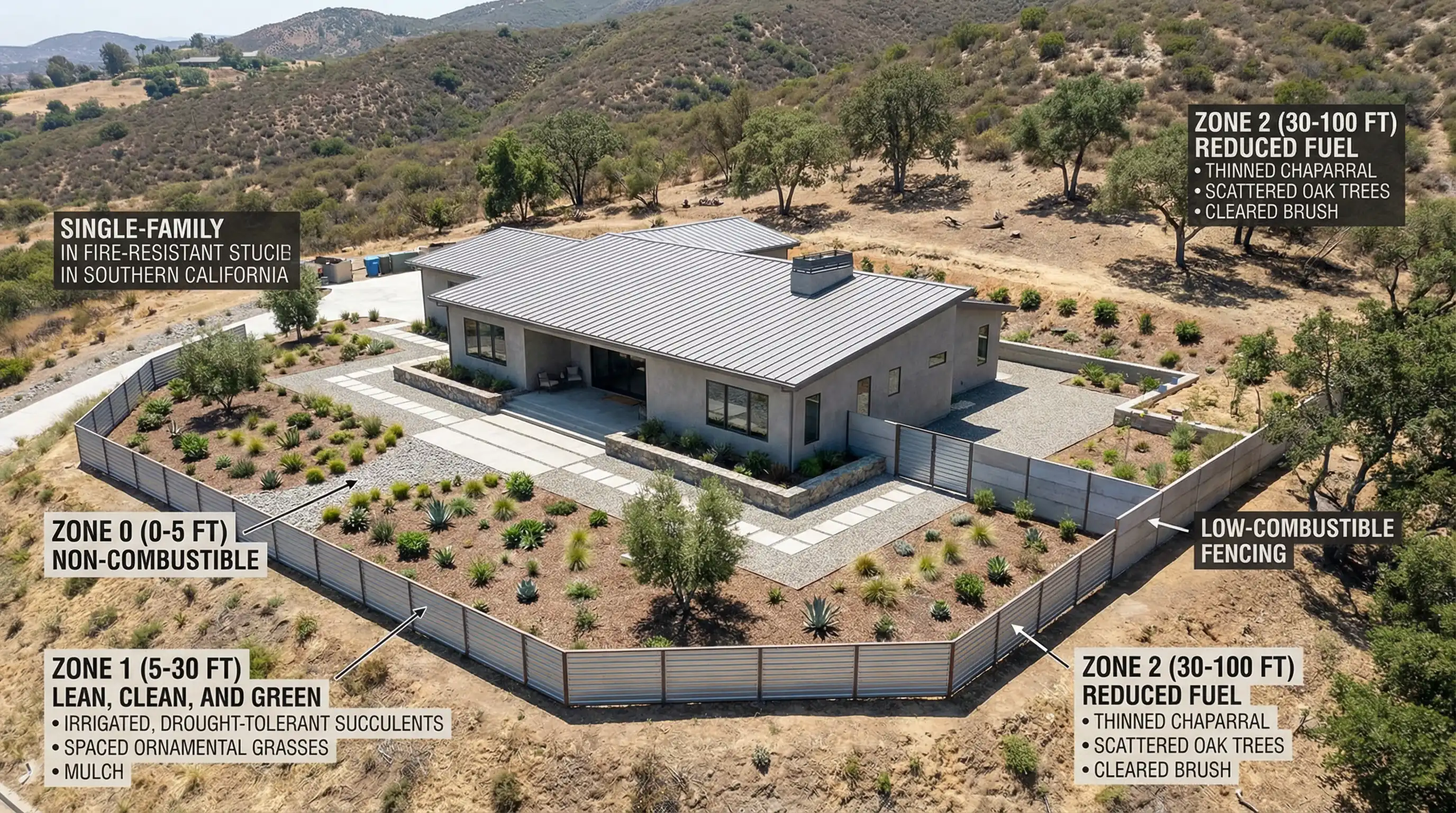
If you own a home in a fire-prone area of California, you have probably heard the term “defensible space.” It comes up during fire inspections, real estate transactions, insurance renewals, and conversations with neighbors after a bad fire season. But when you start looking into the details, the three-zone system can feel unclear — especially the newer Zone 0 requirements that directly affect fencing.
This guide breaks down California’s three defensible space zones in plain language: what each zone covers, what the law requires, how fencing fits into Zone 0 specifically, and how to figure out what applies to your San Diego property.
Most important zone for fencing
Zone 0 is the highest-priority near-structure zone when the fence connects to or sits within the first 5 feet of the home.
What changes by address
The map, the AHJ, and local ordinance adoption can all change what gets enforced.
For the broader picture on fire-resistant fencing — materials, costs, insurance, and more — see our complete fire-resistant fencing guide for San Diego homeowners.
Need help understanding what the zones mean for your fence?
We can help you translate Zone 0, Zone 1, and local enforcement into practical fencing decisions for your property.
Talk Through Your Zone 0 PrioritiesWhat defensible space means and why California requires it
Defensible space is the area around a structure where vegetation, debris, and combustible materials are managed to reduce wildfire risk. The concept is straightforward: create a buffer that slows fire, reduces ember exposure, and gives firefighters a safer zone to work in when defending a home.
California has required defensible space maintenance in fire-prone areas for decades through California Public Resources Code Section 4291 (PRC 4291) [1]. The law applies to property owners in:
- State Responsibility Areas (SRA) — Lands where CAL FIRE has primary fire protection responsibility, generally in unincorporated areas with wildland vegetation.
- Very High Fire Hazard Severity Zones (VHFHSZ) — Areas within Local Responsibility Areas (cities and some counties) that have been designated as very high fire hazard.
In San Diego County, this can affect a significant amount of residential property. Homeowners in communities like Poway, Ramona, Rancho Santa Fe, parts of Escondido, Scripps Ranch, Tierrasanta, San Carlos, and many others often need to verify whether their specific parcel is in SRA or in a locally adopted VHFHSZ map.
The defensible space requirement is not optional. PRC 4291 gives fire authorities the power to inspect properties and require compliance. Non-compliance can result in fines, abatement orders, and in some cases liability exposure if a fire originates from an unmaintained property [1].
How the three zones work
The three zones: an overview
California’s defensible space framework divides the area around a structure into three concentric zones, each with progressively less strict requirements as distance from the home increases:
| Zone | Distance from structure | Primary purpose |
|---|---|---|
| Zone 0 | 0 to 5 feet | Ember-resistant zone — hardened area immediately around the structure |
| Zone 1 | 5 to 30 feet | Lean, clean, and green — reduced and well-maintained vegetation |
| Zone 2 | 30 to 100 feet | Reduced fuel zone — thinned vegetation and fuel breaks |
The distances are measured from the exterior walls of the structure (or from the edge of attached features like decks and porches). On slopes, recommended distances for Zones 1 and 2 may increase because fire travels faster uphill [2].
Let us walk through each zone in detail.
Zone 0: the ember-resistant zone (0 to 5 feet)
What it is
Zone 0 is the newest addition to California’s defensible space framework. It was created by Assembly Bill 3074 (AB 3074), signed into law on September 29, 2020, as Chapter 259 of the Statutes of 2020 [3]. AB 3074 directed the State Board of Forestry and Fire Protection to develop regulations for an “ember-resistant zone” within the first 5 feet of a structure.
For a detailed look at AB 3074 and its implications for fencing, see our AB 3074 compliance guide for homeowners.
Has San Diego adopted Zone 0?
Yes — the City of San Diego has already adopted Zone 0, ahead of the state. The city’s requirement lives in San Diego Municipal Code (SDMC) §512.0604, the San Diego Wildland Urban Interface (SDWUI) Code. It applies to structures in a Very High Fire Hazard Severity Zone within the City of San Diego and took effect for new structures on February 28, 2026, and applies to existing structures beginning February 28, 2027 (subject to change at the discretion of the Fire Code Official).
The statewide Zone 0 rule is separate and is not yet final. The California Board of Forestry released an updated draft on April 17, 2026 (workshop April 23, 2026), and as of this writing it remains a draft — the original December 31, 2025 deadline passed without adoption. That draft traces to AB 3074 and PRC 4291, and its fence and gate language is draft §1298.04(b)(8)–(9).
San Diego’s adopted rule includes specific exceptions. Existing vinyl fencing may be allowed within 5 feet if it runs parallel to the wall, sits no less than 4 feet from the structure, is kept clear of debris, and has no vegetation between the fence and the structure. New parallel wood fencing is permitted only if it is Fire Retardant Treated Wood (FRTW), meets the vinyl conditions, and is on the California OSFM Wildland Urban Interface (WUI) Products Handbook and approved for exterior use. Note that your insurer or the IBHS may not allow vinyl or FRTW within 5 feet even where code does.
| Rule | Status | Key dates |
|---|---|---|
| City of San Diego — SDMC §512.0604 (SDWUI Code) | Adopted | New: Feb 28, 2026 · Existing: Feb 28, 2027 |
| Statewide — Board of Forestry (PRC 4291 / AB 3074) | Draft (April 2026) | Not yet final; comment period open |
Always confirm current status with your AHJ before final design decisions, because dates and exceptions can change.
Why it exists
Research has consistently shown that embers are the leading cause of home ignition during wildfires — not direct flame contact. The Insurance Institute for Business & Home Safety (IBHS) has documented that wind-driven embers can travel more than a mile ahead of a fire front and ignite homes far from the active burn area [4].
The first 5 feet around a home is the most critical zone because:
- Embers land and accumulate in corners, against walls, and along fences
- Combustible materials in this zone can ignite and transfer fire directly to the structure
- Small fires that start in this zone have the shortest path to the home’s exterior
What Zone 0 requires
The Board of Forestry and Fire Protection’s regulations for Zone 0 focus on creating a hardened, ember-resistant perimeter. Key requirements include:
- No combustible items against the structure. This includes woodpiles, lumber, combustible patio furniture stored against the wall, and — critically — combustible fencing attached to or within 5 feet of the structure.
- Non-combustible ground surface or approved materials. Gravel, concrete, pavers, and other non-combustible hardscape are preferred within Zone 0.
- No combustible vegetation touching the structure. Plants within Zone 0 should be well-maintained, irrigated, and non-combustible or highly fire-resistant. No plants should overhang or touch the structure.
- Debris management. Dead leaves, pine needles, and other combustible debris must be regularly removed from this zone.
- Non-combustible fencing and attachments. Fencing that connects to or is within the Zone 0 perimeter should be non-combustible material. This is the requirement that directly affects fence replacement decisions.
How fencing fits into Zone 0
This is where most San Diego homeowners first encounter Zone 0 in a tangible way. If you have a wood fence that attaches to the side of your house, runs along the house wall, or terminates within 5 feet of the structure, it falls within Zone 0.
A combustible fence in Zone 0 creates exactly the scenario the regulations are designed to prevent: a fuel source that, once ignited by embers, can carry fire directly to the home. We have all seen photos of homes where the only thing that burned was the fence — and the section of house it was attached to.
The solution is non-combustible fencing within Zone 0. Aluminum, steel, masonry block, and gabion are all non-combustible materials that meet Zone 0 requirements. Modern Fence & Deck specializes in these installations — you can learn more on our Zone 0 fencing service page.
For a practical guide to aluminum fencing in Zone 0 applications, including how to handle the fence-to-house connection detail, read our Zone 0 aluminum fence guide.
Zone 1: lean, clean, and green (5 to 30 feet)
What it is
Zone 1 extends from 5 to 30 feet around the structure (measured from exterior walls). This has been part of California’s defensible space requirements since before AB 3074 — it is the zone most homeowners are already familiar with.
What Zone 1 requires
The goal of Zone 1 is to create a well-maintained landscape that will not readily carry fire to the structure. PRC 4291 and CAL FIRE guidance require [1] [2]:
- Maintain landscaping to reduce fire intensity. Keep grass mowed to 4 inches or shorter. Remove dead plants, dry leaves, and pine needles regularly.
- Space trees and large shrubs properly. Trees should be spaced so their canopies are at least 10 feet apart (measured from the outermost branches). Shrubs should be spaced to prevent continuous fuel.
- Limb up trees. Remove tree branches within 6 feet of the ground (or one-third of the tree height for smaller trees) to prevent ground fire from climbing into the canopy.
- Remove “ladder fuels.” Ladder fuels are vegetation arrangements that allow fire to climb from ground level to tree canopies — typically low shrubs beneath trees.
- Keep trees and shrubs trimmed away from structures. Branches should not overhang roofs or touch walls, windows, or decks.
- Remove combustible debris. Dead vegetation, woodpiles, and other combustible materials should not be stored in Zone 1.
Fencing in Zone 1
Zone 1 does not have the same strict non-combustible material requirement as Zone 0, but CAL FIRE guidance encourages reducing combustible materials throughout the defensible space area [2]. A long run of wood fencing through Zone 1 can still act as a fuel pathway, especially if it is dry, weathered, or surrounded by combustible vegetation.
If you are replacing fencing throughout your property, using non-combustible materials in Zone 1 as well as Zone 0 provides additional protection — but the regulatory priority is Zone 0 first.
Zone 2: reduced fuel zone (30 to 100 feet)
What it is
Zone 2 extends from 30 to 100 feet from the structure (or to the property line, whichever is closer). This is the outermost defensible space zone.
What Zone 2 requires
The goal of Zone 2 is to reduce fuel loads so that a fire burning through this area arrives at Zone 1 with reduced intensity. Requirements include [1] [2]:
- Thin vegetation to reduce fuel continuity. The specific thinning requirements depend on vegetation type and slope. On steeper slopes, more aggressive thinning is needed.
- Create horizontal spacing between shrubs and trees. Spacing depends on the species and slope — steeper terrain requires wider spacing.
- Remove dead vegetation and debris. Dead trees, fallen branches, and accumulated dead plant material should be cleared.
- Maintain fuel breaks. Roads, driveways, and cleared areas within Zone 2 serve as fuel breaks.
Fencing in Zone 2
Most fencing decisions do not extend into Zone 2 for typical residential properties, since perimeter fencing is usually within the first 30 feet. However, larger properties with fencing along distant property lines should be aware that combustible fencing in Zone 2 can contribute to overall fuel loads.
Common misconceptions about zone requirements
“Zone 0 means I have to remove everything within 5 feet of my house”
Not exactly. Zone 0 requires that materials within 5 feet be non-combustible or ember-resistant — it does not require a bare dirt perimeter. You can have hardscape (pavers, gravel, concrete), non-combustible fencing, and well-maintained fire-resistant plants. The goal is to eliminate combustible materials that can ignite from embers and transfer fire to the structure.
“My property is in the city, so defensible space does not apply to me”
This is a common mistake. While PRC 4291’s defensible space requirement historically applied most directly to SRA (State Responsibility Area) lands, cities within California can and do designate Very High Fire Hazard Severity Zones (VHFHSZ) within their jurisdictions. The City of San Diego has designated VHFHSZ areas, and properties within those zones are subject to defensible space requirements under local ordinances [5].
“Zone 0 only applies to new construction”
AB 3074’s Zone 0 requirements apply to existing properties, not just new construction. If your property is in an applicable area, you are expected to maintain Zone 0 compliance regardless of when your home was built [3].
“A non-combustible fence automatically means I am Zone 0 compliant”
A non-combustible fence is one piece of Zone 0 compliance. You also need to address vegetation, debris, stored items, and ground surface within the 0-to-5-foot perimeter. An aluminum fence with dead leaves piled at its base and firewood stacked against the wall is not compliant.
“The 100-foot rule is always 100 feet”
PRC 4291 requires defensible space maintenance to 100 feet from the structure or to the property line, whichever is less [1]. If your property line is at 40 feet, your defensible space obligation extends to your property line, not into your neighbor’s yard. On slopes, however, CAL FIRE guidance recommends extending distances because fire travels faster uphill.
How to verify what applies to your property
Check the official map
Review CAL FIRE / OSFM hazard mapping and any local adopted maps.
Identify the AHJ
City, county, or fire authority interpretation is what matters at the parcel level.
Confirm fence implications
Ask directly how the near-structure fence connection should be handled for your address.
How to find your property’s specific requirements
Defensible space requirements depend on where your property is located and which jurisdiction has authority. Here is how to determine what applies to your San Diego home:
Step 1: Check the fire hazard severity zone maps
CAL FIRE maintains Fire Hazard Severity Zone (FHSZ) maps that show whether your property is in a Moderate, High, or Very High fire hazard area. These maps cover both SRA and LRA lands [6].
For properties within the City of San Diego, the city’s Fire-Rescue Department maintains its own VHFHSZ designations. For unincorporated San Diego County, the County Fire Authority and CAL FIRE maps apply.
Step 2: Identify your AHJ (Authority Having Jurisdiction)
Your AHJ is the entity that has fire code enforcement authority over your property. In San Diego County, this could be:
- CAL FIRE / San Diego County Fire Authority — For unincorporated areas and SRA lands
- City of San Diego Fire-Rescue Department — For properties within city limits
- Other local fire authorities — Some communities like Poway, Rancho Santa Fe, and others have their own fire authorities or contract with specific agencies
Your AHJ determines how Zone 0 and defensible space requirements are interpreted and enforced for your address.
Step 3: Contact your AHJ before making decisions
Before investing in a fencing project, contact your AHJ to confirm:
- Whether your property is in an area where Zone 0 regulations apply
- What specific materials and details they expect for fencing within Zone 0
- Whether a permit is required for your fencing project
- Any additional local requirements beyond the state-level regulations
This step saves time and money. Different jurisdictions can interpret the same state regulations differently, and your AHJ has the final say on what meets compliance for your address.
For a walkthrough of what San Diego fire inspectors typically look for during a Zone 0 assessment, see our guide on San Diego fire inspections and Zone 0.
Sources & What To Verify Locally
State guidance is real, but city and county adoption details can still change what a specific homeowner needs to address next.
- Confirm whether your city or county has adopted local Very High Fire Hazard Severity Zone maps that affect your parcel.
- Verify how your local AHJ expects fencing within the first 5 feet to be handled.
What this means for your fencing project
If you are a San Diego homeowner planning a fencing project, the defensible space zone system gives you a clear framework for prioritizing:
-
Zone 0 (0 to 5 feet) is the highest priority. Any combustible fencing attached to or within 5 feet of your home should be replaced with non-combustible material. This is both the legal requirement and the highest-impact change you can make for fire safety.
-
Zone 1 (5 to 30 feet) is the next priority. Reducing combustible fencing throughout Zone 1 provides additional protection, even if the regulatory requirements are less strict than Zone 0.
-
Zone 2 (30 to 100 feet) is about fuel reduction. If you have extensive fencing in this zone, consider whether it contributes to overall fuel loads.
The most common project Modern Fence & Deck handles is replacing a wood fence in Zone 0 with aluminum fencing. It is a straightforward improvement that directly addresses the highest-risk area around your home.
For a comprehensive look at non-combustible fencing options and how they compare, see our guide on non-combustible fencing materials compared.
Ready to talk about your specific property? Call Modern Fence & Deck at (619) 975-1883 or request a quote. We will start by helping you understand which zones affect your fencing and what makes the most sense for your site.
Sources
-
California Public Resources Code Section 4291 (PRC 4291). “Defensible Space.” California Legislative Information. leginfo.legislature.ca.gov
-
CAL FIRE. “Ready for Wildfire — Defensible Space.” readyforwildfire.org/prepare-for-wildfire/get-ready/defensible-space
-
California Assembly Bill 3074 (AB 3074), Chapter 259, Statutes of 2020. “Defensible space: ember-resistant zones.” California Legislative Information. leginfo.legislature.ca.gov
-
Insurance Institute for Business & Home Safety (IBHS). “Wildfire Prepared Home.” ibhs.org
-
City of San Diego Municipal Code, Chapter 5, Article 5, Division 10 — Brush Management. sandiego.gov
-
CAL FIRE. “Fire Hazard Severity Zone Maps.” osfm.fire.ca.gov/divisions/community-wildfire-preparedness-and-mitigation/wildfire-preparedness/fire-hazard-severity-zones
Replacing a combustible fence or gate near the home? Review aluminum, steel and wall options for the first five feet, then confirm what your local jurisdiction (AHJ) actually requires before you finalize the design.
Verification note (updated March 26, 2026): Regulatory requirements can vary by parcel, jurisdiction, and inspection cycle. Confirm current requirements with your AHJ and official California sources before final design or contract decisions: PRC 4291, Board of Forestry Zone 0 updates, and OSFM FHSZ maps.