Non-combustible fencing materials compared: aluminum, steel, and beyond
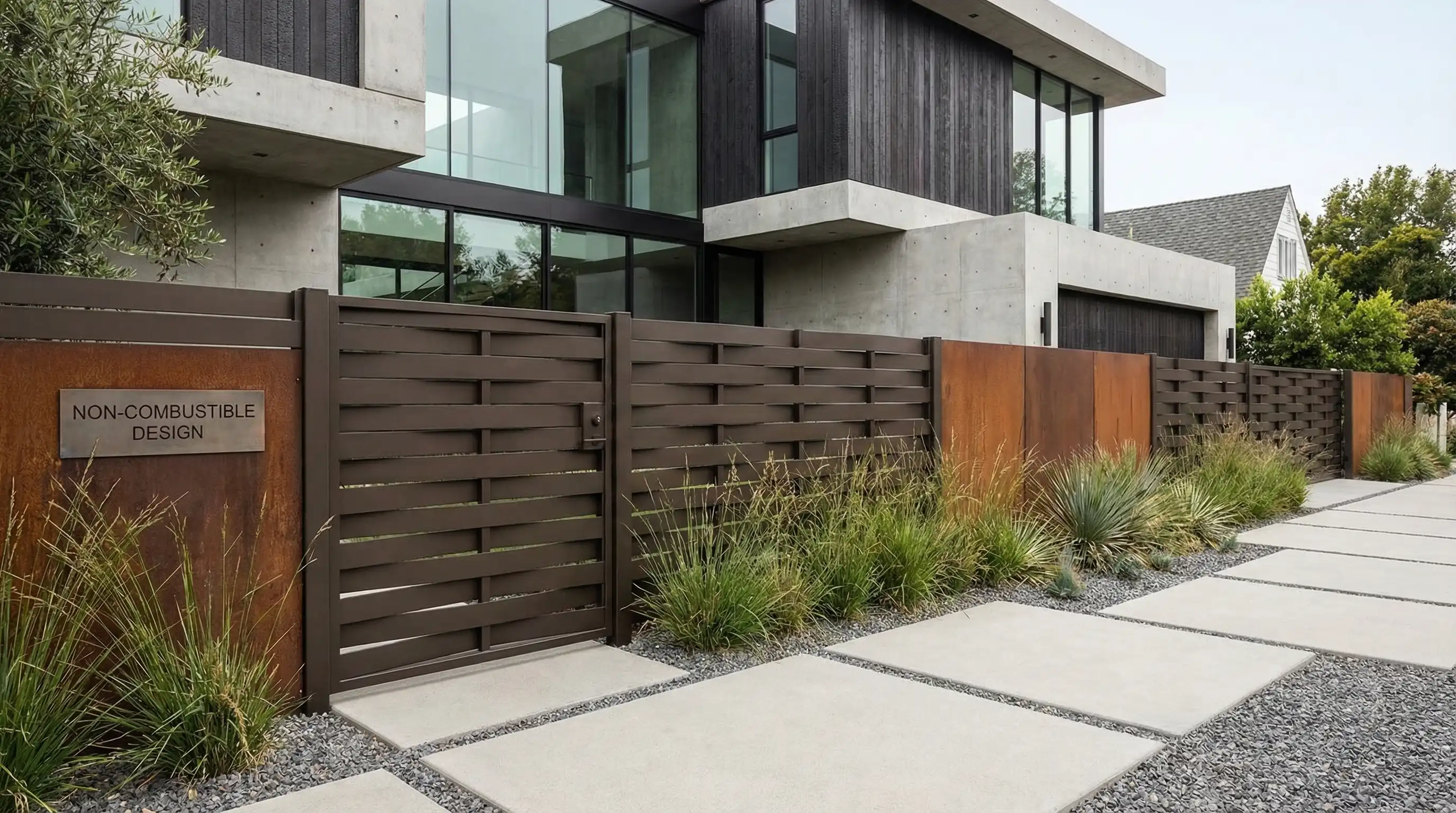
When California’s defensible space regulations say your fencing needs to be “non-combustible,” the next question is obvious: which non-combustible material is actually the best choice for your property? Aluminum, steel, gabion, and masonry all meet the standard, but they are very different products with different strengths, weaknesses, costs, and maintenance requirements.
This guide compares non-combustible fencing materials side by side — fire performance, durability, maintenance, cost factors, and practical considerations for San Diego properties. We also cover where composite and wood alternatives fall on the fire resistance spectrum, because understanding what does not qualify is just as important as knowing what does.
For the broader context on fire-resistant fencing requirements in San Diego, see our complete fire-resistant fencing guide. For a general comparison of all fencing materials (not just fire-rated), visit our fencing comparison page.
Need a non-combustible fence that still looks residential?
See aluminum fence systems built for coastal durability, clean lines, and fire-aware near-structure transitions.
Explore Aluminum FencingWhat “non-combustible” actually means
Before comparing materials, it is important to understand what “non-combustible” means in a regulatory and testing context. It is not a casual term — it has a specific technical definition.
The ASTM E136 standard
ASTM E136 is the Standard Test Method for Assessing Combustibility of Materials Using a Vertical Tube Furnace, published by ASTM International [1]. It is the primary test used to determine whether a building material is non-combustible.
In the ASTM E136 test:
- A specimen is placed in a tube furnace stabilized at 750 degrees Celsius (approximately 1,382 degrees Fahrenheit)
- The specimen is observed for ignition (sustained flaming)
- Temperature rise at the center of the specimen is measured
- Weight loss is measured
A material passes ASTM E136 — and is classified as non-combustible — if it meets all of these criteria [1]:
- No sustained flaming is observed during the test
- The temperature at the center of the specimen does not rise more than 30 degrees Celsius above the furnace temperature during the first 30 minutes
- The specimen does not lose more than 50 percent of its initial weight
Materials that pass ASTM E136 include metals (aluminum, steel, copper), masonry (concrete, brick, stone), glass, and certain mineral-based products.
ASTM E84: a different test entirely
You will sometimes see references to ASTM E84, the Standard Test Method for Surface Burning Characteristics of Building Materials [2]. ASTM E84 is often confused with ASTM E136, but they test completely different things.
ASTM E84 measures surface burning characteristics — specifically flame spread index (FSI) and smoke developed index (SDI). Materials are classified based on their FSI:
| Class | Flame spread index | Examples |
|---|---|---|
| Class A | 0 to 25 | Cement board, some treated composites, metal |
| Class B | 26 to 75 | Some treated woods, certain composites |
| Class C | 76 to 200 | Untreated wood, many plastics |
A Class A rating under ASTM E84 does not mean non-combustible. It means the material has a low flame spread rate when tested in the specific conditions of the Steiner tunnel test. A material can achieve Class A under ASTM E84 and still be combustible — meaning it will ignite and burn under sufficient heat.
This distinction matters because some composite fencing products are marketed with “Class A fire rating” language, which sounds impressive but does not mean they qualify as non-combustible under ASTM E136 or for Zone 0 compliance.
IBC Chapter 7 and the code context
The International Building Code (IBC) Chapter 7 addresses fire-resistance-rated construction and defines how non-combustible materials are used in building assemblies [3]. Under IBC Section 703.5, materials are required to be tested per ASTM E136 to be classified as non-combustible. This is the same framework that California building codes reference for material classification.
For fencing in California’s defensible space zones, the practical takeaway is: if a material passes ASTM E136, it is non-combustible. If it has a Class A rating under ASTM E84, it may be fire-resistant but is not necessarily non-combustible.
Your AHJ (Authority Having Jurisdiction) makes the final determination on what is acceptable for your specific property. When in doubt, non-combustible materials tested under ASTM E136 are always the safer choice for Zone 0.
Aluminum fencing
Aluminum is the most widely used non-combustible fencing material for residential Zone 0 applications in San Diego. Here is why — and where it falls short.
Fire performance
Aluminum is non-combustible under ASTM E136 [1]. It does not ignite, does not sustain combustion, and does not contribute fuel to a fire. Aluminum has a melting point of approximately 1,220 degrees Fahrenheit (660 degrees Celsius) — meaning it will melt in an intense fire but will not burn.
In practical wildfire scenarios involving ember exposure and radiant heat, aluminum fencing will not ignite. In an extreme direct-flame scenario (such as a fully engulfed structure fire or a high-intensity wildfire overrun), aluminum can deform or melt, but it will not contribute additional fuel to the fire.
Advantages
- Lightweight. Aluminum is significantly lighter than steel, making it easier to transport, handle, and install. This is especially beneficial on hillside properties with limited equipment access — common in San Diego neighborhoods like Scripps Ranch, Tierrasanta, and hillside communities in North County.
- Corrosion-resistant. Aluminum naturally forms an oxide layer that protects it from corrosion. With a quality powder coat finish, aluminum fencing performs well in San Diego’s coastal environments. This is a meaningful advantage over steel for properties in La Jolla, Del Mar, Encinitas, Carlsbad, and other coastal communities.
- Low maintenance. Powder-coated aluminum fencing requires only occasional rinsing with water to maintain its appearance. No painting, staining, or sealing required.
- Design versatility. Available in a wide range of styles — vertical picket, horizontal slat, privacy panel — and powder coat colors. Adapts well to San Diego’s architectural diversity, from Spanish Colonial to contemporary.
- Cost-effective. Generally less expensive per linear foot than steel fencing, and significantly less expensive than masonry.
Limitations
- Lower structural strength than steel. For equivalent profiles, aluminum is not as strong as steel. This rarely matters for residential fencing but can be a factor in high-wind or high-impact applications.
- Will melt in extreme heat. While non-combustible, aluminum will deform or melt in direct, sustained flame contact. This is a theoretical concern for fencing (the fence may be damaged in a fire, but it will not contribute to the fire spreading).
- Limited for heavy-duty applications. If you need a very tall security fence or a fence that must resist significant physical force, steel may be more appropriate.
Best applications in San Diego
Aluminum is ideal for side-yard fences, front-yard fences, courtyard fences, and property-line fences where Zone 0 compliance, low maintenance, and modern aesthetics are priorities. It is the material Modern Fence & Deck installs most frequently for Zone 0 projects. Learn more on our aluminum fencing page, or see how we approach near-structure details on our Zone 0 fencing service page.
Steel fencing
Steel is the other major non-combustible metal fencing option. It overlaps with aluminum in fire performance but differs significantly in other characteristics.
Fire performance
Steel is non-combustible under ASTM E136 [1]. It has a melting point of approximately 2,500 degrees Fahrenheit (1,370 degrees Celsius) — roughly twice that of aluminum. In practical terms, steel fencing will neither ignite nor deform in any realistic wildfire ember exposure scenario.
Advantages
- Higher structural strength. Steel is stronger than aluminum for equivalent cross-sections, allowing thinner profiles and longer unsupported spans.
- Higher melting point. Steel maintains structural integrity at higher temperatures than aluminum.
- Architecturally distinctive. Steel can be fabricated into very specific profiles, ornamental details, and custom designs that may not be achievable in aluminum.
- Excellent for security applications. The strength of steel makes it the preferred choice for security fencing, commercial applications, and high-abuse environments.
Limitations
- Corrosion-prone. Steel (except stainless steel) will rust if the protective coating is compromised. In San Diego’s coastal areas, this is a real concern. Galvanizing, powder coating, or both are necessary, and any damage to the coating must be addressed promptly.
- Heavier. Steel’s weight increases transportation, handling, and installation costs compared to aluminum. On hillside properties with limited access, this can be a significant factor.
- Higher maintenance. Steel fencing requires more attention to coating integrity than aluminum. Scratches, chips, and areas where the coating wears through need touch-up to prevent rust.
- Generally more expensive. Steel fencing typically costs more than aluminum for equivalent residential applications, driven by both material and labor costs.
Best applications in San Diego
Steel fencing makes the most sense for security applications, commercial properties, very specific architectural designs that require steel’s fabrication properties, and properties where the higher melting point provides meaningful additional protection (rare in typical residential fencing). For standard residential Zone 0 applications in San Diego, aluminum is usually the more practical choice.
Gabion walls
Gabion walls — stone or rock fill contained in wire mesh cages — are an inherently non-combustible fencing and retaining option that works particularly well on certain San Diego properties.
Fire performance
Gabion walls are non-combustible. Both components — the stone fill and the steel wire mesh cages — are non-combustible under ASTM E136 [1]. Gabion walls provide a solid, heavy barrier that effectively blocks radiant heat and flame spread. In wildfire scenarios, gabion walls are among the most robust fire barriers available for residential boundary applications.
Advantages
- Inherently non-combustible. No coatings or treatments needed for fire resistance — the materials themselves cannot burn.
- Excellent retaining capability. Gabion walls can serve double duty as both a fence/boundary wall and a retaining structure, which is common on San Diego’s hilly terrain.
- Natural aesthetic. The stone-fill look works well with San Diego’s natural landscape, especially in hillside and canyon-adjacent communities.
- Drainage-friendly. Gabion walls allow water to pass through, which is an advantage on slopes where drainage matters.
- Extremely durable. Properly installed gabion walls have a very long lifespan with minimal maintenance.
Limitations
- Not a privacy fence in the traditional sense. Gabion walls are typically solid and heavy — they provide privacy but are a fundamentally different product from a picket or slat fence.
- Higher cost. Material volume and installation labor make gabion walls more expensive per linear foot than aluminum or steel fencing.
- Footprint. Gabion walls are thicker than fence panels, requiring more ground space. On narrow side yards, this can be a constraint.
- Installation complexity. Gabion walls require proper foundation preparation, especially in retaining applications. This is not a DIY project.
Best applications in San Diego
Gabion walls are excellent for properties with retaining conditions, hillside properties, canyon-edge boundaries, and properties where a natural stone aesthetic is desired. They are particularly common in communities like Rancho Santa Fe, parts of Poway, and hillside neighborhoods throughout the county. Learn more on our gabion walls page.
Masonry / CMU block walls
Concrete masonry unit (CMU) block walls are the traditional gold standard for non-combustible boundary walls in Southern California.
Fire performance
Masonry is non-combustible under ASTM E136 [1]. CMU block walls provide fire-resistance ratings that can exceed 4 hours depending on wall thickness and construction details, as rated under ASTM E119 (Standard Test Methods for Fire Tests of Building Construction and Materials) [4]. A properly constructed masonry wall can provide substantial fire separation, but performance depends on wall design, openings, exposure, installation details, and AHJ review.
Advantages
- The highest level of fire protection available in residential boundary construction. A masonry wall is a true fire barrier.
- Complete privacy. Solid masonry walls provide total visual and acoustic privacy.
- Extremely long lifespan. Well-built masonry walls can last 50 years or more with minimal maintenance.
- Structural capability. Masonry walls can be engineered to serve as retaining walls, sound walls, and property boundaries simultaneously.
- No coating or finish required for fire protection. The material itself is inherently non-combustible.
Limitations
- Highest cost. Masonry block walls are typically the most expensive fencing option per linear foot, driven by material volume, reinforcing steel, foundation requirements, and skilled labor.
- Requires engineering on slopes. Masonry walls on San Diego’s hilly terrain often require engineering, permits, and footings that add to project cost and timeline.
- Visual weight. A masonry wall can feel imposing, especially at taller heights. Design treatments (stucco finish, cap details, integrated planters) can soften the appearance but add cost.
- Not easily modified. Once built, masonry walls are difficult and expensive to relocate or modify.
Best applications in San Diego
Masonry block walls are ideal for property-line boundaries, noise-sensitive locations, retaining walls that also serve as property boundaries, and properties where maximum fire protection and total privacy are the priorities. They are common throughout San Diego County, especially on property lines between residential lots. See our block walls page for more information.
Composite and wood: where they fall on the fire scale
While this guide focuses on non-combustible materials, many San Diego homeowners ask about composite and wood fencing in the context of fire safety. Understanding where these materials fall is important for making informed decisions.
Composite fencing
Composite fencing is made from a mixture of wood fibers and plastic polymers (typically polyethylene or polypropylene). It is a combustible material — it will ignite and burn under sufficient heat exposure.
Some composite fencing products carry Class A fire ratings under ASTM E84 [2], meaning they have a flame spread index of 0 to 25. This is the lowest (best) flame spread classification and indicates the material does not spread flame rapidly across its surface in the Steiner tunnel test.
However — and this is critical — Class A under ASTM E84 is not the same as non-combustible under ASTM E136. A Class A composite product will still ignite and burn under sustained fire exposure. It just spreads flame more slowly than a Class B or Class C material.
For Zone 0 applications, composite fencing is generally not recommended because it is combustible. For areas beyond Zone 0 (Zone 1 and beyond), a Class A composite product provides better fire performance than untreated wood but does not match the fire performance of a truly non-combustible material.
Wood fencing
Wood is combustible. Untreated wood fencing typically falls in the Class C range under ASTM E84 (flame spread index of 76 to 200), meaning it spreads flame relatively rapidly [2].
Fire-retardant-treated (FRT) wood can achieve Class A or Class B ratings under ASTM E84, but it is still combustible. The treatment slows ignition and flame spread but does not make the wood non-combustible. FRT wood will eventually ignite under sustained heat or ember exposure.
For Zone 0, wood fencing — including FRT wood — is generally not appropriate. The entire purpose of Zone 0 is to eliminate combustible materials in the first 5 feet around the structure, and wood, by definition, is combustible.
Wood fencing may still be appropriate beyond Zone 0, depending on your AHJ’s requirements and your property’s fire hazard designation. But if you are in an area where defensible space regulations apply, reducing combustible fencing throughout your property improves overall fire resilience.
Comparison table
The following table summarizes the key characteristics of each material. Cost ranges are intentionally general because actual costs vary significantly based on project specifics (linear footage, terrain, access, gate configurations, and local labor rates). Contact Modern Fence & Deck at (619) 975-1883 or request a quote for pricing specific to your project.
| Characteristic | Aluminum | Steel | Gabion | Masonry (CMU) | Composite | Wood |
|---|---|---|---|---|---|---|
| ASTM E136 (non-combustible) | Yes | Yes | Yes | Yes | No | No |
| ASTM E84 class | N/A (non-combustible) | N/A (non-combustible) | N/A (non-combustible) | N/A (non-combustible) | Class A to C (varies) | Class B to C (varies) |
| Zone 0 appropriate | Yes | Yes | Yes | Yes | Generally no | No |
| Melting/failure point | ~1,220 F | ~2,500 F | Stone: extremely high; Wire: ~2,500 F | Extremely high | Varies (400-600 F) | Ignites ~450-500 F |
| Corrosion resistance | Excellent | Requires coating | Excellent (stone); Wire varies | Excellent | Good | Poor to moderate |
| Maintenance level | Low | Moderate | Very low | Very low | Low to moderate | High |
| Typical lifespan | 20-30+ years | 20-30+ years | 30-50+ years | 50+ years | 15-25 years | 10-20 years |
| Relative cost | Moderate | Moderate to high | High | Highest | Moderate | Lowest |
| Privacy options | Slat/panel styles available | Slat/panel styles available | Inherently solid | Inherently solid | Solid panels available | Solid boards available |
| Weight | Light | Heavy | Very heavy | Very heavy | Moderate | Moderate |
| Design flexibility | High | High | Moderate | Moderate | Moderate | High |
How to verify a product’s fire rating documentation
If a manufacturer or installer tells you their product is “fire-rated” or “non-combustible,” you should verify that claim. Here is what to ask for and what to look for.
Ask for the test report
Any legitimate fire rating claim should be backed by a test report from an accredited testing laboratory. The report should identify:
- Which test standard was used — ASTM E136 (non-combustibility) or ASTM E84 (surface burning) or both
- The specific product tested — Including material composition, thickness, and any coatings or treatments
- The testing laboratory — Should be an accredited lab (look for ISO/IEC 17025 accreditation or NVLAP accreditation)
- The test results — For ASTM E136: pass or fail. For ASTM E84: flame spread index and smoke developed index with class designation.
Look for ICC-ES Evaluation Reports
ICC Evaluation Service (ICC-ES) publishes evaluation reports for building products that include fire performance data [5]. An ICC-ES report (ESR number) provides independent verification that a product meets specific code requirements. If a fencing product has an ICC-ES report, it is a strong indicator of legitimate fire performance documentation.
Be skeptical of vague claims
Watch out for:
- “Fire-rated” without specifying which test — This is meaningless without knowing whether the claim refers to ASTM E136, ASTM E84, or something else.
- “Class A” without context — Class A under ASTM E84 is about flame spread, not combustibility. It does not mean non-combustible.
- Marketing language that implies non-combustibility — Terms like “fire-resistant,” “fire-conscious,” or “fire-smart” are not test classifications. They may be accurate descriptions, but they are not substitutes for verified test data.
- Ratings for individual components vs. the assembly — A product might have non-combustible panels but use combustible fasteners, caps, or other components. Ask about the complete assembly.
When in doubt, ask your AHJ
Your Authority Having Jurisdiction has the final say on whether a specific product meets local requirements. If you are uncertain about whether a product qualifies for Zone 0 installation, bring the manufacturer’s fire test documentation to your AHJ and ask for their determination.
Choosing the right material for your San Diego property
The “best” non-combustible fencing material depends on your specific situation. Here is a simplified decision framework:
Choose aluminum if:
- You need Zone 0 compliance with a modern residential fence
- You are in a coastal area and corrosion resistance matters
- You want low maintenance
- You want design flexibility (colors, styles, privacy options)
- Budget is a consideration
Choose steel if:
- You need higher structural strength (security, commercial, or high-abuse applications)
- You have a specific architectural design that requires steel fabrication
- Maximum temperature resistance is important for your risk profile
Choose gabion if:
- You have retaining conditions on your property
- You want a natural stone aesthetic
- You are on a hillside or canyon-edge property
- You want an extremely durable, maintenance-free barrier
Choose masonry if:
- Maximum fire protection is the priority
- You need total visual and acoustic privacy
- You have a property-line wall that also serves a retaining or structural function
- Long-term value over decades is more important than initial cost
For most residential Zone 0 fencing projects in San Diego, aluminum is the most practical choice. It provides non-combustible fire performance, works well in San Diego’s coastal and inland environments, requires minimal maintenance, and offers the widest range of design options at a reasonable cost.
For help deciding what makes sense for your property, call Modern Fence & Deck at (619) 975-1883 or request a quote. We install aluminum, steel, gabion, and masonry fencing throughout San Diego County and can help you evaluate the options for your specific conditions.
For more on how material choices affect insurance, see our guide on insurance benefits of fire-resistant fencing. For the regulatory context behind these material requirements, read our guides on California defensible space zones and AB 3074 compliance.
You can also explore material options on our service pages: aluminum fencing, gabion walls, block walls, and our fire ratings reference. For a broader look at all fencing materials including composites and hardwoods, visit our best fence material guide for San Diego.
Sources
-
ASTM International. “ASTM E136 — Standard Test Method for Assessing Combustibility of Materials Using a Vertical Tube Furnace.” West Conshohocken, PA. astm.org
-
ASTM International. “ASTM E84 — Standard Test Method for Surface Burning Characteristics of Building Materials.” West Conshohocken, PA. astm.org
-
International Code Council (ICC). “International Building Code (IBC), Chapter 7 — Fire and Smoke Protection Features.” iccsafe.org
-
ASTM International. “ASTM E119 — Standard Test Methods for Fire Tests of Building Construction and Materials.” West Conshohocken, PA. astm.org
-
ICC Evaluation Service (ICC-ES). “Evaluation Reports.” icc-es.org
Need a real project recommendation rather than a material summary? Compare aluminum, steel, block and gabion against your span, privacy, access and exposure, then confirm requirements with your local jurisdiction (AHJ).
Verification note (updated March 26, 2026): Regulatory requirements can vary by parcel, jurisdiction, and inspection cycle. Confirm current requirements with your AHJ and official California sources before final design or contract decisions: PRC 4291, Board of Forestry Zone 0 updates, and OSFM FHSZ maps.