Insurance benefits of fire-resistant fencing: what San Diego homeowners should know
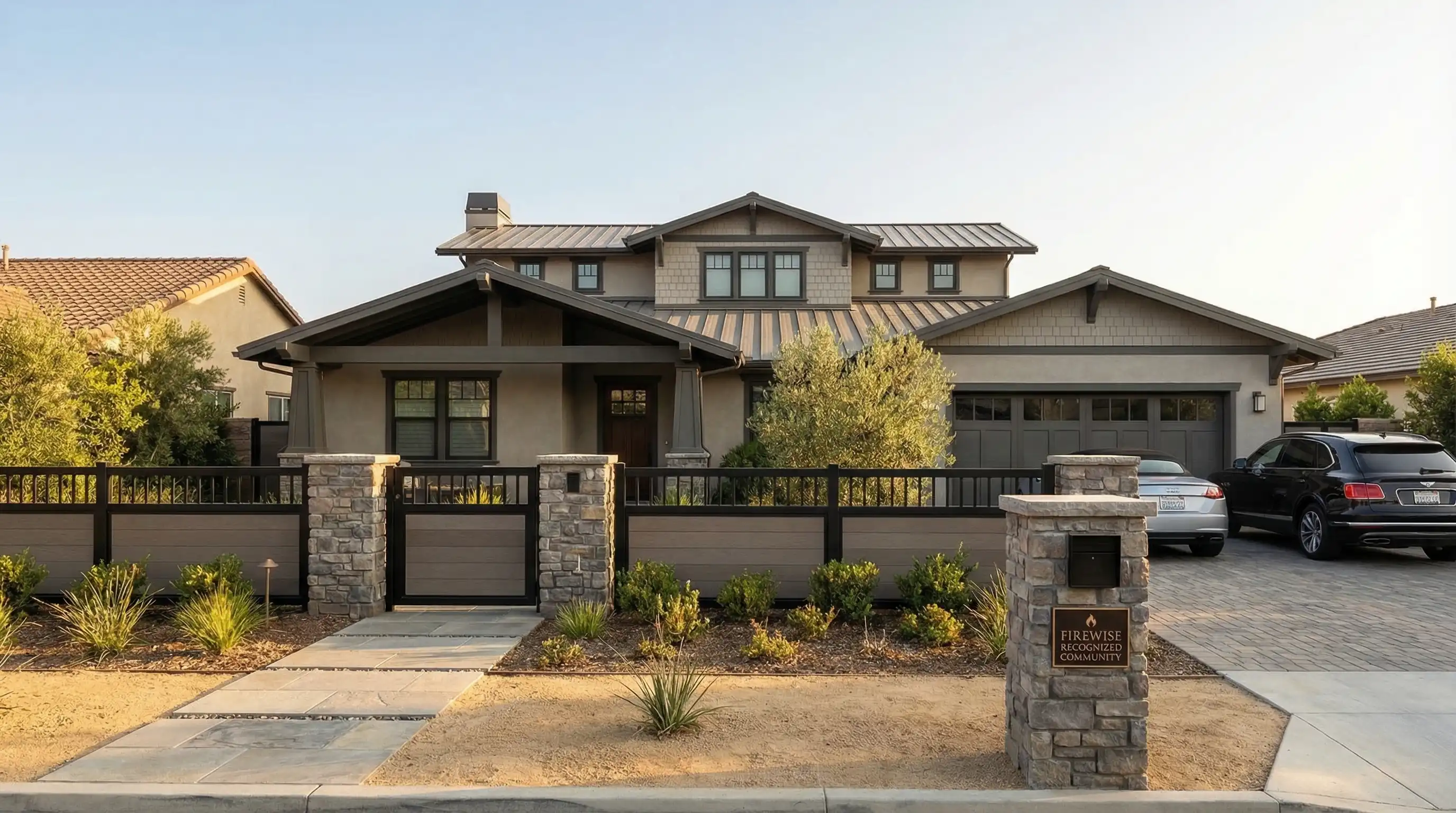
If you live in a wildfire-prone area of San Diego County, your homeowner’s insurance situation has probably changed in the last few years — and not for the better. Non-renewals, steep rate increases, and entire insurers pulling out of the California market have made wildfire insurance one of the most pressing financial concerns for homeowners in communities like Poway, Ramona, Rancho Santa Fe, Scripps Ranch, Tierrasanta, and the unincorporated backcountry.
What many homeowners do not realize is that the steps you take to harden your home against wildfire — including replacing combustible fencing with fire-resistant materials — can directly affect your insurability, your premiums, and your options. This is not about a simple “install aluminum fence, get a discount” equation. It is about how fencing fits into a broader home hardening strategy that insurers, regulators, and industry standards organizations are increasingly recognizing and rewarding.
This guide explains the connection between fire-resistant fencing and homeowner’s insurance in California: what the research says, what frameworks exist for discounts, what documentation matters, and what practical steps you can take. We will stick to verifiable facts and official programs — not speculation about what might happen someday.
Need a Zone 0 planning review?
Review near-structure material options and get parcel-specific guidance before you finalize your layout.
See Zone 0 FencingFor the broader picture on fire-resistant fencing — materials, fire performance, and compliance — see our complete fire-resistant fencing guide for San Diego homeowners.
The wildfire insurance problem in California
Before discussing how fencing fits in, it is important to understand why insurance has become such a challenge for California homeowners in fire-prone areas.
What has happened
Over the past several years, multiple major insurance carriers have reduced their exposure in wildfire-prone areas of California. Some have stopped writing new policies in high-risk zip codes entirely. Others have non-renewed existing policies at renewal time. Still others have remained in the market but increased premiums dramatically to reflect what they calculate as the true wildfire risk [1].
The reasons are straightforward from the insurers’ perspective: wildfire losses in California have been catastrophic. The 2017 and 2018 fire seasons alone produced insured losses exceeding $30 billion according to the California Department of Insurance (CDI) [1]. Insurers have responded by restricting coverage in the areas they consider highest risk.
The California Department of Insurance response
CDI has taken multiple regulatory actions to address the crisis:
- Non-renewal moratoriums — CDI has issued moratoriums preventing insurers from non-renewing policies in areas affected by recent wildfires, typically lasting one year from the date of a declared disaster [1]
- Sustainable Insurance Strategy — CDI has pursued regulatory reforms to encourage insurers to remain in the California market while providing pathways for risk mitigation to be factored into pricing [2]
- Wildfire mitigation requirements — CDI has pushed for regulations that require insurers to consider home hardening and defensible space when evaluating risk and setting rates
The regulatory landscape is actively evolving. CDI’s stated goal is to create a market where homeowners who invest in wildfire mitigation are rewarded with improved availability and pricing, rather than being treated the same as unmitigated properties.
What this means for San Diego homeowners
In San Diego County, the insurance challenge is concentrated in areas mapped as Very High Fire Hazard Severity Zones (VHFHSZ) and in State Responsibility Areas (SRA). If your property is in one of these designations, you have likely experienced at least one of the following:
- A non-renewal notice from your insurer
- A significant premium increase at renewal
- Difficulty finding a new insurer willing to write a policy
- Being directed to the California FAIR Plan as a last resort
The connection to fencing and home hardening: insurers are not just looking at whether your property is in a fire zone. They are increasingly looking at what you have done to mitigate the risk. This is where fire-resistant fencing enters the picture.
How home hardening affects insurability
The concept of home hardening — making physical improvements to a structure and its immediate surroundings to resist wildfire ignition — has moved from a fire safety recommendation to an insurance factor. Here is how.
The shift to property-level assessment
Historically, insurers assessed wildfire risk primarily at the community or zip code level. If your neighborhood was in a high-risk zone, your premium reflected that — regardless of what you personally did to mitigate the risk.
The industry is shifting toward property-level assessment, where the specific characteristics of your home and property — roof material, vent screening, defensible space, fencing material, and other factors — are evaluated individually. This shift is driven by both insurer loss experience and regulatory pressure from CDI [2].
Property-level assessment means that two homes on the same street can receive different risk evaluations if one has been hardened and the other has not. For homeowners who invest in mitigation, this is good news.
What insurers evaluate
While each insurer has its own underwriting criteria, the factors commonly evaluated for wildfire risk include:
- Roof material — Class A fire-rated roofing (composition, tile, metal) versus combustible materials (wood shake)
- Exterior siding and construction — non-combustible or ignition-resistant materials
- Vent and eave protection — screened vents, enclosed eaves
- Defensible space — vegetation management in Zones 0, 1, and 2
- Attached structures and fencing — combustible versus non-combustible materials within Zone 0
- Access — road width and condition for emergency vehicle access
- Water supply — proximity to fire hydrants or other water sources
- Fire protection — proximity to a fire station, fire department response capability
Fencing shows up in this evaluation because of its role in the Zone 0 ember-resistant zone. A combustible fence attached to a home is a documented ignition pathway — research by IBHS has shown that attached combustible structures, including fencing, are among the primary ways fire reaches homes during wildfire events [3].
IBHS Fortified Home and Wildfire Prepared Home programs
The Insurance Institute for Business & Home Safety (IBHS) is a research and standards organization funded by the insurance industry. Its programs directly influence how insurers evaluate homes, and understanding what IBHS recommends helps homeowners make decisions that align with insurance expectations.
What IBHS is
IBHS conducts large-scale, full-structure wildfire testing at its research facility, including tests that evaluate how embers, flames, and radiant heat interact with homes and attached structures. The research findings inform standards that many insurers reference when evaluating wildfire risk [3].
IBHS Wildfire Prepared Home
The IBHS Wildfire Prepared Home program identifies specific building features and property conditions that research has shown reduce wildfire vulnerability. The program evaluates:
- Roof — Class A fire-rated roofing assembly
- Vents — ember-resistant vent design
- Eaves and soffits — enclosed or protected
- Walls — ignition-resistant exterior cladding
- Windows — multi-pane or tempered glass
- Decking and attachments — non-combustible or ignition-resistant materials on decks, porches, and attached structures
- Zone 0 (immediate zone) — non-combustible materials within 5 feet, including fencing that attaches to or abuts the structure
- Zones 1 and 2 — vegetation management and fuel reduction
The program specifically addresses the immediate zone around the structure — what California calls Zone 0. IBHS research has demonstrated that the condition of this zone, including attached fencing, is among the strongest predictors of whether a home survives a wildfire [3].
How IBHS relates to insurance
While IBHS does not itself sell insurance or set rates, its research and standards are widely used by the insurance industry. Insurers that participate in IBHS — which includes many of the major carriers — often incorporate IBHS findings into their underwriting criteria. A home that meets IBHS Wildfire Prepared Home standards is, from an insurer’s perspective, a lower-risk property.
Some insurers offer explicit discounts or preferential underwriting for homes that meet IBHS designations. Others use the standards informally to evaluate mitigation efforts. The specifics vary by insurer, but the direction is clear: mitigation that aligns with IBHS research improves your standing with the insurance market.
California’s Safer from Wildfires framework
In addition to IBHS standards, California has developed its own regulatory framework for connecting wildfire mitigation to insurance benefits.
What it is
The Safer from Wildfires framework is a California Department of Insurance initiative that establishes standardized criteria for wildfire mitigation measures and creates a regulatory expectation that insurers will factor these measures into their underwriting and pricing [4].
The framework grew out of CDI’s broader effort to address the wildfire insurance crisis. The core principle: if homeowners invest in proven mitigation measures, insurers should recognize that investment through improved availability and pricing.
How it works
Under the Safer from Wildfires framework, CDI has identified categories of wildfire mitigation that insurers are expected to consider:
- Defensible space compliance — meeting PRC 4291 requirements for Zones 0, 1, and 2
- Home hardening — improvements to the structure itself (roof, vents, siding, windows, decking)
- Attached structure hardening — improvements to attached decks, porches, fences, and other features within Zone 0
- Community-level mitigation — participation in Firewise USA communities, proximity to fuel breaks, community-level fire protection improvements
The framework includes provisions requiring insurers to offer discounts or rating factors for verified mitigation measures [4]. The specifics of how much of a discount and for which measures are evolving as CDI works with insurers on implementation.
California Insurance Code Section 10103.7
Insurance Code Section 10103.7 is the statutory basis for requiring insurers to consider wildfire mitigation when making underwriting decisions [5]. The law requires admitted insurers to:
- Consider wildfire risk mitigation efforts undertaken by a property owner when making decisions about coverage availability, renewal, and pricing
- Provide clear information to policyholders about what mitigation measures may affect their coverage
This is significant because it moves mitigation recognition from a voluntary practice to a legal requirement. Insurers operating in California cannot simply ignore the work a homeowner has done to harden their property.
What this means for fencing
Fencing falls under the “attached structure hardening” and “defensible space compliance” categories of the Safer from Wildfires framework. Replacing combustible fencing in Zone 0 with non-combustible material directly addresses both:
- It removes a documented ignition pathway (home hardening)
- It brings the property into compliance with Zone 0 defensible space requirements (defensible space)
The framework does not promise a specific dollar amount of savings for replacing a fence — and you should be skeptical of anyone who claims otherwise. What it does is create a regulatory environment where your investment in fire-resistant fencing is supposed to be recognized and factored into your insurance evaluation.
How fire-resistant fencing fits whole-home hardening
Fire-resistant fencing is not a standalone insurance solution. It is one component of a whole-home hardening approach that, taken together, meaningfully reduces your wildfire risk profile.
The chain-of-ignition concept
Wildfire researchers describe home ignition in terms of a chain of ignition — the sequence of events that leads from an ember or flame source to structural ignition. The chain typically involves:
- Embers land on or near combustible materials around the home
- Initial ignition occurs in a receptive fuel bed — debris, mulch, vegetation, or combustible structures (including fencing)
- Fire spreads from the initial ignition to the structure via a connected combustible pathway
- Structural ignition — the home catches fire
Breaking any link in this chain reduces the probability of structural ignition. Replacing combustible fencing in Zone 0 breaks the chain by removing a pathway that fire can use to reach your home [3].
Where fencing ranks in the hardening priority list
From an insurance and fire safety perspective, the typical priority order for home hardening is:
- Roof — the single largest surface area exposed to embers; Class A fire-rated roofing is the highest-priority improvement
- Vents and eaves — ember entry points into the attic and structure
- Zone 0 combustible removal — including fencing, decking, and stored materials within 5 feet
- Windows — multi-pane or tempered glass to resist radiant heat
- Exterior walls — ignition-resistant siding and construction
- Zones 1 and 2 vegetation management — fuel reduction beyond the immediate zone
Fencing typically falls in the Zone 0 category (priority 3), which means it is a meaningful improvement but not the first thing to address if your roof is still wood shake. A whole-home approach addresses all of these categories, and the cumulative effect is what moves the needle with insurers.
For a comparison of non-combustible fencing materials that qualify for Zone 0 compliance, see our guide on non-combustible fencing materials compared.
The documentation difference
One of the most important things about fire-resistant fencing for insurance purposes is not just having it — it is being able to prove you have it. This is where many homeowners miss an opportunity.
What documentation insurers want to see
When you contact your insurer about wildfire mitigation measures — or when an insurer evaluates your property — having documentation ready makes a significant difference.
Material specifications
Keep the manufacturer’s product data sheet for your fencing material, which should include:
- Material composition (aluminum alloy grade, steel type, etc.)
- Fire classification (non-combustible per ASTM E136, or fire performance rating per ASTM E84 with documented flame spread index and smoke developed index) [6]
- Product name and manufacturer
Fire test reports
If your fencing material has been tested under ASTM E136 (non-combustibility) or ASTM E84 (surface burning characteristics), the test reports are valuable documentation. Your fencing installer or manufacturer should be able to provide these. ICC-ES evaluation reports, if available, compile this information in a standardized format recognized by building officials and increasingly by insurers.
Installation documentation
Keep records from your fencing installation:
- Contractor name and license number
- Date of installation
- Scope of work — what was installed, where, and what it replaced
- Invoice or receipt showing the materials specified
Before-and-after photographs
Photographs documenting the condition before and after fire-resistant fencing installation are surprisingly valuable:
- They demonstrate a proactive improvement
- They create a dated record of the work
- They can be included with insurance applications or mitigation documentation
Defensible space inspection reports
If your property has passed a defensible space inspection — whether from CAL FIRE, your local fire authority, or a voluntary evaluation — keep the documentation. A passed inspection is third-party verification that your property meets defensible space requirements, including Zone 0 compliance.
For more detail on what fire inspectors look for in Zone 0, see our guide on San Diego fire inspections and Zone 0.
How to present this to your insurer
When communicating mitigation measures to your insurer:
- Contact your agent or carrier directly — ask what mitigation measures they recognize and how to document them
- Provide a written summary of all improvements — roof, vents, fencing, landscaping, and other hardening measures
- Attach documentation — material specs, test reports, installation records, inspection reports, and photographs
- Ask specifically whether your improvements qualify for a mitigation discount under their underwriting criteria or under the Safer from Wildfires framework
- Get the response in writing — if the insurer acknowledges your mitigation or applies a discount, have it documented in your policy
Do not assume your insurer knows what you have done. The burden of documentation is on the homeowner. Make it easy for your insurer to see the improvement and factor it in.
The California FAIR Plan: last resort and path back
If you have been unable to obtain coverage from the standard insurance market, you have likely been directed to the California FAIR Plan.
What the FAIR Plan is
The California FAIR Plan Association is a shared-market mechanism — essentially an insurer of last resort — that provides basic fire insurance coverage to California property owners who cannot obtain coverage in the voluntary market [7]. FAIR stands for Fair Access to Insurance Requirements.
The FAIR Plan is not a government program. It is an association of all admitted property insurers in California, required by law to participate. It exists specifically for properties that the voluntary market will not cover.
FAIR Plan limitations
The FAIR Plan provides basic fire insurance coverage, which is more limited than a standard homeowner’s policy:
- Coverage may be limited — FAIR Plan policies have maximum coverage amounts that may be below the replacement cost of higher-value homes
- Fewer coverages — a FAIR Plan fire policy covers fire and related perils but not the broader coverage of a standard homeowner’s policy (you may need a separate “difference in conditions” policy for liability, theft, and other perils)
- Premiums can be high — FAIR Plan rates are not subject to the same competitive market forces as voluntary market rates
- Not designed for long-term use — the FAIR Plan is intended as a bridge, not a permanent solution
How home hardening helps you leave the FAIR Plan
The FAIR Plan should be viewed as temporary. The goal is to return to the voluntary insurance market, where coverage is broader, premiums are typically more competitive, and service is better.
Home hardening — including fire-resistant fencing — improves your chances of qualifying for voluntary market coverage because:
- It demonstrates proactive risk reduction to underwriters
- It may bring your property’s risk profile below the threshold that caused non-renewal
- Under Insurance Code Section 10103.7, voluntary market insurers are required to consider your mitigation efforts [5]
- The Safer from Wildfires framework creates a structured way for insurers to evaluate and credit your improvements [4]
If you are currently on the FAIR Plan, document every mitigation improvement you make and proactively shop the voluntary market at each renewal period.
Practical steps for San Diego homeowners
Here is a realistic, step-by-step approach to connecting fire-resistant fencing and home hardening to insurance benefits.
Step 1: understand your current insurance situation
- Review your current policy — know your coverage limits, premium, and renewal date
- Ask your agent or carrier directly: “What wildfire mitigation measures do you recognize for underwriting or pricing purposes?”
- If you have been non-renewed or cannot find coverage, contact the California FAIR Plan for bridge coverage while you work on mitigation
Step 2: assess your property’s fire risk
- Check your Fire Hazard Severity Zone designation using CAL FIRE’s FHSZ maps [8]
- Walk your Zone 0 and identify combustible materials — especially fencing that is within 5 feet of your home or attached to it
- Look at the full picture — roof, vents, eaves, siding, windows, decking, and fencing
Step 3: prioritize improvements
- Start with the highest-impact items: roof, vents, and Zone 0 combustible removal
- Replace combustible fencing in Zone 0 with non-combustible material (aluminum, steel, or masonry)
- Address vegetation management in Zones 0, 1, and 2
- See our guide on Zone 0 fencing costs in San Diego for budgeting information
Step 4: document everything
- Save material specifications, fire test reports, contractor invoices, and photographs
- Request a voluntary defensible space inspection and keep the results
- Create a dated record of every improvement
Step 5: communicate with your insurer
- Present your mitigation documentation to your insurer
- Ask about the Safer from Wildfires framework and any available mitigation discounts
- Reference Insurance Code Section 10103.7 if your insurer does not appear to be considering your mitigation efforts [5]
- If your current insurer does not recognize your improvements, shop other carriers — different insurers weight mitigation differently
Step 6: revisit annually
- Home hardening is not one-and-done — maintain your defensible space, keep fencing and other improvements in good condition, and update documentation as you make additional improvements
- Check the insurance market at each renewal — as the Safer from Wildfires framework matures, more insurers will be factoring mitigation into their pricing
- For seasonal maintenance considerations, see our guide on wildfire season preparation for San Diego
Frequently asked questions
Will replacing my fence lower my insurance premium? Replacing a combustible fence with a non-combustible fence, by itself, is unlikely to produce a large premium reduction. However, it is a recognized component of whole-home hardening that, combined with other improvements (roof, vents, defensible space), can improve your overall risk profile and affect your premium. The specific impact depends on your insurer’s underwriting criteria and how they apply the Safer from Wildfires framework.
Which insurers offer wildfire mitigation discounts? The specific insurers and discount amounts are not publicly standardized — they vary by carrier and change over time. Your best approach is to ask your agent directly and to shop multiple carriers. CDI’s Safer from Wildfires framework is designed to create more consistency across the market, but implementation is ongoing [4].
Does the FAIR Plan care about home hardening? The FAIR Plan provides coverage based on risk assessment. A hardened property is a lower-risk property, which can affect FAIR Plan pricing. More importantly, hardening your property improves your chances of qualifying for voluntary market coverage, which is the goal.
Do I need a specific type of fence to get insurance benefits? There is no single “insurance-approved” fence type. What matters is that fencing within Zone 0 is non-combustible — it will not ignite, burn, or contribute fuel during a wildfire. Aluminum, steel, iron, concrete, and masonry all qualify. The key is being able to document the fire performance of your fencing material. For a practical overview of your options, visit our Zone 0 aluminum fence guide.
Can my insurer non-renew me even after I have done home hardening? Under current law, insurers must consider your mitigation efforts, but consideration does not guarantee coverage [5]. An insurer can still make underwriting decisions based on the overall risk assessment of your property and area. However, a well-documented hardening program significantly improves your position — both with your current insurer and when shopping for alternatives.
What if my insurer does not seem to care about my improvements? If you believe your insurer is not properly considering your wildfire mitigation efforts as required by Insurance Code Section 10103.7, you can file a complaint with the California Department of Insurance [1]. CDI investigates complaints and enforces compliance with insurance regulations.
The bottom line
Fire-resistant fencing is not a magic solution for insurance problems. It is one practical, verifiable improvement that fits into a broader home hardening strategy — a strategy that California’s regulatory framework is increasingly designed to reward.
The insurance market for wildfire-prone areas is evolving, and the direction is clear: properties with documented mitigation will be treated more favorably than those without. Every non-combustible fence panel, every cleared Zone 0, every hardened vent and Class A roof contributes to a property that is both safer and more insurable.
If you are a San Diego homeowner dealing with insurance challenges in a fire-prone area, start with the highest-impact improvements, document everything, and communicate proactively with your insurer. Fire-resistant fencing in Zone 0 is a meaningful part of that equation.
Modern Fence & Deck installs non-combustible fencing for Zone 0 compliance throughout San Diego County. We can provide material specifications and fire test documentation that supports your insurance mitigation efforts. Call us at (619) 975-1883 or request a quote. For more information about our fire-resistant fencing options, visit our insurance and wildfire page.
Sources
-
California Department of Insurance (CDI). “Wildfire.” Consumer information, non-renewal moratoriums, and regulatory actions. insurance.ca.gov
-
California Department of Insurance (CDI). “Sustainable Insurance Strategy.” Regulatory framework for maintaining insurer participation in the California market while incorporating wildfire risk mitigation. insurance.ca.gov
-
Insurance Institute for Business & Home Safety (IBHS). “Wildfire Prepared Home.” Research on home ignition pathways, ember exposure, and structure-level mitigation measures including attached structures and fencing. ibhs.org
-
California Department of Insurance (CDI). “Safer from Wildfires.” Framework establishing standardized wildfire mitigation criteria and insurer requirements for recognizing mitigation measures. insurance.ca.gov
-
California Insurance Code Section 10103.7. Requires admitted insurers to consider wildfire risk mitigation efforts when making underwriting decisions regarding coverage availability, renewal, and pricing. leginfo.legislature.ca.gov
-
ASTM International. “ASTM E136 — Standard Test Method for Assessing Combustibility of Materials Using a Vertical Tube Furnace.” West Conshohocken, PA. astm.org
-
California FAIR Plan Association. Shared-market fire insurance for properties unable to obtain coverage in the voluntary market. cfpnet.com
-
CAL FIRE. “Fire Hazard Severity Zone Maps.” Office of the State Fire Marshal. osfm.fire.ca.gov
Verification note (updated March 26, 2026): Regulatory requirements can vary by parcel, jurisdiction, and inspection cycle. Confirm current requirements with your AHJ and official California sources before final design or contract decisions: PRC 4291, Board of Forestry Zone 0 updates, and OSFM FHSZ maps.