Zone 0 and Insurance premiums in Southern California: what homeowners can control (and what they can’t)
If you live in Southern California and you’ve renewed (or tried to renew) homeowners insurance recently, you’ve probably noticed the change: more inspections, more documentation, and more questions about defensible space. Zone 0 comes up a lot because it’s the easiest area for an inspector to see and measure—0–5 feet from the structure—and small material choices there can affect how embers behave.
This article explains Zone 0 and Insurance premiums in Southern California in plain language. We’ll cover what Zone 0 is (and where it applies), what insurers tend to focus on during wildfire mitigation reviews, and how fences, gates, and decks fit into the picture—especially in San Diego County, Orange County, and Los Angeles County, where conditions can swing from coastal moisture to dry canyon winds within a few miles.
You’ll also get practical, contractor-level guidance: what “non-combustible” usually means on an actual jobsite, how to plan a fence line that doesn’t act like a wick back to the house, and what kinds of photos and paperwork tend to make insurance conversations smoother. No promises—every carrier and policy is different—but you’ll leave with a clear sense of what you can control, what you should confirm with your AHJ (Authority Having Jurisdiction), and how to make upgrades that aren’t just for looks.
Planning a custom gate or design-forward upgrade?
See gate systems, finishes, and installation options built for Southern California properties.
Explore Custom GatesZone 0 rules in California, without the code-speak
Zone 0 is the first 5 feet, and it behaves differently than the rest of your yard
Zone 0 is the area 0–5 feet from your home or an attached structure. It’s treated differently because it’s where embers tend to land and pile up—in corners, against walls, under steps, and along connections like a fence meeting the house. In wind-driven fires, the main flame front may never reach your home. Embers can still do plenty of damage by finding one dry, ignitable spot right next to the structure.
In plain terms, Zone 0 is about getting rid of “easy ignition” stuff right up against the building. Think mulch pressed against stucco, a wood gate that touches the house, or a planter box jammed under a window. For a lot of homeowners, it’s also the most annoying zone because it overlaps with the things people actually use: landscaping, privacy screens, wood details, stored bins.
AB 3074 and “Zone 0” are related, but your local enforcement is what matters
California has been tightening guidance around ember-resistant construction and defensible space, including the idea of Zone 0. What you’re actually held to can change based on your property designation (like Very High Fire Hazard Severity Zone), city/county amendments, and what the inspector in front of your house decides to focus on.
So the most practical advice is simple: confirm requirements with your AHJ (Authority Having Jurisdiction)—your local building department or fire authority. In places like Poway, Rancho Santa Fe, Encinitas, and parts of Escondido near wildland edges, defensible space guidance is often treated like a baseline expectation, not a nice-to-have.
The fence and gate detail people miss: “attached” changes the conversation
A fence that’s fully freestanding is one thing. A fence that physically ties into your home is another.
If a wood fence is attached to the house, it can become a fuse during ember exposure—embers ignite the fence, and the fence brings flame right to your siding or eaves. A common Zone 0 approach is switching to non-combustible fencing (aluminum or steel) for the first section near the house, or building a non-combustible “break” where the fence meets the structure.
This is where things get practical fast: a small change at the connection point can reduce risk without forcing you to replace every linear foot of fence on the property.
How insurers look at wildfire mitigation (and where Zone 0 fits)
Insurance is underwriting, not code enforcement
It’s tempting to treat Zone 0 like a pass/fail checklist that automatically changes premiums. That’s usually not how it plays out.
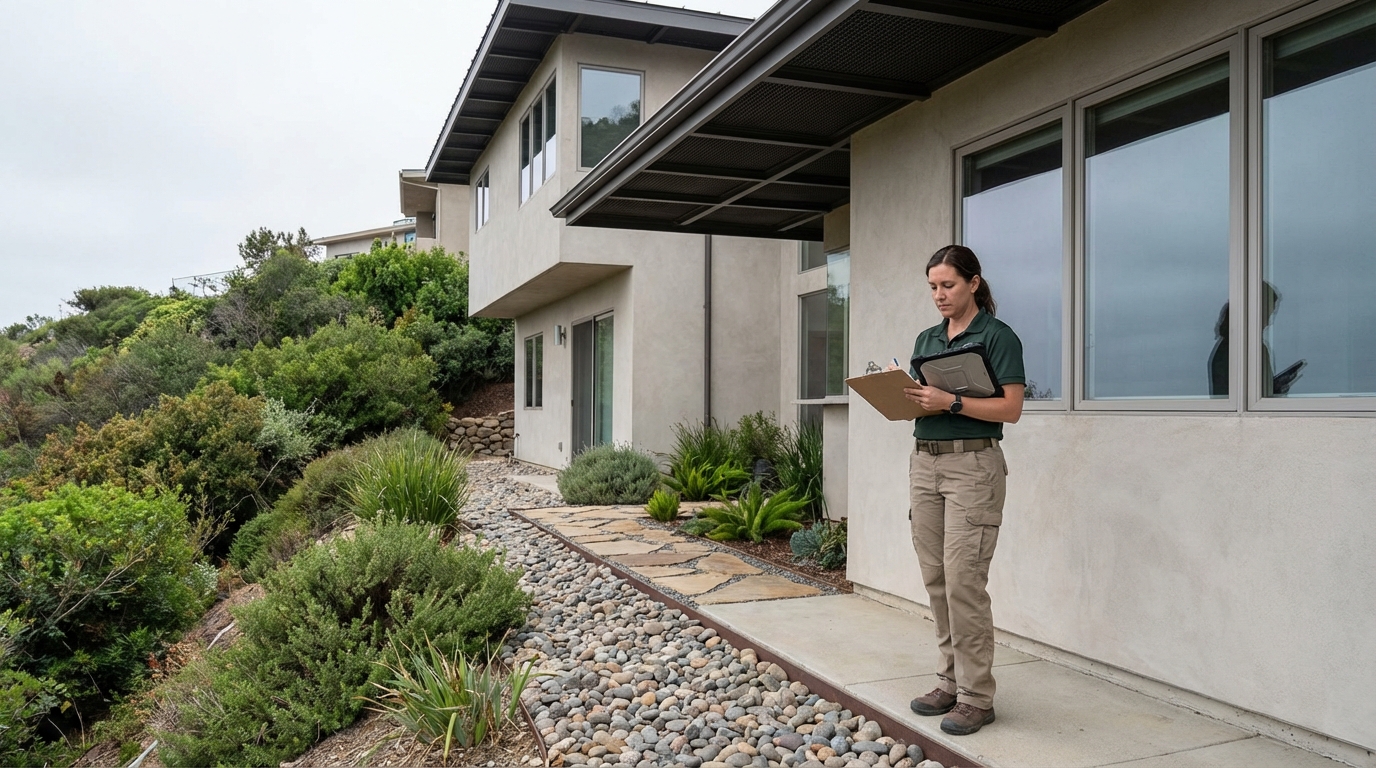
Carriers use underwriting guidelines that can include defensible space, roof condition, vents, proximity to brush, and property access. They might request photos, send an inspector, or rely on third-party imagery. Cleaning up Zone 0 can help your home look better in that review, but the outcome still depends on the carrier, claim history, and local risk.
So when we talk about Zone 0 and Insurance premiums in Southern California, the honest framing is: Zone 0 upgrades can remove obvious ignition hazards and may help with eligibility or reduce the number of required corrections. Premium pricing itself has more moving parts than that.
What gets flagged in real inspections: “combustible right next to the wall”
If you’ve ever read an insurance inspection report, the same themes show up again and again. Common flags include:
Dry mulch against the structure, especially under windows.
Wood lattice, wood fences, or wood gates touching the home.
Stored items along exterior walls.
Vegetation packed tightly near siding, vents, or corners.
Decking or steps with debris buildup underneath.
Zone 0 is where these problems tend to bunch up. It’s also where you can often make changes fast: swap mulch for rock, move storage, trim plants, replace a gate, or change how a fence ties into the house.
Documentation helps more than people expect
If you make a Zone 0 change, document it like you’re sending it to an underwriter who’s never set foot in your neighborhood.
Date-stamped photos. Wide shots plus close-ups.
Notes about materials (e.g., aluminum fence panel, steel posts).
If applicable, product sheets that describe materials as non-combustible.
If you worked with a contractor, keep the invoice and scope of work.
None of this guarantees a premium change. But it can cut down the back-and-forth and help you respond quickly if a carrier asks for proof.
The fence line problem: when privacy design conflicts with Zone 0
Wood fences aren’t “bad,” but the attachment detail is a known weak spot
Wood fencing is common in Southern California because it’s private, relatively affordable, and easy to repair. But wood burns—and ember exposure can be enough to light it up, especially when the fence is dry and weathered.
The issue usually isn’t “wood fence somewhere on the lot.” It’s wood fence connected directly to the house, sometimes paired with a wood gate that closes against the structure. If embers ignite the fence, the flame path can run straight to the building.
A workable compromise many homeowners choose: keep wood fencing for most of the perimeter, but switch to non-combustible aluminum fencing (or steel) for the first section near the house, or use a metal gate/frame where the fence meets the structure.
What “non-combustible” means for fencing materials
For fencing, the materials most commonly treated as non-combustible are aluminum and steel. They will not ignite from embers the way wood can. That does not remove every fire risk, but it removes one common ignition source right next to the structure.
Composite is its own category. A lot of composite products hold up well and resist rot and insects, but they aren’t automatically non-combustible. If you’re making a Zone 0 decision at a structure connection, ask for product documentation and confirm with your AHJ.
A real-world design detail: the 5-foot transition plan
Here’s a clean way to think about it if you want to line up with Zone 0 expectations without redesigning the whole yard:
Within 0–5 feet of the house, stick with non-combustible or ignition-resistant surfaces and cut down on “catch points” for debris.
At the 5-foot line, transition into your preferred privacy solution (wood, composite, or a different style), but avoid direct attachment that creates a flame path.
This kind of “transition plan” comes up a lot in places like Carlsbad, Del Mar, La Jolla, and Rancho Santa Fe, where side yards are tight and the fence naturally wants to tie into the house for privacy.
If you’re not sure where the 5-foot line really is, measure from the exterior wall—not from the edge of a patio slab or planter.
Decks, side yards, and the stuff that quietly fails Zone 0
The “under-deck” zone is where embers hide
Insurance conversations often stay focused on roofs and brush clearance. But embers also collect under decks and steps, especially where leaves and needles build up.
If you have a deck attached to the home, treat the first five feet around and beneath it with Zone 0 logic: keep it clear, avoid storing combustible items underneath, and don’t let landscape debris turn into fuel. If you’re changing materials, ask about fire performance and, just as important, how the assembly is detailed. It’s not only the board—it’s the gaps, the edges, and what ends up trapped underneath.
Side-yard pinch points: fences, gates, AC units, and storage
Side yards in Southern California often turn into utility corridors—trash bins, spare pavers, kids’ toys, a hose reel, maybe a shed. That’s also where fences run close to the home and where wind can drive embers.
A few practical changes that usually help:
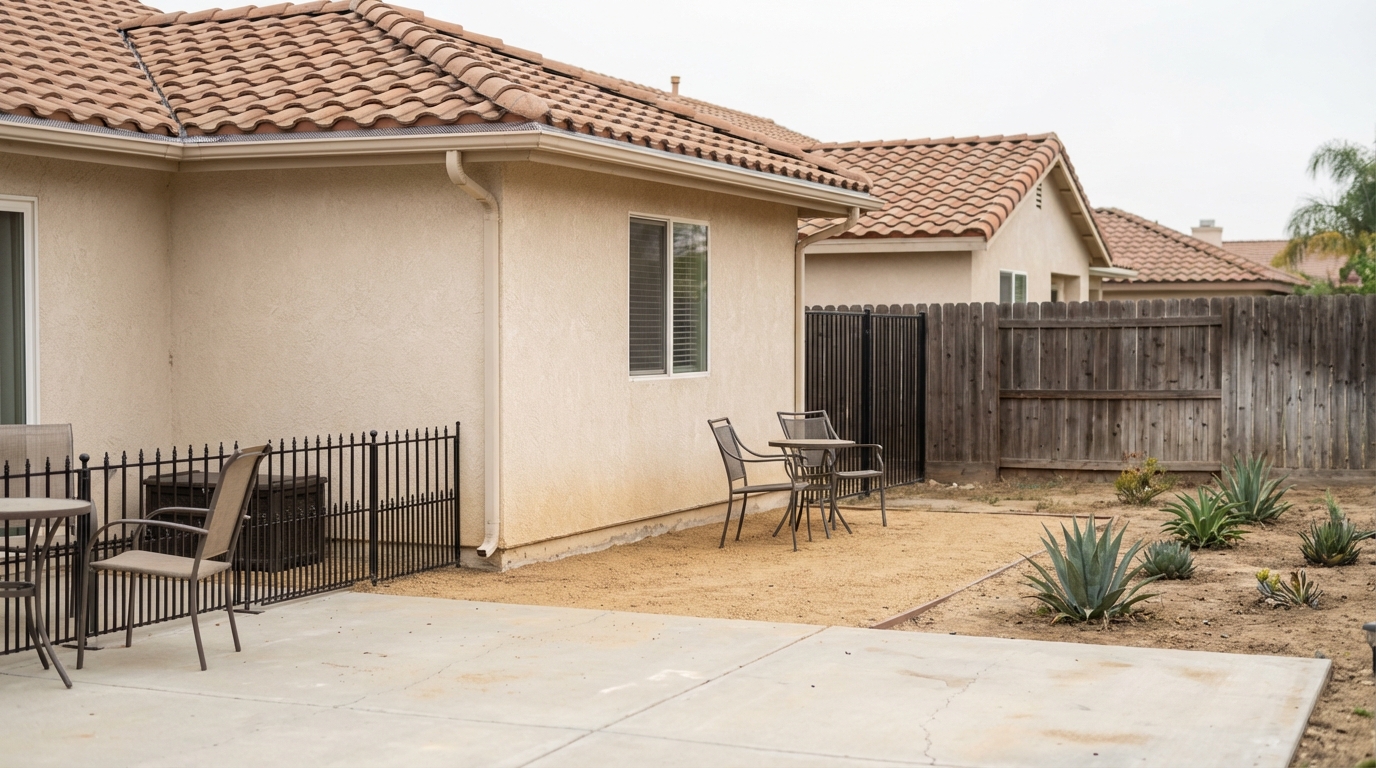
Keep combustible storage out of the 0–5 foot band.
If you need a gate near the house, consider aluminum or steel construction and avoid wood-to-wall contact.
Maintain clearance around HVAC equipment, and keep the pad area free of dry debris.
It’s not glamorous, but these are the details that show up clearly in inspection photos.
Hardscape choices that align with Zone 0 thinking
When homeowners ask what to do “instead of mulch,” the simplest options are usually the ones that last:
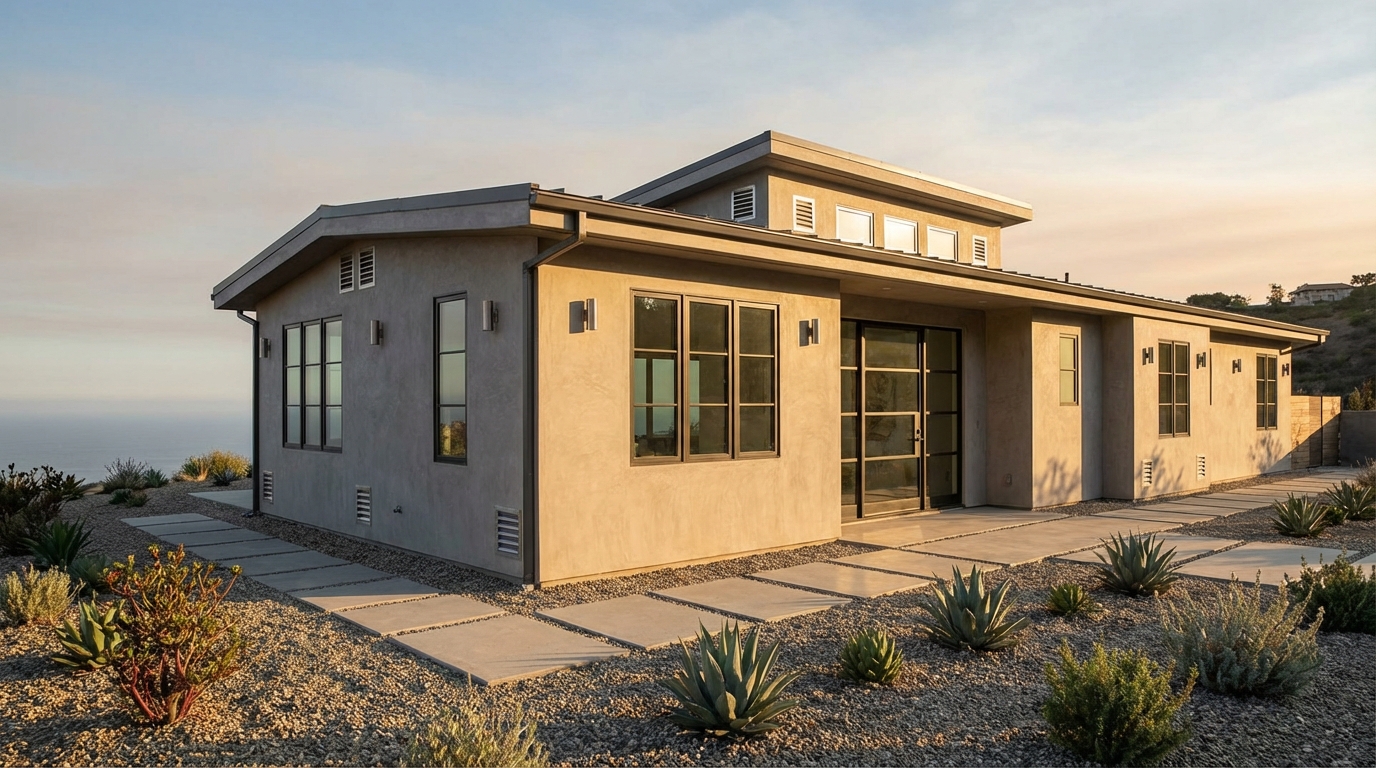
3/8" or 3/4" gravel over a weed barrier in ornamental areas.
Concrete, pavers, or decomposed granite where you need walkable space.
A clean border detail that keeps materials from creeping back to the wall.
These choices don’t guarantee anything with insurance, but they reduce ignition opportunities near the structure and cut maintenance. And in places like Irvine, Laguna Beach, Calabasas, and Pacific Palisades, lower-maintenance Zone 0 design often matters because properties are frequently managed by busy owners or property managers.
What to ask your insurer (and what to bring to the call)
Ask the right question: “What mitigation items affect eligibility for my policy?”
If you call and ask, “Will Zone 0 lower my premium?” you’ll often get a fuzzy answer—because pricing models are complicated and not always transparent.
A more useful question is: “What wildfire mitigation items affect eligibility, inspection outcomes, or required corrections for my policy?” Then ask what proof they’ll accept (photos, receipts, inspection forms).
Some carriers care most about defensible space documentation. Some focus on roof age and vents. Some use internal scoring based on location and loss history. Your goal is to figure out what actually moves the needle for your policy.
Bring a simple documentation packet
If you’ve upgraded a fence connection near the home or changed the first five feet around the structure, you want to show it clearly.
A practical “packet” can be as simple as:
A one-page note: address, date, what changed.
6–10 photos: corners, side yards, fence-to-house transition, gates.
Material notes: aluminum/steel vs wood, plus product spec sheets if you have them.
Contractor invoice or scope of work.
This keeps you from scrambling if you get a “please provide proof within X days” message.
Don’t let the AHJ and your insurer contradict each other
Your AHJ sets local rules and interprets state guidance. Your insurer sets underwriting requirements. They’re related, but they’re not the same.
If your insurer asks for something that conflicts with local requirements or HOA rules, stop and sort it out before you build. That might mean a call to the city/county fire authority, a quick HOA architectural review, or a design tweak (for example, changing a gate swing or using a different attachment detail).
The smoothest projects are the ones where the fence plan and defensible space plan match up before the first post hole gets dug.
Materials and details that tend to play well in Zone 0 designs
Aluminum fencing for the first section near the house
For Zone 0 areas, aluminum fencing is a common pick because it’s non-combustible and doesn’t usually need paint the way steel sometimes does near the coast.
In coastal San Diego neighborhoods like Encinitas, Del Mar, and Coronado, salt air can be tough on finishes. Powder-coated aluminum is often chosen for corrosion resistance, but it still benefits from an occasional rinse, especially close to the ocean.
From a design standpoint, aluminum can be privacy-forward (tighter spacing or panels) or more open to reduce debris catch. The right call depends on what you’re trying to solve: privacy, pets, pool code, or a mix.
Steel where you need strength (and how to manage corrosion)
Steel is also non-combustible and can make sense for security-focused gates, high-traffic entries, or commercial properties. In Southern California, the trade-off is corrosion control.
If you’re near the coast, ask about galvanization, coating specs, weld treatment, and what maintenance looks like. A steel gate can look perfect on day one and still start showing problems at edges and welds if it wasn’t protected correctly.
Fire ratings: what to ask about ASTM E84 / Class A
If a product is described as “Class A” under ASTM E84, that refers to surface burning characteristics (flame spread and smoke). It’s not the same as saying an entire fence assembly won’t ignite, and it doesn’t automatically mean a material is non-combustible.
Still, knowing the terminology helps when you’re comparing products or talking with inspectors. If you’re looking at composite or coatings, ask the manufacturer for documentation and clarify exactly what the rating applies to.
And always circle back to the AHJ. Some jurisdictions care more about defensible space layout than test language; others want both.
Conclusion: aim for fewer ignition opportunities, clearer documentation, and fewer surprises
Most homeowners aren’t trying to become wildfire mitigation specialists. They’re trying to keep coverage in place, avoid last-minute inspection fixes, and make upgrades that don’t look like a rushed patch job.
That’s where understanding Zone 0 and Insurance premiums in Southern California helps: Zone 0 is one of the few areas where small, visible changes can reduce obvious ignition hazards and make the property easier to underwrite. It won’t override regional risk or carrier decisions, and it won’t guarantee a premium drop. But it can cut down on the “combustible next to the structure” issues that tend to trigger correction notices.
If you’re planning fence or gate work, start with the fence-to-house connection and the first five feet around the structure. Decide where non-combustible materials make sense. Then document what you did so you’re not trying to recreate the details later when an inspector asks.
If you want a second set of eyes on a fence layout for a Zone 0-sensitive side yard—whether you’re in Poway, Rancho Santa Fe, Carlsbad, Irvine, Malibu, or Calabasas—Modern Fence & Deck can talk you through material options and connection details in plain language. And if your situation is complicated, we’ll tell you up front when the right next step is calling your AHJ or your insurance agent before you build.
FAQ
Does Zone 0 automatically lower insurance premiums in Southern California?
Not automatically. Zone 0 work can reduce visible ignition hazards and may help with inspection outcomes or eligibility, but premiums depend on your carrier’s pricing model, location risk, and policy details. Ask your insurer which mitigation items they actually count.
Can I keep a wood fence if I’m trying to follow Zone 0 guidance?
Sometimes, yes. A common approach is to avoid wood fencing attached to the home and use a non-combustible transition near the structure. Confirm the detail with your AHJ (Authority Having Jurisdiction).
What counts as non-combustible fencing?
In most residential fencing situations, aluminum and steel are treated as non-combustible. Composite products vary and aren’t automatically non-combustible. If you’re making a defensible space or Zone 0-related decision, request product documentation and confirm with your AHJ.
What should I photograph for an insurance inspection or reinspection?
Focus on the 0–5 foot band around the home: corners, side yards, fence-to-house connections, gates, under-deck areas, and anywhere debris collects. Wide shots plus close-ups usually work best.
Who sets the rules for Zone 0 on my property?
Your local AHJ sets and interprets requirements. Your insurance carrier sets underwriting guidelines. They’re related, but not the same, so it’s worth checking both before you start a project.
Verification note (updated March 26, 2026): Regulatory requirements can vary by parcel, jurisdiction, and inspection cycle. Confirm current requirements with your AHJ and official California sources before final design or contract decisions: PRC 4291, Board of Forestry Zone 0 updates, and OSFM FHSZ maps.