Rancho Bernardo fences that don’t feed embers: aluminum, steel, and composite options that make sense
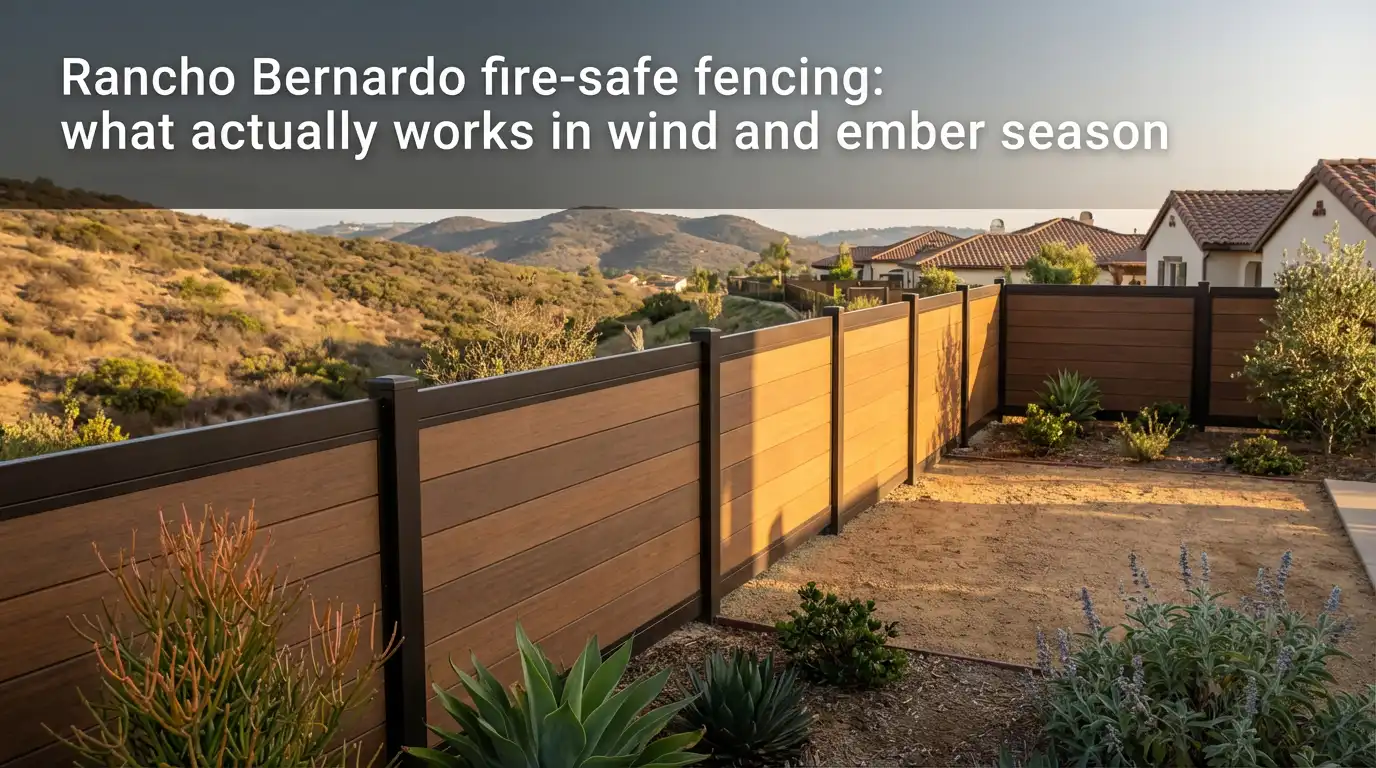
If you’ve lived through a hot, dry Santa Ana week in Rancho Bernardo, you’ve felt how fast things go from “nice evening walk” to “why does the air feel like a hair dryer?” That’s usually when homeowners start paying attention to the parts of the yard that can unintentionally carry fire right up to the house—often without thinking about it before.
One of the most common trouble spots is the fence line, especially where a side-yard fence ties into the exterior wall. That’s a big reason searches for Fire wise aluminum, steel and composite fencing. in Rancho Bernardo are up: people want something that looks current, holds up, and doesn’t add fuel in the exact spots where embers tend to land.
In this guide, I’ll walk through how non-combustible aluminum and steel fencing stacks up against composite fencing and composite decking, how Zone 0 thinking plays out around a real house, what AB 3074 fencing requirements do (and don’t) cover, and the Rancho Bernardo details that can change the answer from one block to the next.
Need a non-combustible fence that still looks residential?
See aluminum fence systems built for coastal durability, clean lines, and fire-aware near-structure transitions.
Explore Aluminum Fencing1) The local fencing reality in Rancho Bernardo (and why “fire wise” isn’t just a buzzword)
Rancho Bernardo sits in San Diego’s inland north corridor where vegetation, canyons, and wind patterns all play a part. Some neighborhoods sit right up against open space and slopes—places like Westwood, Sabre Springs (near the RB edge), and pockets around 4S Ranch-adjacent areas—where ember exposure isn’t just theoretical.
A lot of the fencing around Rancho Bernardo is older wood: vertical board, board-on-board, and cap-and-trim styles that went in because they were affordable and easy to patch. The catch is simple: wood burns. And fence lines are often exactly where leaves and mulch stack up.
Here’s what usually pushes local homeowners toward non-combustible fencing:
You’ll see the classic “fence-to-house connection” at side yards and back corners. That junction is a magnet for embers, especially when gate hardware, lattice, or trim creates little ledges.
You’ll also see perimeter fences along greenbelts and canyon edges. Even if the house is set back, a wood fence can act like a fuse if there’s a long, unbroken run.
And then there’s maintenance. Rancho Bernardo sun is hard on finishes. Paint and stain fade, boards twist, repairs turn into a patchwork project. Metal fencing skips the rot/termite/warp cycle that steals weekends.
A quick, plain-language note on Zone 0 and AB 3074
Zone 0 is the “0 to 5 feet from the building” area used in California defensible space discussions. The idea is straightforward: cut down ignition opportunities right next to the structure, where embers like to pile up.
AB 3074 is a California bill that directed the state to develop ember-resistant building standards for the “Zone 0” area. For homeowners, the day-to-day takeaway looks like this: more inspectors, HOAs, and insurers are asking specific questions about what’s right next to the house—even when the exact rule set doesn’t apply the same way to every address.
One more term you’ll hear: AHJ (Authority Having Jurisdiction). That’s the local agency that interprets and enforces rules for your property (often your local fire authority and building department). When two neighbors get slightly different answers, the AHJ is usually the reason.
2) Why Rancho Bernardo homeowners choose aluminum, steel, or composite (and when each one makes sense)
There isn’t one “best” fence material for every property. It comes down to where the fence sits, what it connects to, and how much maintenance you’re willing to live with.
Aluminum fencing: non-combustible, clean lines, low upkeep
Aluminum is non-combustible. It won’t ignite from embers the way wood can. That makes it a practical pick for side yards, pool fencing, and runs that come close to the house.
On a lot of Rancho Bernardo homes, aluminum also just fits visually. Many yards mix stucco, tile roofs, and drought-tolerant landscaping. A powder-coated aluminum fence (often black or bronze) usually reads as intentional with that architecture.
A few practical notes we share with homeowners:
Aluminum fencing works well when you want visibility—along a slope or near a view corridor. It’s also easier to keep clear of debris than a solid wood fence.
It’s not the best choice for full privacy unless you’re using a panel system made for it. If privacy is the goal, steel or a composite privacy system is often a better match.
Powder coating matters. Ask what coating system they’re using and what the warranty actually covers (chalking, fading, corrosion).
Steel fencing: non-combustible and strong, especially for privacy and security
Steel is also non-combustible, and it’s a good choice when the design needs heavier spans, more security, or a more architectural “frame-and-infill” look.
In Rancho Bernardo, steel tends to fit well:
Along perimeter lines where you want a solid privacy fence that doesn’t feel light.
For custom gates that need stiffness so they don’t sag over time.
Where you’re trying to match modern fence details—clean horizontals, tight reveals, flush-mounted hardware.
Steel needs proper corrosion protection (galvanizing and/or a good coating system). San Diego isn’t as punishing as coastal salt zones, but the specs still matter—especially if irrigation overspray hits the fence.
Composite fencing and composite decking: good looks, but placement near the home matters
Composite is a broad category. Some composite products perform well in fire-related testing, but composite usually isn’t “non-combustible” the way aluminum and steel are. That doesn’t make composite a bad choice. It just means you need to be picky about where it goes.
Composite fencing and composite decking are often chosen because:
They don’t rot and don’t attract termites the way wood does.
They tend to hold color better than many painted wood systems.
They can look consistent across long runs.
If you’re trying to follow Zone 0 fencing California thinking, the detail that matters is the first five feet from the structure. A common approach is a non-combustible section near the house (metal), then a transition to composite farther out where it works aesthetically and functionally.
Fire ratings: what “Class A” and ASTM E84 actually tell you
You’ll sometimes see ASTM E84 listed with a Class A rating. That’s a surface burning test (flame spread and smoke developed) for certain materials in certain assemblies. It’s useful, but it isn’t a promise about how a real fence behaves in wind-driven ember conditions.
When you’re comparing products, ask which standard applies to the exact product and configuration you’re buying. And if your property sits in a higher fire hazard area, confirm what your AHJ expects for fence materials near structures.
3) What to look for in a Rancho Bernardo fire wise fencing provider (so the install matches the material)
A lot of fence failures aren’t really “material failures.” They’re layout and installation problems. If the fence traps debris, touches the house in the wrong spot, or creates gaps where embers collect, you can end up with something that looks good and still performs badly where it matters.
Ask how they handle the fence-to-house connection
This is where defensible space fencing conversations stop being theoretical.
A good provider should be able to talk through options like:
Stopping a combustible fence before it reaches the structure and transitioning to a non-combustible return.
Using a non-combustible gate frame and posts where the gate is close to the wall.
Keeping wood blocking or trim from butting right up to stucco.
If the answer is hand-wavy (“we always do it the same way”), ask for the actual detail.
Ask what they do about the “debris line” at the bottom
In Rancho Bernardo, leaves, needles, and windblown debris collect along fence lines—especially after seasonal winds and during dry months.
Your installer should bring up:
Bottom clearances that make debris less likely to pile up.
Grade changes and how they’ll avoid burying the bottom rail or panels.
How irrigation overspray will be handled so you’re not soaking the base of posts all year.
Ask for specific material specs, not just the material name
“Aluminum fencing” can mean very different things depending on thickness, coating, posts, and hardware.
You want specifics like:
Post sizing and wall thickness (especially for gates).
Coating type (powder coat system details) and what’s included.
For steel: whether it’s galvanized, what primer system is used, and how welds are protected.
For composite: the manufacturer, the warranty terms, and whether there’s any published fire performance data.
Make sure they understand HOA expectations in Rancho Bernardo
A lot of Rancho Bernardo neighborhoods have HOA rules on height, style, and visibility—especially in front yards and on corner lots.
A contractor who works locally should be able to help you put together a clean submittal: drawings, material descriptions, color chips, gate details.
Look for a provider who won’t promise instant compliance
Any contractor who guarantees you’ll “pass code” without seeing the site and confirming AHJ requirements is guessing.
A more realistic approach is: design toward fire safe fencing principles, use non-combustible fencing where it makes sense, and confirm any jurisdiction-specific requirements that apply to your parcel.
4) Rancho Bernardo-specific factors that change the best fence choice
Two Rancho Bernardo homes can be a mile apart and deal with completely different constraints.
1) Canyon edges, wind corridors, and ember exposure
If your property backs up to open space or sits near a canyon edge, wind-driven debris and embers are more likely. That doesn’t mean composite is off the table. It means the sections closest to the structure—and the fence-to-house transitions—need more thought.
In practical terms, homeowners near open space often go with:
Non-combustible aluminum or steel for side-yard runs that approach the house.
Gate designs that avoid ledges and debris catch points.
Layouts that keep combustible shrubs from sitting right against a solid privacy fence.
2) Summer heat, UV, and coating longevity
Rancho Bernardo heat and sun will expose weak finishes. With metal fencing, that puts the focus on prep and coating quality. With composite, it means asking how the product handles heat build-up and color stability.
Dark colors look sharp, but they also run hotter. If kids or pets are around the fence line, think about where the afternoon sun hits hardest.
3) Soil, slopes, and drainage
A lot of yards around Rancho Bernardo have mild-to-serious slopes. That affects:
How a privacy fence steps or racks along grade.
Where water moves during heavy rain.
Whether certain areas need deeper footings.
If you’re near Rancho Bernardo Community Park or driving around Bernardo Center Drive, you’ve seen properties where the back line drops fast. A good provider should be able to explain how they’ll keep panels straight, gates swinging properly, and bottom gaps consistent.
4) Access, staging, and noise sensitivity
Some Rancho Bernardo streets are tighter than they look on a map, and side-yard access can be a real constraint. If your home is near West Bernardo Drive or tucked into a cul-de-sac, staging can be the surprise issue.
A good contractor will plan for:
Where materials get delivered.
How hardscape and irrigation will be protected.
Work hours that line up with HOA rules and neighbor expectations.
5) Getting started with fire wise aluminum, steel and composite fencing in Rancho Bernardo
If you want to make a decision without getting lost in product marketing, start with three straightforward steps.
First, map the first five feet. Walk your home’s perimeter and note any fence segments, gates, or storage within about five feet of the structure. That’s where Zone 0 thinking comes up most.
Second, be honest about where you actually need privacy versus where airflow and visibility help. Plenty of Rancho Bernardo homeowners assume they need solid privacy everywhere, then realize an open aluminum design works better along slopes, pool areas, or view edges.
Third, bring HOA rules and site constraints into the same conversation early. If a fence style is likely to get kicked back by the HOA, you want to know before anything gets fabricated.
If you want help sorting this out on-site, Modern Fence & Deck installs fire resistant fencing, including aluminum fencing, steel fencing California-style modern systems, and carefully planned composite runs where they make sense for the property. You can reach the team at (619) 975-1883.
Conclusion: a practical path to a more fire wise fence line in Rancho Bernardo
A fire wise fence plan in Rancho Bernardo usually isn’t “swap everything to one material.” It’s putting non-combustible aluminum or steel where the fence approaches the house, designing gates and transitions that don’t collect debris, and using composite where it fits your privacy and maintenance goals.
If you’re comparing wildfire compliant fence options and want a site-specific recommendation—especially for side yards, fence-to-house connections, and modern gate layouts—call Modern Fence & Deck at (619) 975-1883. We’ll help you figure out what your property and your local AHJ are likely to want, then design around that.
FAQ
Do I need Zone 0 fencing in Rancho Bernardo? It depends on your property’s designation and what your local AHJ (Authority Having Jurisdiction) enforces. A lot of homeowners still follow Zone 0 principles because the fence-to-house area is where embers often collect.
Is aluminum fencing actually non-combustible? Aluminum is generally considered non-combustible as a material. The fence assembly can still include things (debris, nearby vegetation, attachments) that affect how it performs in the real world, so the details matter.
Is composite fencing non-combustible? No. Composite isn’t usually non-combustible. Some products may publish fire performance data or ratings, but it’s safer to treat composite as a material that needs smart placement—especially near the structure.
What are AB 3074 fencing requirements? AB 3074 directed California to develop standards that reduce ember ignition in the Zone 0 area (0–5 feet from structures). How that turns into fence-specific rules can vary by jurisdiction, so check with your AHJ.
Will a fire-resistant fence lower my insurance? It depends on your carrier, your policy, and your property. If you make changes, document the materials and take photos, then ask your insurance provider what they consider during underwriting.
Can I mix steel and composite in one fence line? Yes, and it’s often the most practical setup: use steel or aluminum where the fence meets the house or where you need strength, then transition to composite for longer privacy runs if it fits your design and HOA rules.
Disclaimers: Fire ratings and compliance vary by jurisdiction. Always confirm requirements with your AHJ (Authority Having Jurisdiction). Material performance depends on product specs and installation details. Insurance outcomes depend on individual policies and circumstances.
Verification note (updated March 26, 2026): Regulatory requirements can vary by parcel, jurisdiction, and inspection cycle. Confirm current requirements with your AHJ and official California sources before final design or contract decisions: PRC 4291, Board of Forestry Zone 0 updates, and OSFM FHSZ maps.