Zone 0 to HOA: fire-wise aluminum, steel, and composite fencing in Rancho Santa Fe
You’re not imagining it—fencing has gotten more complicated in Rancho Santa Fe.
Between Zone 0 defensible space talk, HOA design review, and the reality of wind-driven embers in North County, a fence isn’t just a boundary anymore. It’s part of how your property deals with heat, blowing debris, and ongoing maintenance.
If you’re searching for Fire wise aluminum, steel and composite fencing. in Rancho Santa Fe, this guide is here to answer the questions we hear most from homeowners in The Covenant, Fairbanks Ranch, and Rancho Santa Fe Farms. We’ll walk through which materials are actually non-combustible, where composite can work (and where it usually shouldn’t), how “Zone 0” tends to show up on real properties, and what to look for in a local installer who understands San Diego County constraints.
Working on a project in Rancho Santa Fe?
See local service options, material guidance, and nearby project coverage for Rancho Santa Fe.
Explore Rancho Santa Fe1) The local fencing landscape in Rancho Santa Fe (what’s different here)
Rancho Santa Fe sits in a part of San Diego County where Santa Ana wind events and long dry stretches are a normal part of life. Those hot, gusty days don’t always wait for “fire season,” and they change what makes sense for fence design—especially where fencing meets the house, a gate post, or landscaping that can trap embers.
A few on-the-ground realities shape fencing decisions here:
First, properties are larger and less uniform. In The Covenant you’ll see long runs along equestrian paths and setbacks. In Fairbanks Ranch, it’s often perimeter fencing with controlled access plus aesthetic rules. And in Rancho Santa Fe Farms, you’ll see everything from privacy-driven lots to open, view-focused layouts. So fencing isn’t one-size-fits-all—wind exposure, slope, and how close the fence gets to structures all matter.
Second, HOA review is part of the schedule. Rancho Santa Fe associations can be strict about picket spacing, height, color, and overall style. Metal fencing can fit in just fine—especially with the right powder coat color and details that read “estate” instead of “industrial.” But you want a contractor who expects the review process and can put together clean drawings, cut sheets, and finish samples without drama.
Third, fire guidance keeps changing. People ask about “AB 3074 fencing requirements” and “wildfire compliant fence” because they’re hearing about tighter defensible space expectations. What applies depends on your AHJ (Authority Having Jurisdiction)—the agency that interprets and enforces rules for your address. In Rancho Santa Fe, that can mean San Diego County fire authority guidance plus any extra community or HOA requirements.
Finally, wood is still common, but it’s falling out of favor near the house. Traditional wood runs look great when they’re new. But in this climate they take more upkeep and, close to structures, they can become the weak link if embers land in the wrong place. That’s why more Rancho Santa Fe homeowners are moving to non-combustible aluminum and steel near the home and using other materials farther out when it makes sense.
You’ll also see more hybrid designs: metal fencing in the “Zone 0” area closest to the house, then a transition to other styles at property edges or landscape separations. When it’s planned well, it doesn’t look patched together—it looks like a deliberate choice.
2) Why Rancho Santa Fe residents choose fire-resistant fencing materials (without turning the yard into a fortress)
Most people don’t start with “I want a metal fence.” They start with a practical problem:
The old wood fence is leaning, posts are rotting, termites are back, or the side gate swells and sticks every summer. Then they read up on Zone 0 fencing California guidance and realize the first five feet from the home often gets treated differently than the rest of the yard.
Here’s how the common material choices really compare in Rancho Santa Fe.
Aluminum fencing: non-combustible, low maintenance, clean lines
Aluminum fencing is non-combustible and won’t ignite from embers the way wood can. That’s the main reason it comes up in Zone 0 conversations.
On Rancho Santa Fe properties, aluminum also helps with day-to-day upkeep:
Powder-coated finishes hold up well in sun, and you don’t get the repaint cycle that comes with wood. If you’re near roads like Via de la Valle or other busier connectors, aluminum is also easy to hose off when dust builds up.
And aluminum doesn’t have to look like a “pool fence.” You can do:
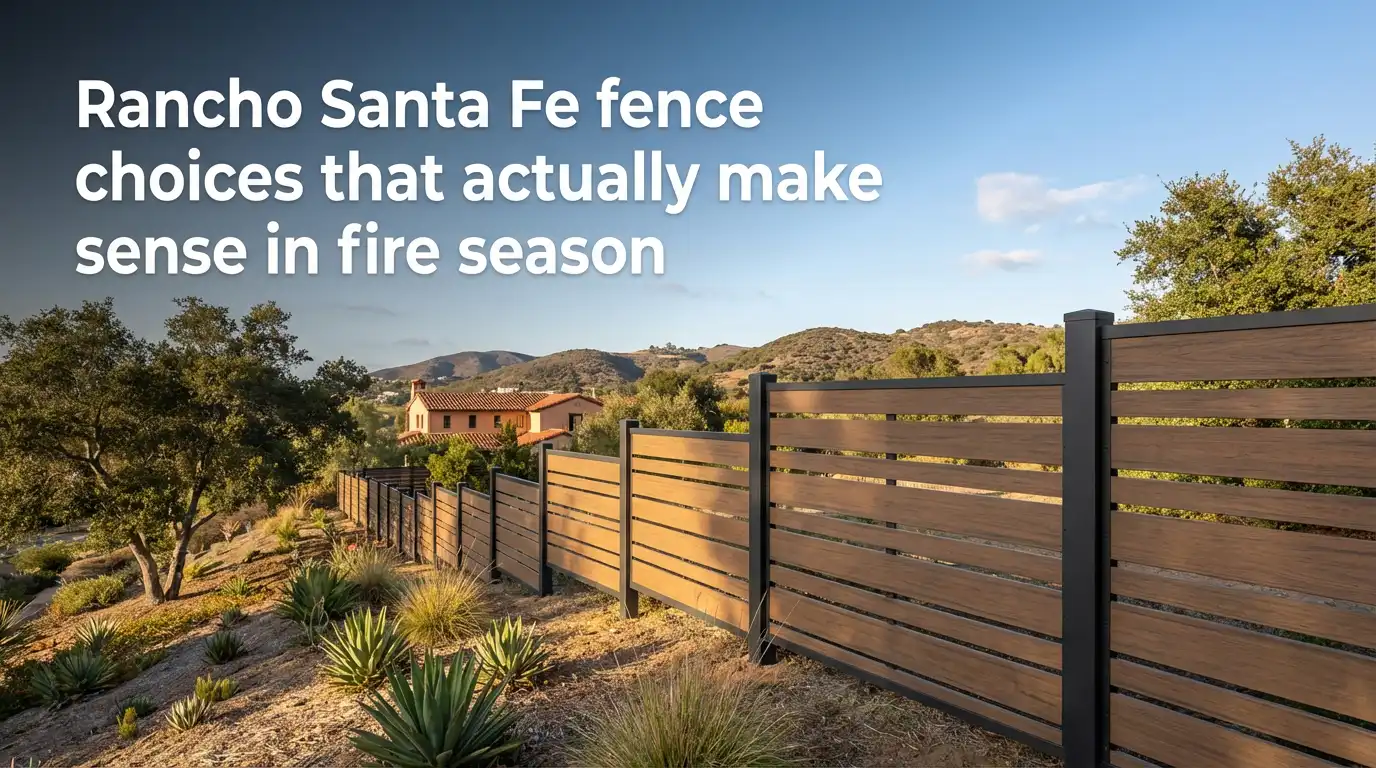
- Horizontal slats for a modern fence design (with spacing that still lets wind move through)
- Vertical pickets with estate-style top rails
- Mixed infill panels paired with masonry columns
One real trade-off: aluminum is lighter than steel. That’s good for corrosion resistance and handling, but it means gate frames and hinge/post engineering matter more. A wide driveway gate or tall privacy-style panel needs proper reinforcement so it doesn’t sag over time.
Steel fencing: non-combustible, strong, and great for gates
Steel fencing is also non-combustible, and it’s usually the better option when you need stiffness—especially for gates.
In Rancho Santa Fe, steel often makes sense for:
- Long-span driveway gates
- Sloped areas where a rigid frame helps
- Higher-security perimeters that still look polished
Steel needs serious corrosion protection. In practice, that means galvanizing plus a quality powder coat, and hardware that won’t rust-stain the posts. Coastal moisture can drift inland, and even though Rancho Santa Fe isn’t right on the water like Del Mar, you still want finishes that won’t chalk or fail early.
Composite: good for privacy and look, but it isn’t non-combustible
Composite fencing and Composite Decking are popular because they’re consistent, clean, and don’t need paint. But here’s the plain truth: composite is usually not non-combustible.
That doesn’t make composite “bad.” It just means you should be thoughtful about where you put it.
On a lot of Rancho Santa Fe projects, composite works well:
- For privacy screens farther from structures
- In courtyard areas where the fence isn’t the first thing an ember hits
- Where HOA rules prefer a solid-panel look
But in Zone 0 near the house, many homeowners choose aluminum or steel (or other non-combustible options) instead of composite. If you want composite close to a structure, talk through the exact product, any available test data, and what your AHJ is likely to accept.
How fire ratings come into the conversation (ASTM E84 and “Class A”)
You’ll hear “Class A” used like it’s a universal stamp of approval. It isn’t.
ASTM E84 is a test for surface burning characteristics—it measures flame spread and smoke developed for a material in a controlled setup. A “Class A” result can be useful context, but it doesn’t automatically mean a product is the right choice for every near-home application.
For Zone 0, the practical question is usually: “Will this ignite easily from embers, and can it help carry fire toward the structure?” Non-combustible metals (aluminum and steel) are a clearer answer than most wood-plastic composites.
3) What to look for in a Rancho Santa Fe fencing provider (materials are only half of it)
In Rancho Santa Fe, most fence problems aren’t from choosing the “wrong” material. They come from details: gate geometry, post footings, drainage, and how the fence meets landscaping and hardscape.
Here’s what to screen for.
1) They can talk about Zone 0 without hand-waving
A good contractor will tell you early: Zone 0 guidance and enforcement varies by AHJ, and you should confirm what applies at your address.
They should also be able to turn the intent into real design choices:
- Use non-combustible fencing in the near-home zone when required/desired
- Avoid “ember traps” (tight corners packed with mulch, leaf litter, or wood chips)
- Detail the fence connection near eaves, siding transitions, and gates
If a contractor guarantees you’ll “pass inspection,” treat that as a warning sign. Inspectors can interpret edge cases differently.
2) They understand HOA submittals and what actually gets approved
For communities like The Covenant and Fairbanks Ranch, you want someone who can provide:
- Scaled drawings (site plan + elevations)
- Finish samples (powder coat chips, composite color boards)
- Hardware details for gates and latches
This matters because delays often come from vague descriptions like “black metal fence.” In Rancho Santa Fe, the difference between matte black and satin black—or between a flat top rail and a decorative rail—can be the difference between quick approval and a resubmittal.
3) Gate engineering is treated as a structural problem, not a carpentry problem
Wide gates are common in Rancho Santa Fe—long driveways, landscaping equipment access, equestrian access.
Ask how they build:
- Gate frames (welded vs mechanically fastened)
- Post sizing and footing depth (site conditions vary)
- Hinge selection (rated hinges, adjustable hinges)
- Latch hardware (especially for pool codes where applicable)
This is where steel often earns its keep. Aluminum can work too, but it needs the right internal reinforcement and hardware.
4) They plan for drainage and slope—because Rancho Santa Fe lots aren’t flat
Slope changes everything: how panels rack, where gaps show up at grade, and where water goes during heavy rain.
Even with San Diego’s long dry spells, Rancho Santa Fe still gets intense winter storms in some years. If your fence line crosses a swale or drainage path, you need a plan so water doesn’t undermine footings or rot out adjacent landscape borders.
5) They’re straight with you about where composite belongs
Composite fencing can be a good option for privacy, but the provider should be able to explain:
- Where it makes sense on your lot
- Where metal is the better call (especially near structures)
- What maintenance still exists (washing, hardware checks, movement with temperature)
If everything is pitched as “equally fire safe,” you’re not getting useful guidance.
Modern Fence & Deck works on these projects throughout San Diego County, and Rancho Santa Fe is the kind of area where planning and details make the difference: long fence runs, strict review, and high expectations for fit and finish.
4) Rancho Santa Fe-specific considerations (wind, landscaping, and where embers actually land)
If you’ve lived through a Santa Ana event here, you know the wind doesn’t stick to one neat direction.
In Rancho Santa Fe, fences often sit next to things that collect debris: mature hedges, eucalyptus or ornamental plantings, leaf litter in corners, and decorative bark or mulch. Those details matter because embers tend to settle in the same spots again and again.
Zone 0 and the “first five feet” next to structures
Zone 0 is often described as the first 0–5 feet around the home, where the goal is to reduce ignition opportunities from embers.
Fencing hits Zone 0 in a very specific way: a fence that connects to a structure can act like a path for heat and flame to reach the house if the fence itself is combustible.
That’s why homeowners ask about:
- Defensible space fencing design
- Non-combustible fencing options like aluminum and steel
- How to end a fence at a wall or column without bringing combustibles right up to the structure
Your AHJ decides what’s required, but the design goal is simple: don’t create an easy ignition point right next to the home.
Landscaping choices can cancel out a good fence material
Even with aluminum or steel, you can still create a problem if the fence line is packed with combustible landscaping right against the house.
Common Rancho Santa Fe culprits:
- Mulch piled high against posts
- Leaf litter collecting behind privacy screens
- Wood chips in tight corners near gates
A fire-wise fence plan also needs a maintenance plan for the first few feet: keep it clean, keep it sparse, and don’t let debris build up.
Heat, sun, and finish selection in North County
Rancho Santa Fe gets strong sun exposure, and darker finishes can get hot to the touch in summer.
For metal fencing, powder coat quality matters more than color. Ask what powder coat system is being used and whether it’s rated for exterior architectural use.
For composite fencing, expect some thermal movement. That doesn’t mean it’s flimsy—it means the installer has to follow spacing and fastening rules so panels don’t oil-can or warp.
Road dust and irrigation overspray
If you’re near Via de Santa Fe or other traveled roads, dust is part of the deal. And if irrigation mist hits the same spot every day, mineral deposits can build up on darker metal finishes.
It’s not a dealbreaker. It just affects finish choice and expectations: an occasional rinse can keep fences looking good without turning into a weekend chore.
5) Getting started with fire-wise aluminum, steel, and composite fencing in Rancho Santa Fe
Most Rancho Santa Fe fence replacements follow the same general path, and doing the early steps right helps you avoid change orders later.
Start with the layout. Walk the property and note where the fence is within 5 feet of a structure, where it ties into the house, and where gates sit. If you’re replacing an old wood fence, pay attention to the repeat offenders—soft soil, standing water, or posts that always lean. If you don’t fix those at the footing and drainage level, they tend to come right back.
Then decide on a material strategy. A common approach is:
Use aluminum fencing or steel fencing where you want non-combustible performance near the home or at tie-ins, and use composite where you want privacy farther from structures. On many Rancho Santa Fe lots, that hybrid plan looks more natural than forcing one material everywhere.
Next, plan for review. If you’re in an HOA area (The Covenant, Fairbanks Ranch, Rancho Santa Fe Farms), you’ll probably need a submittal package before fabrication. That package should spell out drawings, heights, colors, and gate hardware notes.
Finally, schedule an on-site consult. Modern Fence & Deck can walk the fence line with you, talk through Zone 0 goals, and help you line up questions for your AHJ so you’re not guessing. If you want to talk through options, call (619) 975-1883.
Conclusion: a practical path to fire-wise fencing in Rancho Santa Fe
A fire-wise fence plan in Rancho Santa Fe usually comes down to two moves: use non-combustible aluminum or steel where it matters most (especially near structures), and use composite where privacy and aesthetics outrank ignition resistance.
If you’re weighing fire resistant fencing, trying to make sense of AB 3074 fencing requirements, or need a design that won’t get stuck in HOA review, Modern Fence & Deck can help you put together a clear plan for your Rancho Santa Fe property. Call (619) 975-1883 to set up a site visit and talk through materials, layout, and next steps.
FAQ
Does Rancho Santa Fe require Zone 0 fencing? Zone 0 guidance is handled through your AHJ (Authority Having Jurisdiction) and can vary by address and project scope. If your fence connects to a structure, it’s worth asking your AHJ what they want to see for non-combustible materials within 0–5 feet.
Is aluminum fencing considered non-combustible? Yes. Aluminum is a non-combustible metal. That’s why it’s commonly used close to the home where ember ignition is a concern.
Is composite fencing non-combustible? No. Composite is generally not non-combustible. Some products may have specific test data (like ASTM E84 surface burning results), but that’s different from being non-combustible or automatically acceptable for Zone 0.
What’s better for Rancho Santa Fe: steel or aluminum? It depends. Steel is stiffer and often the better fit for large gates and security-focused areas. Aluminum is lighter and corrosion-resistant, and it works well for most residential fence runs when it’s designed correctly.
Can you design a fence that will satisfy my HOA and my fire goals? Often, yes—but it takes some design work. The usual approach is a non-combustible material plan near the home paired with an HOA-friendly look (finish, rail profiles, spacing, and height). Final approval still comes down to your HOA’s review.
Disclaimers: Fire ratings and compliance vary by jurisdiction—consult your AHJ (Authority Having Jurisdiction) for requirements at your address. Insurance outcomes depend on individual policies and circumstances.
Verification note (updated March 26, 2026): Regulatory requirements can vary by parcel, jurisdiction, and inspection cycle. Confirm current requirements with your AHJ and official California sources before final design or contract decisions: PRC 4291, Board of Forestry Zone 0 updates, and OSFM FHSZ maps.