Manhattan Beach homeowners: what “fire-wise” fencing really means (and what to install near the house)
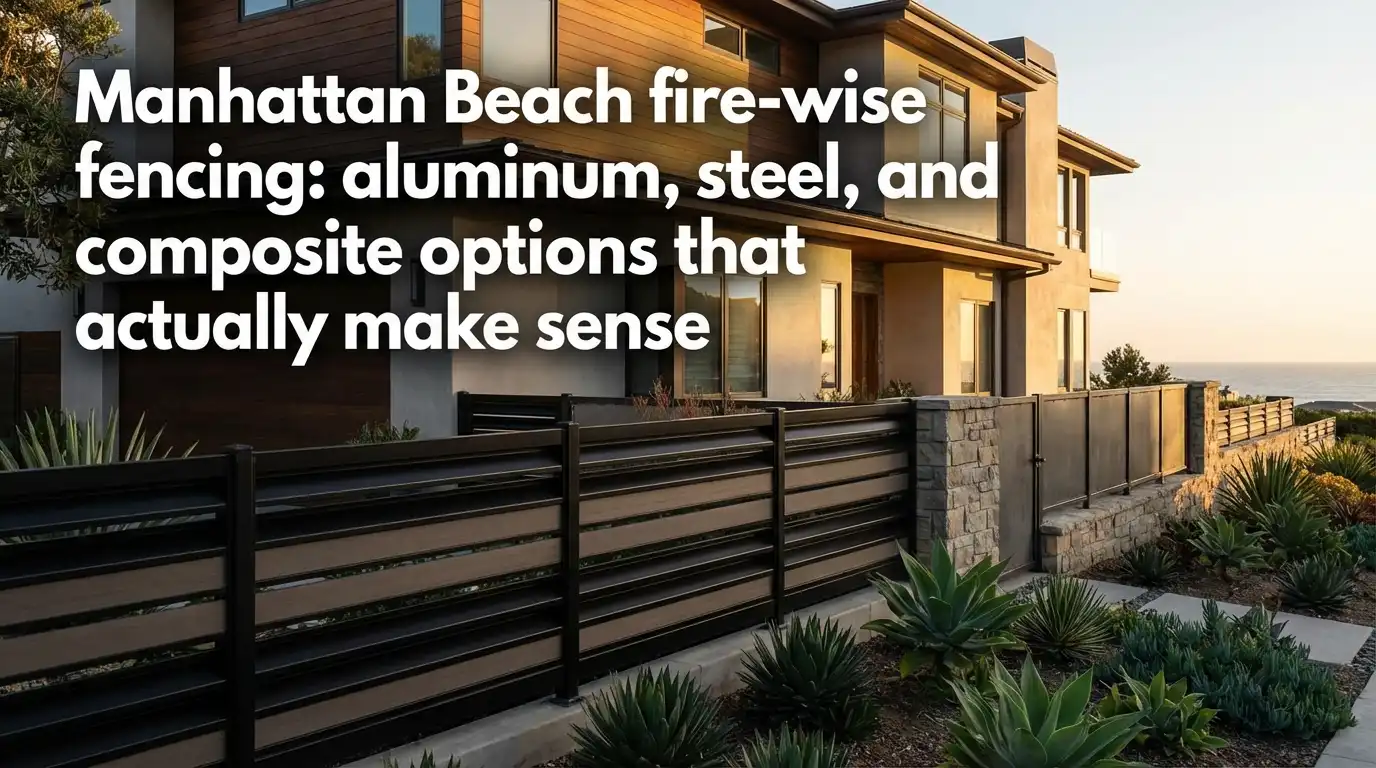
If you’ve got an older wood fence in Manhattan Beach, you’ve probably had this moment: you’re walking the side yard, spotting peeling paint, wobbly posts, and that tight gap between the fence and the house. Then you hear “Zone 0” or “defensible space” and start wondering if your fence is now part of the risk.
This guide explains Fire wise aluminum, steel and composite fencing. in Manhattan Beach in plain language—what “fire-wise” actually means, when metal or composite makes sense, and what to ask before you sign anything. We’ll walk through non-combustible fencing (aluminum and steel), where composite can still fit, and how California’s Zone 0 talk is changing the way fences and gates get designed—especially in neighborhoods like The Hill Section, Sand Section, and Tree Section.
The local fencing situation in Manhattan Beach (and why “fire-wise” is suddenly part of the conversation)
Manhattan Beach doesn’t look like the classic wildfire hillside town. It’s coastal, often cooler, and you’re more likely to worry about salt air and sun fade than ember storms. But fire-wise construction details still come up here for a few practical reasons: codes are moving toward tighter ignition-resistant rules, insurers ask more questions than they used to, and the fence is often the first thing that touches your house—literally.
Working on a project in Manhattan Beach?
See local service options, material guidance, and nearby project coverage for Manhattan Beach.
Explore Manhattan BeachA typical Manhattan Beach lot can make fencing trickier than it seems. Side yards get narrow. Property lines are tight. You might have a fence that ties straight into a garage, a deck stair, or a side gate that leads to the front walk. That “attachment” detail is usually where the fire-wise conversation starts.
You’ll also see a lot of modern fence design in this area: clean horizontal lines, dark powder-coated metal, and privacy screens that match contemporary remodels. On streets near Highland Avenue and Manhattan Beach Boulevard, the design pressure is real—your fence is part of the street-facing look, not just something that separates backyards.
Then there’s the coastal reality. Salt air can eat through low-grade hardware fast. Wind-driven sand can wear on finishes. And the sun is intense year-round. Those factors push a lot of Manhattan Beach homeowners toward materials that don’t rot, don’t attract termites, and don’t need repainting every couple of years.
So where does “fire-wise” come in?
California has been moving toward clearer guidance on defensible space, including the idea of Zone 0—the first 0–5 feet around the home where the goal is to reduce ignition pathways (often driven by embers and radiant heat during a wildfire event). Exact requirements can vary based on your AHJ (Authority Having Jurisdiction)—the city/county department that enforces building and fire rules for your property.
In practice, homeowners hear “Zone 0” and ask a straightforward question: If my fence touches my house, should that section be non-combustible? That’s where aluminum fencing and steel fencing California projects have been getting more attention.
Why Manhattan Beach residents choose aluminum, steel, and composite for fire-wise fencing
Most people don’t replace a fence for a single reason. It’s usually a pile-up: the wood is tired, the gate drags, the posts are leaning, the neighbors are complaining, and then you add one more reason—fire-wise materials near structures.
Aluminum fencing: non-combustible, clean lines, low maintenance
Aluminum is popular for a reason. It’s non-combustible, it won’t rot, and it’s easy to keep looking clean. In Manhattan Beach, powder-coated aluminum fits modern architecture well—especially matte black or dark bronze.
From a fire-wise standpoint, aluminum won’t ignite from embers the way wood can. That doesn’t make everything “safe” in every scenario, but it does remove a common pathway: a combustible fence acting like a fuse line into the house.
Where aluminum can fall short is impact resistance and long-span designs. If you want a tall privacy fence with long horizontal slats and minimal posts, aluminum can flex more than steel depending on the profile thickness. A good installer will talk through post spacing, reinforcement, and wind load instead of guessing.
Steel fencing: strength, crisp detailing, and good for tricky gates
If you want thin profiles that still feel solid, steel is hard to beat. It’s also non-combustible fencing, so it sits in the same basic fire-wise category as aluminum.
Steel often makes sense in Manhattan Beach for:
- Driveway gates that need stiffness
- Tall privacy panels where you don’t want “bounce”
- Custom gate frames that need to stay square over time
The trade-off is corrosion management. Steel near the coast needs the right coating system and the right hardware. If someone quotes you steel with vague language like “painted black,” make them spell it out. Powder coating is common, but the prep work is what decides whether it holds up.
Composite fencing: good privacy, but it’s not the same as non-combustible
Composite fencing (and composite decking) is popular with homeowners who want a consistent look without constant staining. Composite can be a practical choice for privacy panels, especially when you want something warmer-looking than metal.
But here’s the plain truth: composite isn’t automatically “non-combustible.” Many composite products are fire-resistant to a degree, and some have specific ratings, but it depends on the brand and the exact product line.
If someone tells you composite is non-combustible without product documentation, treat that as a red flag. What you want instead is documentation: does the product have an ASTM E84 flame spread/smoke developed rating (often discussed as Class A/B/C), and what does that mean for your project location?
ASTM E84 is a tunnel test that measures flame spread and smoke development on a material’s surface. A better rating can reduce risk, but it doesn’t turn a fence into a non-combustible assembly.
The “Zone 0” reality: where metal usually wins
For homeowners trying to line up with Zone 0 fencing California guidance—especially where the fence connects to the house—metal is usually the cleanest option.
A common strategy we see is a hybrid build:
- A short run of aluminum or steel near the structure (where the fence meets the house or within the first few feet)
- Composite or other materials farther out where the fence isn’t acting as a direct ignition bridge
That blend often works well for design and risk reduction. And if it’s planned from the start, it can look intentional instead of patched together.
What to look for in a Manhattan Beach fire-wise fencing contractor (so you don’t get stuck with a “pretty fence” that ages badly)
A fire-wise fence is still a fence. It needs to stay straight, swing cleanly, and hold up in coastal conditions. The contractor you hire should be able to explain material choices with specifics—not broad claims.
1) They talk about your AHJ (and don’t pretend every rule is statewide)
Any time you hear AB 3074 fencing requirements or “Zone 0,” remember: the rules can shift depending on the Authority Having Jurisdiction (AHJ) and whether your home sits in a designated fire hazard severity zone.
A good contractor will say something like: “Here’s what the state guidance says, and here’s what your local building department may enforce for fences attached to structures. Let’s confirm before we lock the design.”
That’s the right approach. No made-up guarantees.
2) They understand how fences fail in Manhattan Beach: hardware, posts, and finish
In coastal Manhattan Beach, fence failures often start with small stuff:
- Gate hinges corrode and bind
- Latches get gritty from sand
- Mild steel fasteners rust and stain the finish
- Posts shift because the footing wasn’t right for the soil and drainage
Ask what hardware they use (hinges, latches, fasteners) and whether it’s meant for salt air. If you’re near the ocean in the Sand Section, you want someone thinking about corrosion from day one.
3) They design “attachment points” carefully
A lot of the fire-wise discussion centers on the fence-to-house connection. This is also where water intrusion can happen if it’s handled badly.
Your installer should be able to walk you through:
- Whether the fence will physically touch the home or use a standoff detail
- How posts are placed near foundations
- How gate posts are reinforced (especially for heavier metal gates)
This is also where looks matter. Good modern fence design can hide the functional parts without doing anything questionable.
4) They can explain composite fire performance without hand-waving
If your plan includes composite privacy panels or matching composite decking, ask for the product documentation. Specifically:
- Any published ASTM E84 rating (and the class)
- Whether the product is marketed for WUI (Wildland-Urban Interface) use
- Installation details that affect performance (gaps, framing, proximity to structures)
Composite can be a smart choice. You just want receipts, not reassurance.
5) They offer a realistic plan for defensible space fencing details
“Defensible space” is the buffer around a building meant to reduce ignition opportunities. For fencing, that usually means reducing combustible materials right next to the structure and avoiding designs that trap debris.
In Manhattan Beach, that might look like:
- Keeping the area at the base of the fence easy to clean (no tight pockets that collect leaves)
- Choosing metal pickets or slats near the house instead of wood
- Planning gate swing and clearances so you can actually maintain the perimeter
A fence that’s annoying to clean turns into a maintenance headache fast.
Manhattan Beach-specific considerations: HOAs, tight lots, coastal corrosion, and “normal” fire season weather
Manhattan Beach projects tend to come with constraints that don’t show up in generic fencing articles.
HOAs and design review are common
Depending on where you are, you may have HOA guidelines on height, color, and street-facing styles. Even without an HOA, Manhattan Beach has a strong design culture. If you’re in the Hill Section with a newer build, a basic off-the-shelf fence can look out of place.
A contractor who does modern fence design regularly can help you pick a profile that matches your home (horizontal slats, vertical pickets, mixed materials) without creating something that’s fussy to maintain.
Wind, salt, and sun affect material choices
Coastal weather doesn’t just “weather” a fence—it can shorten the life of finishes and hardware.
- Aluminum: generally good in salt air, but hardware still matters.
- Steel: strong, but needs a coating system meant for coastal exposure.
- Composite: stable, but color and surface temperature in full sun are real considerations.
If your yard gets hammered by afternoon sun and reflected heat off stucco, ask about darker colors. Dark fences look clean, but they can get hot to the touch.
Narrow side yards change how you build gates
In the Tree Section, side yards can be tight enough that a gate can’t swing the way you pictured. That affects:
- Gate hardware choice
- Latch placement
- Whether you need a custom gate frame to prevent sag
A good installer will measure real clearances and ask how you actually use the gate day to day—trash bins, surfboards, bikes, landscaping access.
About “local statistics” and what’s fair to claim
You’ll see lots of numbers online about wildfires, ember spread, and home loss. Some of it is solid, some of it is context-free. The most useful point to plan around is simple: wind-driven embers can ignite vulnerable parts of a home, and a combustible fence that attaches to a structure can be part of that pathway.
For your property, the actionable stuff is closer to home: how close the fence is to the structure, what the fence is made of, and whether debris collects at the base. Those are things you can change.
And remember: fire ratings and compliance vary by jurisdiction. Confirm with your local AHJ before you treat any fence detail as “required.”
Getting started with fire-wise aluminum, steel, and composite fencing in Manhattan Beach
Start by walking the perimeter like an inspector would. Where does the fence touch the house, garage, or deck? Where are the gates? Where does debris pile up?
Then take a few photos and jot down the basics: fence height, approximate linear feet, and whether you need privacy or just a boundary.
When you talk to an installer, keep it practical:
- Tell them you’re looking for fire resistant fencing and non-combustible fencing options near the structure.
- Ask what they recommend for a short non-combustible run at the attachment point.
- If you’re considering composite, ask which product line and what rating documentation they can provide.
Modern Fence & Deck works with homeowners and property managers across Southern California, and we regularly help people sort through wildfire compliant fence details without turning it into a code seminar. If you want to talk through a defensible space fencing approach for your Manhattan Beach property—especially near a garage or side yard gate—call (619) 975-1883 and we’ll start with the constraints.
Wrapping it up: a Manhattan Beach fence can be modern and fire-wise
If your current fence is wood and it ties directly into your home, it’s worth looking at a redesign that uses non-combustible aluminum fencing or steel fencing California style construction at the attachment point. Composite can still be part of the plan, especially for privacy, but pick it based on documentation and install it with real clearances.
If you’re in Manhattan Beach—whether that’s the Sand Section near the pier area, the Hill Section with more wind exposure, or the Tree Section with tighter lots—we can help you think through a fence plan that fits the neighborhood and how you use your property. Reach out when you’re ready to compare materials and layouts for your specific lot.
FAQ: questions we hear in Manhattan Beach
Does a metal fence automatically meet Zone 0? Metal (aluminum/steel) is non-combustible, which lines up well with Zone 0 goals. But Zone 0 can involve more than fence material—like how it attaches to the structure and what else is within 0–5 feet. Confirm requirements with your AHJ.
Is composite fencing allowed near the house? Sometimes, depending on product ratings and local enforcement. Composite isn’t the same thing as non-combustible. Ask for ASTM E84 documentation and review your plan with your AHJ.
What about AB 3074—does it apply to my Manhattan Beach home? AB 3074 relates to defensible space and related updates, but how it’s interpreted and enforced can vary. The practical move is to ask your local AHJ what they want to see for fences attached to structures or within the first 5 feet.
Will switching to metal fencing lower my insurance? Insurance outcomes depend on your carrier, your policy, and the full set of property features. It’s fine to ask your agent whether non-combustible fencing or Zone 0 work changes underwriting, but no contractor should promise a premium drop.
Aluminum or steel for a driveway gate in salty air? Both can work. Steel usually feels stiffer for large gates, but coating quality and hardware selection matter a lot near the coast. For aluminum, the design needs to account for stiffness and span. A site visit usually makes the choice pretty clear.
Disclaimers: Fire ratings and compliance vary by jurisdiction. Always confirm local requirements with your AHJ (Authority Having Jurisdiction). Material fire performance depends on the exact product and installation details. Insurance outcomes depend on individual policies and circumstances.
Verification note (updated March 26, 2026): Regulatory requirements can vary by parcel, jurisdiction, and inspection cycle. Confirm current requirements with your AHJ and official California sources before final design or contract decisions: PRC 4291, Board of Forestry Zone 0 updates, and OSFM FHSZ maps.