Newport Beach fire-wise fencing: aluminum, steel, or composite—what actually holds up near the coast
Introduction
You’re in Newport Beach, you like the clean look of modern fence design, and suddenly you’re hearing more about Zone 0 and defensible space than you ever planned to. The catch is that most fencing advice online is either written for inland foothills or it skips over what actually matters here: salty air, HOA rules, tight side yards, and properties where hardscape, landscape, and fencing all sit within a few feet of the house.
This guide is for homeowners and property managers looking for Fire wise aluminum, steel and composite fencing. in Newport Beach—and trying to pick something that won’t become a maintenance project a year from now. We’ll walk through how non-combustible fencing (aluminum and steel) stacks up against composite products, what “Zone 0” usually turns into in the real world, and what to ask a contractor before you sign anything.
You’ll also get Newport Beach-specific context—think Balboa Peninsula, Corona del Mar, and Newport Coast—plus the unglamorous details like corrosion and gate hardware that still works after a few summers of marine layer.
Working on a project in Newport Beach?
See local service options, material guidance, and nearby project coverage for Newport Beach.
Explore Newport BeachThe local fencing reality in Newport Beach (and why fire-wise materials come up more often)
Newport Beach is a mix: coastal neighborhoods with mild temps and high humidity, areas closer to canyons with heavier vegetation, and a lot of homes where fences sit close to the house because the lots are tight. Even if your street doesn’t feel “fire-prone,” fire safe fencing comes up more often now for a few practical reasons.
First, California defensible space guidance has pushed people to think harder about the first few feet around a structure. You’ll hear “Zone 0” used as shorthand for the strip right next to the home where the goal is to reduce ignition paths—especially from embers. People read the rules differently, and enforcement depends on your AHJ (Authority Having Jurisdiction), but the direction is pretty consistent: keep combustible materials away from buildings.
Second, the way Newport Beach properties are laid out turns fencing into part of the defensible-space conversation. On the Balboa Peninsula, side yards can be narrow. Fences, gates, trash enclosure panels, and deck transitions often end up just a few feet from the exterior wall. In Corona del Mar, you might have a mix of masonry walls, decorative fencing, and landscaping on sloped lots—again, with features close to the house.
Third, local property standards are a real constraint. HOAs and architectural review boards in places like Newport Coast can be strict about sight lines, heights, and finish colors. That often nudges homeowners toward aluminum fencing (clean profiles, consistent finishes) or steel fencing California styles (thin pickets, modern lines), while still trying to stay aligned with fire-resistant intent.
And then there’s the coastal factor people underplay until they’ve lived with it: salt air. Wood tends to fail here in predictable ways—warping, corroded fasteners, and constant refinishing. When homeowners move away from wood, they often realize the non-combustible fencing options also happen to be lower-maintenance. That’s a convenience point, not a fire claim. But it’s one reason a lot of Newport Beach projects land on aluminum or steel.
If you’re trying to figure out what applies to your place, start by confirming who your AHJ is for permits/inspections and whether your home is in a mapped fire hazard severity zone. That one step changes what “recommended” and “required” even mean.
Why Newport Beach residents choose aluminum, steel, and composite for fire-wise fencing
Most homeowners aren’t searching “wildfire compliant fence” because they’re excited about rules. They’re trying to solve a bunch of things at once: looks, lifespan, maintenance, and what happens if embers hit the fence.
Aluminum fencing: non-combustible and low maintenance in salty air
Aluminum comes up a lot in fire resistant fencing conversations because it’s non-combustible and won’t ignite from ember exposure the way wood can. In Newport Beach it has another advantage: it generally handles marine conditions well when it’s properly powder-coated and installed with hardware that’s chosen with corrosion in mind.
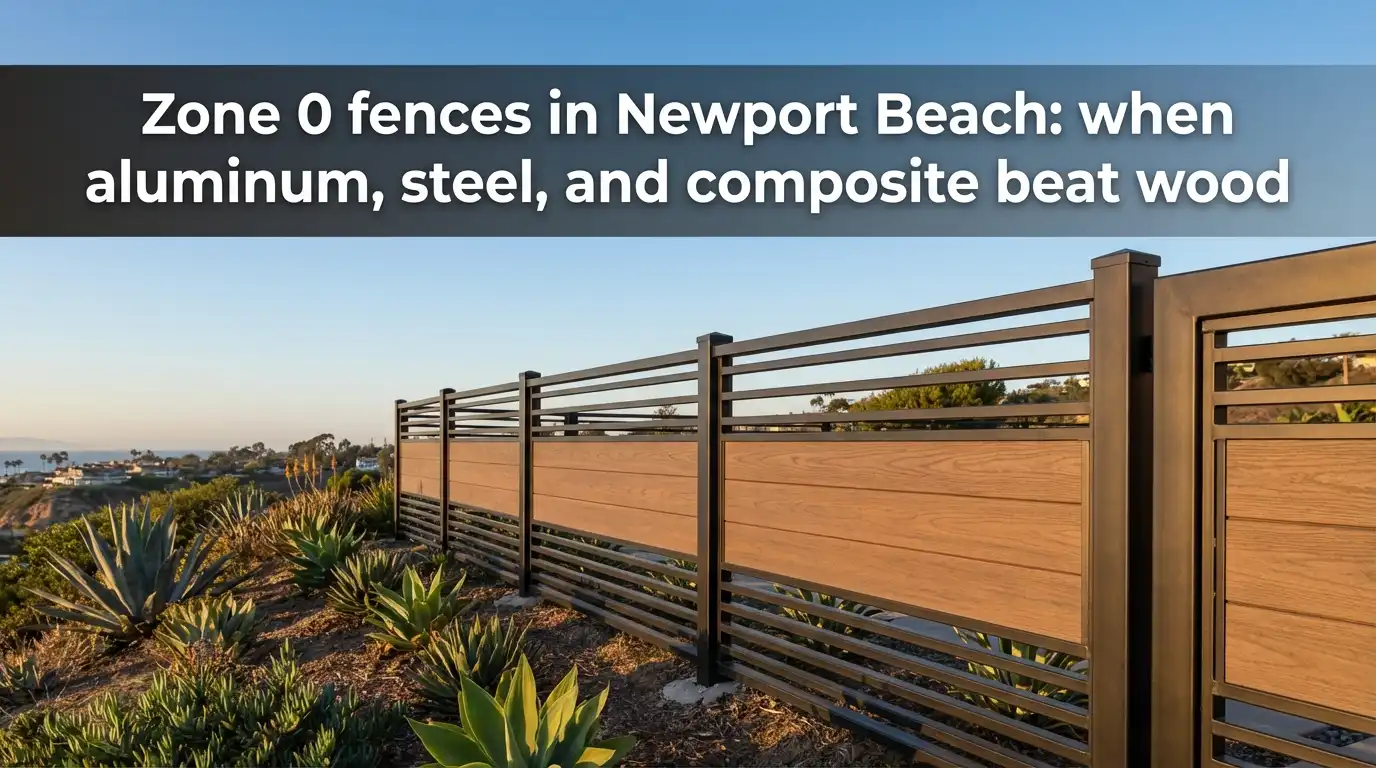
From a design standpoint, aluminum fits the “modern fence design” look many Newport Beach homeowners want—thin pickets, some horizontal privacy-style options (depending on the system), and clean gate frames that don’t sag when they’re built and braced correctly.
Trade-offs: aluminum can dent, and powder coat quality varies. When you’re comparing bids, ask which powder coat system they’re using and whether the manufacturer’s warranty actually covers coastal exposure in a way that matters.
Steel fencing: stronger feel, but corrosion has to be part of the spec
Steel is also non-combustible fencing, and it’s a good pick when you want a stiffer, heavier feel—especially for taller fences, security needs, or long gate spans where rigidity is the whole point.
In Newport Beach, the downside is simple: corrosion risk. That doesn’t mean “never use steel.” It means you need the right spec. For coastal Orange County, a solid steel package usually includes galvanizing plus a good powder coat, and close attention to welded seams, cut edges, and post caps. Installation details matter as much as the metal.
If you’re considering metal fencing near Pacific Coast Highway (PCH) or closer to the water, the finish system and the hardware choice can be the difference between “still looks good in 10 years” and “surface rust shows up fast.”
Composite fencing: fire-resistant intent, but be clear on what it is (and isn’t)
Composite fencing products aren’t all the same. Some are built around specific performance standards; others are mostly about the look and lower maintenance. Composite isn’t “non-combustible,” and it shouldn’t be described that way. But certain composite systems can fit into a fire wise aluminum, steel and composite fencing. Newport Beach CA plan when they’re used with some care—especially when paired with non-combustible posts, steel-reinforced rails, and smart placement near the structure.
Homeowners also match composite fencing with Composite Decking to keep the exterior consistent. That can work well in Newport Beach where outdoor spaces get used year-round. Just remember: for any product, you want to know what testing it points to. One common standard you’ll see is ASTM E84, which measures surface burning characteristics (often summarized as a “Class A” rating for the top category under that test). A Class A E84 rating is useful, but it isn’t the same as “won’t burn.” It describes flame spread and smoke developed under that test method.
A word about AB 3074 and “Zone 0 fencing California” searches
People often search AB 3074 fencing requirements and Zone 0 fencing California together. The practical takeaway is that California has been moving toward tighter expectations for the area immediately next to structures, with a focus on ignition resistance.
But here’s the straight answer: what you’re required to do can vary by city, property type, mapped hazard status, and how your AHJ interprets and enforces the rules. If someone promises “guaranteed compliance,” they’re guessing. A better approach is to design toward non-combustible or ignition-resistant materials near the home and then confirm requirements with the AHJ when permits or inspections are involved.
What to look for in a Newport Beach fire-wise fencing provider (so the job doesn’t get value-engineered into a problem)
In Newport Beach, the contractor choice matters because the environment doesn’t forgive shortcuts. A fence can look perfect on install day and still fail early if the finish system, fasteners, or post setting is wrong.
Start with how they talk about materials (and whether they use the right words)
A solid provider will be careful with language:
Aluminum and steel are non-combustible. Composite usually isn’t.
If you hear a fence described as removing fire risk, ask what that means. The realistic goal is usually fire-resistant design choices that reduce ignition chance and slow heat damage.
Ask how they handle coastal corrosion
In Newport Beach, this isn’t optional. You want real specifics, like:
- Are posts and panels powder-coated? What powder coat system and warranty?
- If steel: is it galvanized? How are cut edges treated?
- What fasteners are used—stainless steel, coated, or something else? (Cheap screws fail all the time.)
- How do they separate dissimilar metals to reduce galvanic corrosion?
If a contractor can’t explain this clearly, you’ll probably end up paying for it later.
Look for defensible space awareness without the scare pitch
A competent installer should be able to talk about defensible space fencing in practical terms: fence placement relative to the structure, fence-to-gate transitions, and the spots where combustible material tends to collect (mulch lines, planter beds, stored items near side gates).
They should also be comfortable saying, “This is what we typically do, but your AHJ may want it done differently,” especially for projects near public walkways or where property lines are tight.
Details that separate a clean install from a constant nuisance
In Newport Beach, little issues show up quickly:
Gate alignment matters because wind, daily use, and temperature swings cause movement.
Post setting matters because sandy or mixed soils can shift, and water near irrigation lines can undermine a poorly compacted footing.
Privacy panels matter because solid surfaces catch wind loads. If your home gets afternoon gusts off the ocean, the fence needs to be designed for it.
Ask your provider how they handle long runs, corners, and gate posts. If the answer is “we do it the way we always do,” ask them to get specific.
Documentation, permits, and HOA submissions
Newport Beach homeowners often need drawings for HOA review, and some fence replacements trigger permits depending on scope and location. A provider who regularly works in Orange County should be able to supply clear spec sheets, finish samples, and a simple plan set for review.
This is also where Modern Fence & Deck tends to fit well: we’re used to explaining material choices and code-adjacent requirements in plain language, and we can provide the documentation HOAs typically ask for. If you call, use the office line at (619) 975-1883 and tell us your neighborhood and whether you’re near the coast or inland—those details change the recommendation.
Newport Beach-specific considerations that change the “best” answer
Even inside the same city, the right fence material can change from one block to the next.
1) Marine layer, salt air, and hardware selection
If you’re closer to the water—say near Balboa Pier or along Newport Harbor—you’ll see more corrosion pressure. Aluminum is often the simplest long-term ownership option. Steel can work, but the finish system needs to match coastal exposure, and the hardware has to keep up.
A simple example: hinges, latches, and drop rods. These are usually the first parts to start sticking once salt and grit build up. Better hardware costs more than builder-grade parts, but it helps avoid the “my gate only closes if I lift it” routine.
2) Wind load on privacy-style fencing
The modern solid-panel look is popular, but solid panels act like sails. If your property gets steady coastal winds, you may need thicker posts, tighter post spacing, or a design that breaks up the airflow.
This is where slatted aluminum can be a good compromise: you keep privacy angles while taking some stress off the structure.
3) Tight side yards and the Zone 0 conversation
On narrow lots, fences and gates often sit close to walls, eaves, or exterior vents. That’s exactly where “Zone 0” concerns start showing up.
A reasonable approach many Newport Beach owners take is:
Use non-combustible aluminum or steel for the sections closest to the structure.
If you want composite for the look, keep it farther from the building or in areas where you can maintain separation.
Keep the ground line clean—don’t store bins, planters, or spare lumber against the fence next to the house.
That last one sounds obvious, but it’s one of the most common real-world breakdowns in defensible space: the fence gets upgraded, and the side yard turns into storage anyway.
4) Seasonal realities: Santa Ana winds and dry stretches
Even though Newport Beach is coastal, Southern California still gets stretches of hot, dry offshore winds. When those conditions hit, ember exposure becomes part of the regional risk picture.
A wildfire compliant fence isn’t only about “will this fence burn.” It’s also about how the fence connects to the rest of the exterior. If you have a wood gate attached to a non-combustible fence, or combustible debris collecting in corners, you can create an ignition path even if the main fence line is metal.
Getting started with fire-wise aluminum, steel and composite fencing in Newport Beach
If you’re ready to get out of research mode and into a real plan, here’s a straightforward way to start.
First, walk the property and note where fencing sits within a few feet of the structure—especially side yards and gate areas. Take photos of corners, transitions, and anywhere materials touch the building.
Next, decide what you’re optimizing for. Some homeowners want the lowest maintenance possible near the water. Others want a modern fence design that matches a remodel. Others are reacting to defensible space guidance and want non-combustible materials near the house. You can usually get two of those goals without much drama. Getting all three typically takes better design and a higher-spec build.
Then, talk to a contractor who can explain material specs without vague answers: powder coat, galvanizing (for steel), hardware, post sizing, and how they’re planning for wind loads. If you’re in an HOA, ask for finish samples and a simple drawing package early.
Modern Fence & Deck builds fire resistant fencing systems in Southern California, including Newport Beach, with an emphasis on aluminum, steel, and well-specified composite where it makes sense. If you want a site visit, call (619) 975-1883. We’ll ask a few questions upfront (neighborhood, distance to the water, fence height, and whether you’re near the structure) so the first proposal is based on your actual conditions.
Conclusion: a Newport Beach fence should look right—and still behave predictably in real conditions
A fence in Newport Beach has to do more than look good on install day. It has to keep working through salt air, wind, sun, and the daily wear of a gate that gets used constantly.
If you’re searching for Fire wise aluminum, steel and composite fencing. in Newport Beach, start with the basics: use non-combustible fencing (aluminum or steel) closest to the structure when Zone 0/defensible space is part of your plan, and choose composite with a clear understanding of what it is and where it makes sense.
When you’re ready to price options and see sample profiles and finishes that actually hold up near the coast, contact Modern Fence & Deck at (619) 975-1883. We’ll help you work through material choices, HOA constraints, and the details that decide whether the fence still feels “new” years later.
FAQ
Do I need Zone 0 fencing in Newport Beach? It depends on your property’s location, hazard mapping, and how your AHJ applies defensible space expectations. If you’re planning work near the structure, it’s smart to ask your AHJ what they expect for the first 0–5 feet.
Is aluminum fencing considered non-combustible? Aluminum is non-combustible as a material. The overall fence assembly can still include combustible elements (like inserts or nearby debris), so design and maintenance still matter.
Is steel fencing better than aluminum near the ocean? Steel is stronger, but it needs the right corrosion protection (typically galvanizing plus a quality powder coat) and good hardware. Aluminum often wins on low maintenance in marine conditions.
Does composite fencing meet AB 3074 fencing requirements? Composite products vary. Some have tested fire performance data; others don’t. Requirements also depend on the AHJ and where the fence sits relative to the structure. Treat “AB 3074 compliant” claims carefully and confirm what standard they’re referencing.
Will a fire-resistant fence lower my insurance? Insurance outcomes depend on your carrier and policy. A fire-resistant or non-combustible fence may support a broader mitigation profile for the property, but no contractor should promise premium changes.
Disclaimer: Fire ratings, product approvals, and code requirements vary by jurisdiction and project conditions. Always confirm requirements with your local AHJ (Authority Having Jurisdiction).
Verification note (updated March 26, 2026): Regulatory requirements can vary by parcel, jurisdiction, and inspection cycle. Confirm current requirements with your AHJ and official California sources before final design or contract decisions: PRC 4291, Board of Forestry Zone 0 updates, and OSFM FHSZ maps.