Laguna Beach’s no-nonsense guide to fire-wise aluminum, steel, and composite fencing
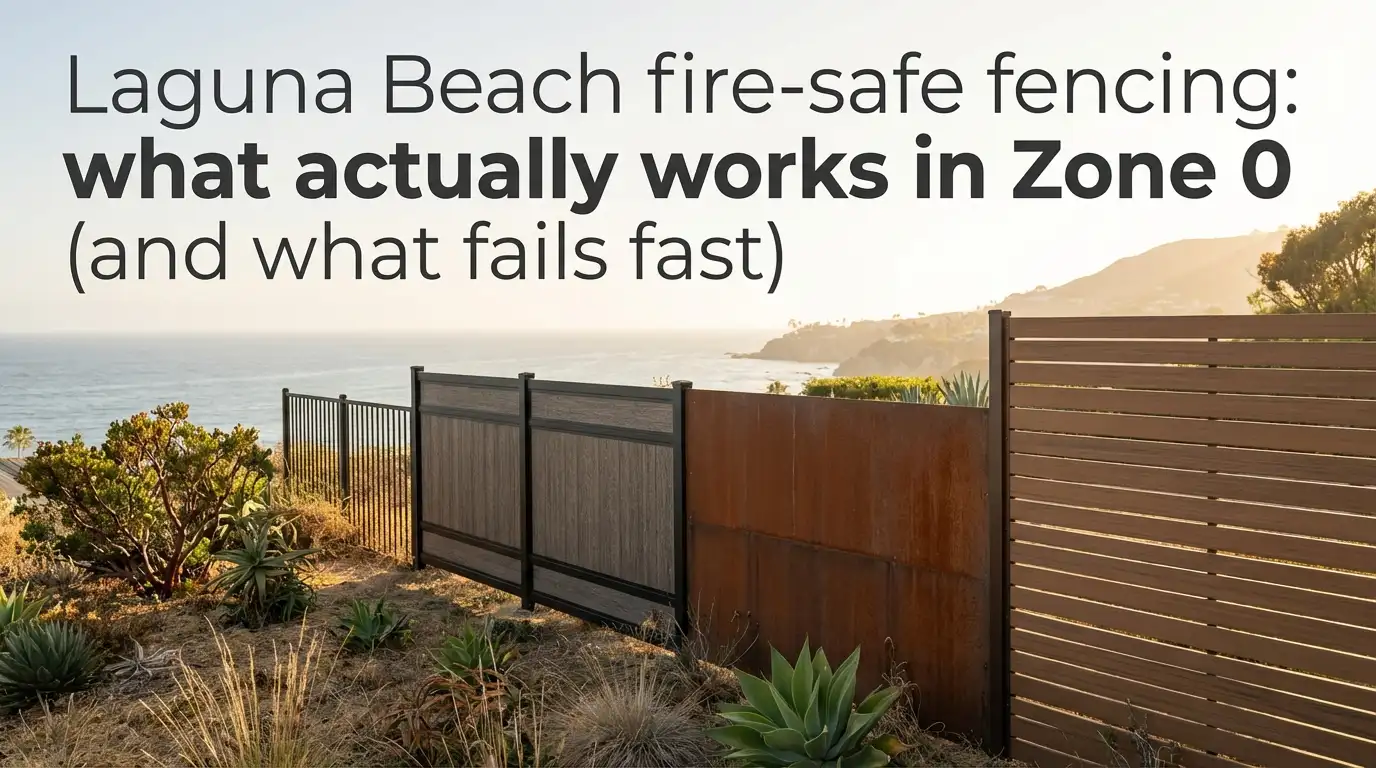
You’re not imagining it: in Laguna Beach, fences get judged on more than looks.
Between coastal air that eats finishes, tight lots on hillside streets, and the push for defensible space, the “standard” wood fence can start to feel like a short-term fix. If you’re searching for Fire wise aluminum, steel and composite fencing. in Laguna Beach, you’re probably trying to do two things at once: draw a clean, modern boundary and cut down on combustibles right next to the house.
This guide explains what fire-resistant fencing means at the material level, how Zone 0 fencing California discussions can affect what you do near structures, and what to ask a contractor so you don’t end up with a fence that looks great but falls apart in the details (hardware, gaps, attachment points, or where the fence meets the home).
Working on a project in Laguna Beach?
See local service options, material guidance, and nearby project coverage for Laguna Beach.
Explore Laguna BeachThe local fencing reality in Laguna Beach (it’s not a blank slate)
Laguna Beach homes aren’t sitting on wide, flat suburban parcels where you can place a fence anywhere and forget about it. A lot of properties near Top of the World, North Laguna, and the Canyon Acres / Laguna Canyon Road area deal with slope, limited access, and neighbors close enough that every inch of setback can turn into a conversation.
That local context changes how “fire safe fencing” works in practice.
First, there’s the ember problem. During wildfire conditions, embers can fly ahead of the main fire and land in spots where debris collects—along fence lines, behind gates, and at the base of posts. Fences are long, continuous runs with lots of edges and joints. If the fence (or what’s around it) can burn, it can act like a fuse that brings fire closer to the home. That’s why so many homeowners here ask about non-combustible fencing—especially for the sections closest to the structure.
Second, there’s the coastal corrosion problem. Closer to PCH and the ocean-facing side of town—think pockets near Heisler Park or along the routes that lead toward Main Beach—salt air and moisture can speed up rust on unprotected steel and cause staining when dissimilar metals touch. Aluminum generally holds up well in coastal exposure, but fasteners and welds still make or break the outcome.
Third, Laguna Beach has a strong design point of view. In areas with clean-lined architecture (and where HOAs or design review can be part of the process), chunky rails and basic dog-eared wood pickets often look out of place. That’s where modern fence design in aluminum or steel—thin pickets, horizontal slats, or mixed-material panels—usually fits better.
And then there’s the compliance conversation. Homeowners often ask about AB 3074 fencing requirements or “Zone 0,” expecting one statewide rulebook that answers everything. In reality, what applies to your specific parcel depends on your AHJ (Authority Having Jurisdiction)—the local agency that interprets and enforces the building and fire standards where you live. That might be a city building department, a county agency, or a local fire authority. The practical move is to design to the intent (reduce combustibles next to the structure, avoid ignition pathways) and then confirm the details with the AHJ when the job gets close to the home.
Why Laguna Beach residents are choosing aluminum, steel, and composite
Most homeowners don’t start out saying, “I want metal fencing.” They start with a problem: a wood fence that’s warping, rotting at the posts, or always needing paint—plus the nagging feeling that wood right next to the house isn’t doing their defensible space plan any favors.
Aluminum: non-combustible, clean, and low drama near the home
Aluminum fencing is a go-to for defensible space fencing because aluminum is non-combustible. It won’t ignite the way wood can when embers pile up at the base. For Zone 0-style thinking (the area closest to the structure), that matters.
In Laguna Beach, aluminum also makes sense because it naturally resists corrosion. You still want a quality powder coat and the right hardware, but compared to steel, aluminum is often the simpler choice for coastal exposure.
Where aluminum works well:
- Short runs close to structures where you want a non-combustible boundary
- Front-yard fences where clean picket spacing and a modern look matter
- Side-yard lines where access is tight and you’d rather not wrestle heavy steel
Where you need to think it through:
- Very tall privacy applications (aluminum can do privacy-style panels, but the design needs stiffness and proper posts)
- Long, wind-exposed runs on slopes (post sizing and footing design matter)
Steel: strong, precise, and good for gates (if you spec it for coastal life)
Steel is also non-combustible, and it’s hard to beat for rigidity. In Laguna Beach, steel often shows up in:
- Tall, narrow picket fences where you want minimal flex
- Custom gates that need to stay square over time
- Architectural details where you want crisp lines and tight tolerances
But steel isn’t “set it and forget it” near the coast. Talk through finish systems (galvanizing vs. a high-quality powder coat), how welds are sealed, and what fasteners are used. A steel fence that looks great on day one but starts bleeding rust at the joints isn’t a fire issue—it’s a maintenance and lifespan issue. Still, it’s common in steel fencing California projects when the design needs strength.
Composite: useful, but it’s not the same conversation as metal
Composite fencing (and Composite Decking) comes up a lot because people want privacy and they’re done with painting. Composite also tends to read more “solid” than pickets.
Here’s the straight answer: composite is usually not non-combustible. Some composite products can meet certain fire performance standards (often talked about in terms of surface burning characteristics like ASTM E84 Class A, depending on the product and assembly), but that doesn’t automatically mean the whole fence system belongs right next to a structure in every jurisdiction.
So why do Laguna Beach homeowners still pick composite?
- They want privacy screens for patios and side yards
- They want a consistent look without the checking/splitting that comes with wood
- They like mixed designs: metal posts + composite infill for a cleaner modern look
A practical approach we often suggest is a hybrid layout: use non-combustible aluminum or steel where the fence is closest to the structure (where Zone 0 concerns are highest), then use composite where it’s allowed and where it does its job best (privacy runs farther from the home, interior courtyards, or areas your AHJ is comfortable with).
What to look for in a Laguna Beach fire-wise fencing provider
A lot of fence quotes look identical until you ask questions that force specifics. If you’re hiring a contractor for fire resistant fencing in Laguna Beach, here’s what separates “we install fences” from someone who’s thinking about how fire actually moves.
1) They talk about the first five feet without getting weird about it
When people say “Zone 0 fencing California,” they usually mean the area right next to the home where combustibles are discouraged. The fence is only part of it; what’s under it and around it matters too.
A good contractor should be comfortable talking through:
- Whether the fence attaches to the structure, and how
- How they transition from a non-combustible run to other materials
- Where debris will collect (corners, gate returns, planter edges)
They should also say plainly that requirements vary by AHJ, and that the safest plan is to confirm details with the local authority when the project is close to the structure.
2) They can explain materials in plain language (and name the standards)
If a provider says a product is “fire-rated,” ask: “Rated to what?”
For example, you may hear:
- ASTM E84 (often used to describe “surface burning” characteristics—flame spread and smoke developed—for building materials)
- ASTM E136 (a test method used to determine whether a material is non-combustible under certain conditions)
You don’t need a technical seminar. You need someone who can tell you what those labels do—and don’t—mean for a fence assembly in a real yard.
3) They’re specific about the full system: posts, hardware, and gaps
Fire-wise details aren’t only “wood vs. metal.” They’re about the whole system.
Ask what they specify for:
- Post material and thickness (especially for long spans and hillside installs)
- Fasteners (stainless vs. coated; avoiding galvanic corrosion near the coast)
- Gate frames and hinges (sagging gates create gaps; gaps collect debris)
- Bottom clearances (too tight and debris packs in; too high and pets slip through)
If you’re in ocean air, also ask how they protect cut ends and drilled holes. That’s where corrosion often starts.
4) They understand Laguna Beach permitting realities
Even when a fence seems simple, hillside lots, retaining walls, and visibility rules can trigger extra review. A provider who works around Orange County coastal cities should be able to walk you through the usual friction points: access, staging, concrete delivery, and how to work without chewing up your driveway.
5) They can show you modern designs that don’t rely on gimmicks
“Modern fence design” in Laguna Beach usually means clean lines, consistent spacing, and finishes that look right next to stucco, stone, and coastal planting.
A good provider should be able to talk through real options like:
- Vertical aluminum pickets with tighter spacing near public-facing areas
- Steel frames with mixed infill panels where privacy is needed
- Composite privacy runs where allowed, paired with metal posts for a crisp outline
If the only design they can explain is “wood but painted black,” keep looking.
Laguna Beach-specific considerations you’ll want to decide upfront
Slope, soil movement, and fence alignment
Laguna Beach has plenty of properties where the fence line tracks a grade change. On a slope, a fence can either “rack” (follow the slope) or “step” (stair-step panels). Each option changes the bottom gaps, the privacy level, and how easily leaves pile up. It also changes how a gate behaves—gates on slopes need careful layout so they don’t bind.
For defensible space, the bottom edge matters because that’s where wind-driven debris tends to collect. A contractor should propose a layout you can actually keep clean, not one that turns into a permanent leaf trap.
Coastal air and finish selection
If your property gets regular marine layer and salt exposure, finishes and hardware matter more than most people expect.
Aluminum usually holds up well, especially with a quality powder coat. For steel, talk through whether the project calls for galvanized steel, a specific powder system, or both. And don’t ignore the small stuff: cheap fasteners corrode early and can stain nearby surfaces.
Gate placement near driveways and narrow streets
Where streets are tight and driveways are short, gate swings and latch placement can become a daily annoyance if they’re wrong. Think about how you actually use the entry—trash day, deliveries, surfboards, bikes—and size the gate and swing to match real life.
If you’re near common routes like Pacific Coast Highway (PCH) or heading inland on Laguna Canyon Road, you already know how traffic and parking can complicate staging. Contractors who plan for that tend to leave a cleaner jobsite.
Vegetation, mulch, and the “fence line strip”
A fence can be non-combustible and still sit next to combustible ground cover. Lots of Laguna Beach homeowners like bark mulch and dense plantings for privacy. That can work, but for a fire-wise plan you’ll want to think about what sits at the base of the fence—especially near the house.
The goal is pretty simple: keep the near-structure area easier to clean and less likely to trap debris, and put dense planting where it’s less likely to create a path to the structure.
Compliance language, without overpromising
People often ask for a “wildfire compliant fence.” The honest answer is that compliance depends on location, design, materials, and how your AHJ interprets the rules.
We can design fire-resistant fencing that follows defensible space principles and uses non-combustible materials (aluminum and steel). But you should still confirm what your AHJ expects for your exact site—especially if the fence attaches to the home or sits within the closest zone.
Getting started with fire-wise aluminum, steel, and composite fencing in Laguna Beach
If you want to move forward without getting stuck in research mode, start simple.
First, walk the fence line and note three things: where the fence comes closest to the house, where debris collects (corners and gate returns), and any slope changes. Snap a few photos.
Next, decide what you’re optimizing for.
If your priority is the near-structure area, aluminum fencing—or metal fencing in general—is usually the cleanest non-combustible option. If your priority is privacy farther from the home, composite might be a fit—just don’t assume it’s non-combustible.
Then have a contractor come out and talk through a material map: metal where defensible space concerns are highest, and composite where it makes sense for privacy and maintenance.
Modern Fence & Deck works across Southern California and handles fire wise aluminum, steel and composite fencing. Laguna Beach CA projects with attention to the stuff that decides whether a fence ages well—posts, hardware, and transitions—so you’re not redoing the tricky parts later. If you want to talk through a layout, call (619) 975-1883.
Conclusion: a fire-wise fence plan that still looks like Laguna Beach
A good fence in Laguna Beach needs to handle coastal air, match the architecture, and cut down combustibles where it actually matters. Aluminum and steel are non-combustible, which makes them a solid choice near structures and for defensible space planning. Composite can still make sense for privacy and lower maintenance, but it needs to go in the right spots with realistic expectations.
If you’re ready to sketch a fire-wise design—especially if you’re dealing with slope, tight access, or a fence line close to the house—Modern Fence & Deck can help you work through materials, layout, and permitting questions without turning it into a months-long rabbit hole. Call (619) 975-1883 to schedule a site visit in Laguna Beach.
Fire ratings and compliance vary by jurisdiction. Always confirm requirements with your AHJ (Authority Having Jurisdiction). Insurance outcomes depend on individual policies and circumstances.
Verification note (updated March 26, 2026): Regulatory requirements can vary by parcel, jurisdiction, and inspection cycle. Confirm current requirements with your AHJ and official California sources before final design or contract decisions: PRC 4291, Board of Forestry Zone 0 updates, and OSFM FHSZ maps.