Del Mar’s no-nonsense guide to fire-wise aluminum, steel, and composite fencing
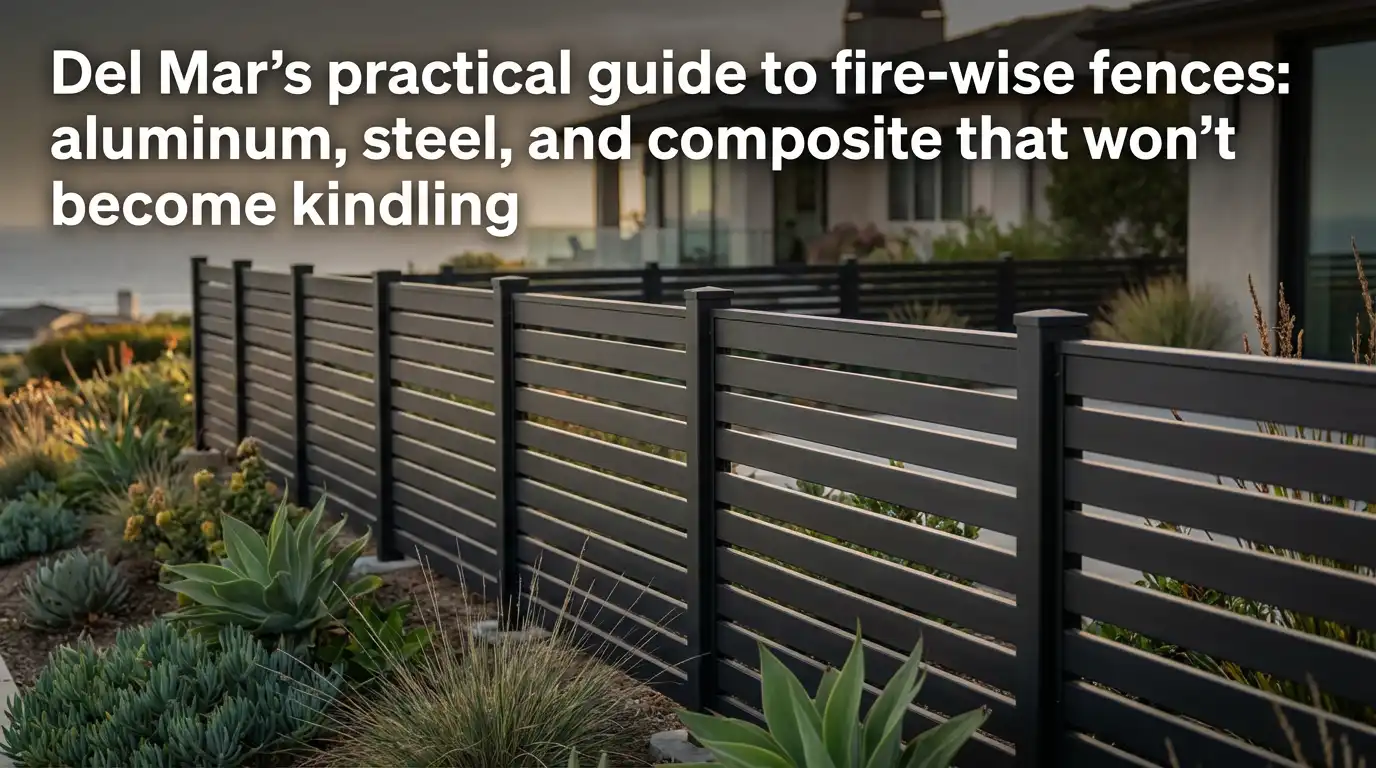
Del Mar comes with a pretty specific set of fencing headaches: coastal air that breaks down finishes, tight property lines, HOAs that care about sightlines, and wildfire planning that doesn’t feel hypothetical anymore.
If you’ve been searching for Fire wise aluminum, steel and composite fencing. in Del Mar (or you’re trying to figure out what “Zone 0” means for a fence that touches your house), you’re in the right place. This guide covers what Del Mar homeowners typically run into, how non-combustible fencing fits into defensible space, and what to ask a contractor so you’re not replacing a “new” fence five years from now.
We’ll also get clear on where aluminum and steel actually differ, when composite is a sensible middle ground, and when wood might still be fine—depending on your layout and local requirements. And because codes and interpretations can vary, we’ll talk about how to verify details with your AHJ (Authority Having Jurisdiction)—the local agency that enforces building and fire rules.
Working on a project in Del Mar?
See local service options, material guidance, and nearby project coverage for Del Mar.
Explore Del MarWhat the fencing market looks like in Del Mar (and why fire-wise specs keep coming up)
Del Mar isn’t one uniform neighborhood. A fence decision near Del Mar Heights often looks different than one closer to the bluffs by Olde Del Mar, and the “right” material can change again if you’re nearer the activity around the Del Mar Fairgrounds.
A few local realities shape what people end up installing:
First, coastal corrosion is real. Salt air travels inland, and you don’t need to be oceanfront to deal with it. If you’ve seen rusty fasteners, chalky paint, or gate hardware that starts sticking after a couple seasons, you already know the pattern. That’s one reason aluminum fencing shows up so often near the coast—it won’t rust the way carbon steel does. But it’s not automatic: the coating system and hardware choices still make or break the job.
Second, Del Mar properties often come with visibility and design constraints. A lot of homeowners want clean horizontal lines, thinner pickets, and gates that don’t look like a bolt-on kit. That usually nudges projects toward modern fence design in powder-coated metal and composite systems that can keep the same look across panels and gates.
Third, the fire conversation has moved from “What if?” to “What can I change?” In California, defensible space guidance and newer rules like AB 3074 have put more attention on what’s closest to the home. People hear “Zone 0” and think roofs and vents (fair), but fencing often connects straight into the house—so it can become part of the route embers use to reach siding, eaves, or a deck.
That’s where non-combustible fencing comes in. Aluminum and steel don’t ignite. Composite doesn’t behave like wood, but it’s still not non-combustible. So the real question usually isn’t “What’s the one best fence?” It’s where each material makes sense on your lot.
One more Del Mar-specific factor: microclimates and wind. Late summer and fall can bring hot, dry offshore winds that drop humidity fast. Even with the coastal influence, those Santa Ana-style days are when embers travel and when maintenance issues (like leaf litter piled along a fence) stop being just “yard mess.”
Why Del Mar residents pick aluminum, steel, or composite for fire-wise fencing
Nobody starts a weekend excited to compare fence materials. In Del Mar, people pick aluminum, steel, and composite because they’re trying to solve a few practical problems without constantly fussing with the fence.
Aluminum: non-combustible and coastal-friendly
Aluminum fencing is non-combustible, which makes it a good option for sections that fall into the Zone 0 discussion—especially where a fence returns to the house or runs tight to exterior walls.
In Del Mar, aluminum also makes sense because it doesn’t rust. That matters at gate frames, weld points, and anywhere sprinklers hit metal every day.
The trade-off is stiffness and dent resistance. Aluminum is strong, but it doesn’t take hits the same way heavier steel can. If you’ve got a narrow driveway off Camino Del Mar or a tight access path where trash bins and surfboards are always bumping a gate, you’ll want the right rail profile and gate frame so it doesn’t feel light or flimsy.
Steel: strength and crisp modern lines (but you have to manage corrosion)
Steel fencing California projects tend to come up when homeowners want thinner members, longer spans, and gates that feel solid. Steel is also non-combustible.
But in Del Mar, steel needs a real corrosion plan. “Painted” isn’t a plan. For coastal installs, powder coating with the right prep helps, and hardware choices matter just as much. If your contractor can’t talk about stainless fasteners, isolating dissimilar metals, and what they do with cut ends, you’re probably not getting a fence built for Del Mar conditions.
Steel is often the best fit for:
- Driveway gates that need rigidity
- Long runs where you don’t want visible sag
- Modern designs with minimal visual bulk
Composite: privacy and lower maintenance, with smart placement
Composite is popular in Del Mar for one simple reason: privacy. Lots are close together, and an open picket fence doesn’t always do the job.
Composite doesn’t rot like wood and usually needs less upkeep than a stained cedar fence. But it’s not non-combustible. So when people ask about fire safe fencing, the practical answer is often a layout that uses metal near structures and composite where it isn’t creating a straight ignition path back to the home.
A common approach is mixing materials: use aluminum or steel for the first 5 feet where Zone 0 comes up, then transition to composite privacy panels farther out along the property line. Done well, it can still look like one design while keeping combustible material away from the house.
About “Zone 0 fencing California” and what homeowners usually misunderstand
Zone 0 (often described as the first 0–5 feet adjacent to structures) is where you want the most conservative choices: non-combustible surfaces and details that don’t trap embers.
A lot of homeowners assume Zone 0 is only about plants and mulch. But fences are often attached to the structure, and a combustible fence can act like a wick. If your fence connects to the house, the material at that connection point matters a lot more than whatever you install at the back corner of the yard.
A note on standards: when we say aluminum and steel are non-combustible, that matches how these metals are treated in building materials testing. One commonly referenced non-combustibility test is ASTM E136. For surface burning characteristics, you may also hear ASTM E84 (Class A/B/C). E84 is about flame spread and smoke development on surfaces; it’s not the same thing as “won’t burn.” That’s why it’s worth asking what a manufacturer is actually claiming.
What to look for in a Del Mar fencing contractor (beyond the brochure stuff)
If you’re hiring a contractor for fire resistant fencing in Del Mar, you’re not just buying panels. You’re buying the plan: layout, attachment details, hardware, drainage, and how the fence will behave after five salty summers.
Here’s what’s worth asking—because it changes what you end up living with.
1) How they handle the fence-to-house connection
This is where “wildfire compliant fence” talk gets specific. If a fence attaches to the house, ask:
- Do you recommend a non-combustible return (aluminum or steel) at the house?
- If the rest of the run is composite, how do you transition materials?
- Are there gaps or caps that prevent ember traps?
You’re looking for someone who treats that connection like a detail they plan, not something they figure out on install day.
2) What they do for corrosion in coastal Del Mar
For metal fencing in Del Mar, the contractor should be able to explain:
- Coating type (powder coat system, prep steps)
- Hardware material (stainless vs zinc-plated)
- How they isolate dissimilar metals to reduce galvanic corrosion
- Gate hardware that won’t seize after a couple wet winters
If they gloss over this, you’ll see the consequences later—usually at hinges and latches first.
3) How they work with your AHJ (Authority Having Jurisdiction)
Fire rules and defensible space enforcement can vary by jurisdiction and property details. A solid contractor won’t promise “guaranteed approval.” They’ll ask where you are, what you’re replacing, and whether you’re in an area that gets extra scrutiny.
In practice, that means they’ll help you pull together the right documentation (product specs, drawings, site photos) so you can confirm requirements with the AHJ.
4) Gate engineering, not just gate styling
In Del Mar, gates do a lot of work. Side-yard gates sit in tight passages and get used constantly. Driveway gates deal with wind load and the occasional bump.
Ask about:
- Gate frame material and thickness
- Hinge style and weight rating
- Latch type (especially for pool areas)
- How they prevent sag over time
A modern fence can look great on day one and still be a daily annoyance if the gate drags.
5) Design that fits Del Mar streetscapes and HOAs
If you’re in a community with HOA review, ask early what’s been approved nearby. In areas around Del Mar Heights or closer to the village, HOAs often care about picket spacing, height, and visibility.
A contractor who works locally should be comfortable building something that meets safety needs without reading like a commercial perimeter fence.
Del Mar-specific considerations that change the material choice
This is where generic “metal vs composite” advice stops being that helpful. Del Mar has a few quirks.
Coastal wind, sand, and finish wear
Even if corrosion is handled correctly, wind-driven grit can wear finishes at the bottom rail and gate edges—especially if you’ve got a walkway that stays sandy after beach trips.
Practical fixes include a bit more bottom clearance, smart drainage at posts, and skipping details that trap sand where it grinds every time a gate swings.
Slope, drainage, and step-downs
A lot of Del Mar lots aren’t perfectly flat. A fence that looks clean on a flat suburban lot can get weird fast on a slope if the contractor doesn’t plan step-downs and transitions.
Metal fences can rack in certain systems, but there are limits. Composite privacy panels may need stepped sections, which changes the look. If your property drops toward a canyon edge or has terracing, ask for a drawing that shows how the fence handles grade changes.
Vegetation management as part of defensible space fencing
“Defensible space” is the buffer around your home that you manage to reduce ignition risk. It’s not only about the fence material. A non-combustible fence can still end up buried in dry plant debris.
In Del Mar, the simplest routine that helps is seasonal:
- Late spring: trim back growth that’s touching fence lines
- Late summer/fall: clear leaf litter and dead plant matter, especially near structures
This isn’t meant to be scary. It’s just how ember exposure works: embers land where they can collect.
AB 3074 and where it intersects with exterior details
AB 3074 usually comes up in the context of building hardening and defensible space practices near structures. How it applies can depend on your property and jurisdiction. The homeowner takeaway for fences is straightforward: materials and details nearest the home tend to get more scrutiny.
So if you’re rebuilding a fence that ties into the house, it’s worth planning that return section in metal—even if you prefer the look of full composite privacy.
Reminder: Fire ratings and compliance vary by jurisdiction. Always confirm details with your local AHJ.
Getting started with fire-wise aluminum, steel, and composite fencing in Del Mar
Most Del Mar projects are easier when you do a little homework before anyone shows up with a tape measure.
Start by walking your property and noting three spots: where the fence comes within 5 feet of the house, where a gate gets daily use, and where water hits the fence (sprinklers, roof runoff, hose bibs). Those three areas usually drive material and hardware decisions.
Next, decide what you’re optimizing for. If your top priority is Zone 0-friendly construction near the home, you’ll likely want non-combustible aluminum or steel at least at the returns and any sections adjacent to the structure. If your priority is privacy along the side yard farther from the home, composite may make sense there.
Then schedule a site visit with a contractor who can talk in specifics—post spacing, finish, gate frame design, and how they’ll handle transitions between materials.
If you want a local team that builds fire resistant fencing with modern metal and composite options, Modern Fence & Deck works throughout Del Mar and north coastal San Diego. Call (619) 975-1883 to talk through your layout and get a plan that fits your property and local requirements.
FAQ: what Del Mar homeowners ask about fire-wise fencing
Does aluminum fencing meet Zone 0 requirements in California?
Aluminum is non-combustible, which generally makes it a good match for Zone 0-style goals near structures. But Zone 0 enforcement and details vary by jurisdiction and property conditions. Confirm with your AHJ (Authority Having Jurisdiction).
Is steel fencing better than aluminum in Del Mar?
Steel can feel stiffer and works well for long spans and heavy gates. In Del Mar’s coastal air, steel needs the right coating system and hardware to avoid corrosion problems. Aluminum won’t rust, so it’s often simpler to live with near the coast.
Can I use composite fencing if I’m trying to be wildfire-conscious?
Yes, if you’re smart about placement and details. Composite isn’t non-combustible, so many homeowners use metal near the home (especially where a fence touches the structure) and composite farther out for privacy.
What does “ASTM E84 Class A” mean for fencing materials?
ASTM E84 measures surface burning characteristics (flame spread and smoke development). It doesn’t automatically mean a material is non-combustible. Ask what standard a product is tested to and what the test result actually claims.
Will a fire-wise fence lower my insurance?
Insurance outcomes depend on your carrier, your policy, and your property’s overall risk profile. A fire-wise fence can be one part of a broader hardening and defensible space approach, but you should confirm any benefits directly with your insurance provider.
Wrapping up: a Del Mar fence plan that’s safer and built for the coast
If you’re replacing an aging wood fence, dealing with corrosion, or trying to make smarter choices near your home under Zone 0 thinking, the best move is usually a material plan—not a one-material rule.
In Del Mar, that often means non-combustible aluminum or steel where the fence meets the house, and composite or more metal where privacy and design drive the rest of the layout.
If you want help mapping that out for your lot in Del Mar Heights, Olde Del Mar, or near the Del Mar Fairgrounds, reach out to Modern Fence & Deck at (619) 975-1883. We’ll walk the site, explain the trade-offs without jargon, and design a fence that fits your property and local requirements.
Disclaimers: Fire ratings and compliance vary by jurisdiction—always confirm requirements with your local AHJ. Insurance outcomes depend on individual policies and circumstances.
Verification note (updated March 26, 2026): Regulatory requirements can vary by parcel, jurisdiction, and inspection cycle. Confirm current requirements with your AHJ and official California sources before final design or contract decisions: PRC 4291, Board of Forestry Zone 0 updates, and OSFM FHSZ maps.